

In May 2026, diesel prices in India rose nearly ₹5 in under 10 days driven by global conflict, restrictions around the Strait of Hormuz squeezing crude supply, and a weaker rupee raising import costs.For most procurement teams, that triggered one conversation: how much does this add to our freight bill?
The right question was different. It was: is our Fuel Adjustment Factor (FAF) clause actually built to handle this? Understanding FAF in freight starts with knowing where the number comes from in the first place.
Almost every freight contract in India carries a fuel adjustment factor clause. It exists to protect transporters when diesel moves and to keep shippers from absorbing arbitrary cost hikes. In theory, it's a fair mechanism. In practice, the number most contracts use, 40%, is a thumb rule that was never validated against actual trip economics.
This blog breaks down where that number came from, where it fails, what it costs you on short and long haul lanes, and how to replace it with something your contract can actually defend.
Open almost any freight contract signed between an Indian manufacturer and a road transporter. Somewhere in the rate annexure, you'll find a Fuel Adjustment Factor clause. It adjusts the freight rate when diesel prices move beyond a defined threshold.
The number attached to it is almost always 40%.
Not 38. Not 43. 40.
That number has been in contracts long enough that most procurement teams treat it the way they treat font choices in a legal document, it's just there. Nobody put it there deliberately. Nobody is sure who did. And almost nobody has questioned whether it's right.
Then May 2026 forced the question., As diesel spiked, the All India Transporters Welfare Association (AITWA) issued a circular pushing for a more aggressive fuel adjustment: a 0.65% increase in freight rates for every ₹1 rise in diesel above a mid-May base price. Crucially, AITWA's own leadership pointed at the legacy number as the problem. "Most of the customers are still working on factors of 0.4 to 0.5 rather than 0.65, which we are proposing as FAF and which is more real," said AITWA's Pradeep Singhal.
The problem isn't that 40% is wrong. It's that 40% is only correct for some trips, on some lanes, at certain diesel prices. For everything else, it's quietly transferring money in the wrong direction, either out of your freight budget or out of your carrier's margin.
To understand why 40% stuck, you have to understand what FAF was originally trying to solve.
Diesel is the single largest variable cost in road freight. AITWA puts it at nearly 65% of a fleet's total running costs and as an operating-cost line, that's about right. But the running cost isn't the same as a fully-loaded trip cost. Once you add tolls, driver wages, handling, documentation, branch overhead, and transporter margin, diesel's share of the total cost of a given trip typically lands somewhere between 30% and 51%, depending on the route. That distinction matters, because FAF is meant to track diesel's share of the trip, not its share of the fleet's fuel bill.When diesel prices move, that cost moves with it, but the freight rate in a signed contract doesn't.
FAF was designed to bridge that gap. If diesel rises by ₹5 per litre, the transporter shouldn't have to absorb that entirely. The clause passes a proportional share of the increase back to the shipper, keeping the contract viable without renegotiating rates every time crude moves.
The 40% figure came from a reasonable approximation. Across a broad mix of routes: short haul, mid-range, long haul, diesel's average share of trip cost lands somewhere in that range. A single flat number was easy to apply, easy to audit, and easy to agree on across a table. It's why the freight contract fuel clause settled on one round figure instead of a range.
For contracts written before lane-level cost data was accessible, that logic held. A thumb rule that's roughly right across most lanes is better than no adjustment at all.
The problem is that roughly right across most lanes means precisely wrong on specific ones. And AITWA's move to 0.65% is the same mistake in the opposite direction, a flat number that will over-recover on exactly the short lanes where the old 40% already overcharged.
Here's the core issue. FAF isn't a fixed percentage. As a working intuition, it tracks diesel's share of total trip cost and that share is a function of two variables: lane distance and diesel price.Change either one, and the correct FAF changes with it.
The reason is straightforward. Diesel's share of total trip cost isn't constant across routes. Fixed costs like driver wages, vehicle depreciation, insurance, and permit fees don't scale linearly with distance. Fuel does. So on a longer route, diesel occupies a larger share of the total cost pie.
The numbers bear this out:
A flat 40% FAF is only mathematically correct in a narrow band around 350 km. Below that, it overstates diesel's share. Above that, it understates.
And that's before accounting for diesel price itself. At ₹87/litre, a transporter's fuel cost per km sits at one level. At ₹92/litre, the same route costs more, and the proportion of trip cost attributable to fuel shifts again. The correct FAF for a 600 km lane at ₹87/litre is not the same as the correct FAF for the same lane at ₹92/litre.
This is what makes FAF a surface, not a number. It has two axes. A single flat percentage, whether it's the legacy 40% or AITWA's proposed 0.65%, collapses that surface into one point and applies it everywhere.
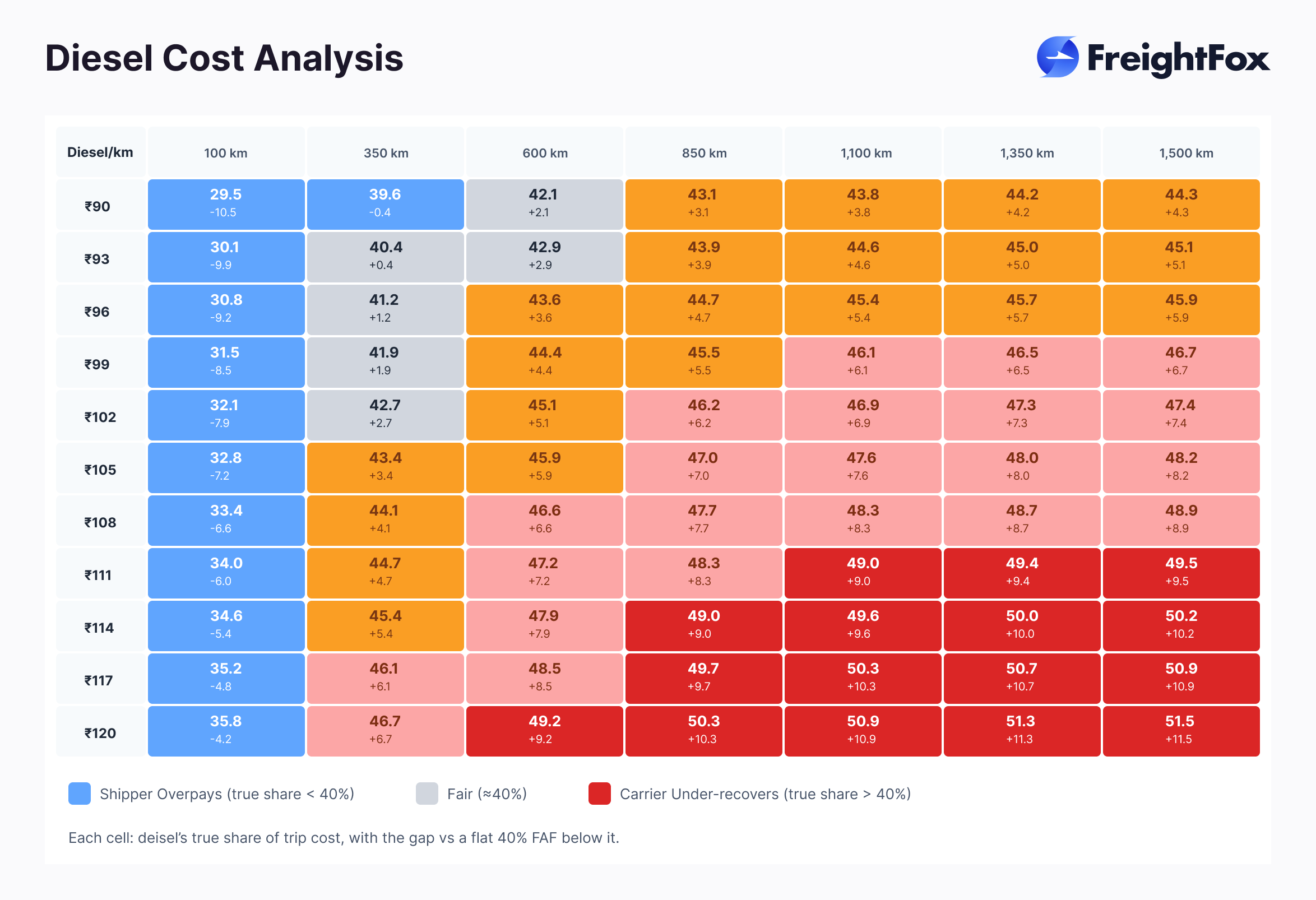
Every cell in that matrix where the correct FAF differs from 40% represents a contract that is quietly misfiring.
The math above is abstract until you attach rupees to it. Here's what the mismatch actually costs, on two specific lane types where 40% consistently fails.
On short lanes, diesel's share of trip cost sits closer to 30%. A FAF clause set at 40% overcorrects. The shipper absorbs a fuel adjustment that is 10 percentage points higher than diesel's actual share of that trip.
In rupee terms, that translates to an overpayment of roughly 2 to 3% of freight value per trip.
That number sounds small. It isn't, once you apply it to primary distribution lanes running daily or multiple times a week. An FMCG manufacturer running daily distribution across a 200 km radius isn't losing money on one invoice. They're losing it on every invoice, every week, across every lane, invisibly.
No single trip flags it. No audit catches it. It just leaks. And note: if the industry moves to AITWA's 0.65%, this short-haul overpayment gets worse, not better.
On long lanes, diesel's share climbs to 44% and above. A FAF set at 40% now understates the actual fuel burden on the transporter by 4 to 11 percentage points depending on distance and diesel price.
The under-recovery per trip runs at 2 to 4% of trip value.
This is exactly the gap AITWA is reacting to.Transporters don't breach contracts over this. What they do is subtler. When diesel is high and spot rates are attractive, they quietly deprioritise contract lanes where they're losing money. Trucks become unavailable. Lead times stretch. The shipper doesn't get a rate dispute. They get a service problem, and they rarely connect it to a clause in their rate annexure.
This is how a misfired FAF clause creates supply chain risk without ever triggering a formal escalation, and it's why the carrier body is now formally demanding a higher factor.
Most freight procurement cycles follow the same pattern. Weeks of preparation before a contract renewal. Rate benchmarking across lanes. Negotiations that run across multiple rounds. A final rate that the team defends in a leadership review.
Then the contract gets signed, and the FAF clause stays at 40%. Because it was always 40%.
Here's the problem with that. Your base rate is negotiated once and locked for the contract period. FAF is triggered every time diesel moves beyond your threshold. In a year where diesel shifts three or four times, the adjustment clause is triggered more often than most teams realise. The fuel adjustment clause in logistics contracts rarely gets the same scrutiny as the base rate, even though it moves more often.
Procurement teams typically spend 80% of their energy on the base rate and treat the adjustment clause as an administrative detail. That's where the real leakage lives. Not in the rate you fought for. In the clause you didn't question.
A 1% improvement on your base rate across a ₹50 crore annual freight spend saves ₹50 lakhs. That's real money and worth fighting for.
But a misfired FAF clause running 2 to 3% against you on short haul lanes, or quietly pushing carriers off your long haul network when diesel spikes, operates continuously. It doesn't show up as a line item. It shows up as freight costs that never quite match your model, and service levels that degrade without a clear cause.
The base rate is visible. The FAF leakage isn't. That's exactly why it persists.
Getting FAF calculation right in logistics contracts doesn't require a consultant or a renegotiation from scratch. It requires replacing a single thumb rule with a method that reflects how trip costs actually behave. Here are three approaches, ranked by maturity.
The simplest upgrade. Instead of one flat FAF, define three bands based on lane distance and assign a different fuel share coefficient to each.
A starting framework for a 25 MT open truck:
This doesn't require trip-level data. It requires knowing your lane distances, which every procurement team already has. It can be implemented in your next contract cycle without any new tooling.
It won't be perfectly accurate for every lane. But it will be materially more accurate than a single 40% applied across all of them.
The next level adds a second dimension. Instead of a fixed FAF within each distance band, the adjustment coefficient moves with diesel price within a defined range.
For example, on a 600 km lane: FAF is 44% when diesel is between ₹85 and ₹90 per litre, and steps up to 47% when diesel crosses ₹90.
This requires two inputs: your lane distances and a reference diesel price index, typically the published retail price for the relevant state. Both are publicly available. The clause gets slightly more complex to administer but stays fully auditable.
The most accurate approach. Instead of bands, you calculate the actual diesel share of trip cost for each lane using your own operational data: distance, vehicle type, average fuel efficiency, and local diesel price.
This produces a unique FAF for every lane in your network. It adjusts automatically as diesel moves. And it gives you something neither of the first two tiers can: a number you can defend in a board review because it came from your own data, not an industry average.
This is the direction freight procurement is moving in for manufacturers with high lane complexity. The barrier isn't methodology. It's data availability and the infrastructure to apply it consistently across contract cycles.
The methodology is only half the problem. The other half is operationalising it inside a procurement cycle that wasn't built for lane-level precision.
Here's what that actually looks like in practice.
The data you need
Three inputs drive a lane-level FAF calculation:
Most procurement teams already have the first two sitting inside their TMS, their ERP, or their transporter rate cards. The third is publicly available and updated daily. FAF calculation in logistics is rarely a data availability problem. It's about the fact that nobody has pulled it together for this specific purpose.
Where it already exists in your operations
Your rate annexures carry lane distances. Your finance team has historical freight invoices that contain vehicle type by lane. Your logistics team knows which lanes run which truck configurations. The inputs for a Tier 1 or Tier 2 fix exist today, in systems you already operate.
A Tier 3 lane-level coefficient requires one additional step: calculating actual fuel cost per km by lane using your own trip data. If your TMS captures trip-level fuel consumption or distance, you already have this. If it doesn't, a reasonable approximation can be built from published fuel efficiency norms for each vehicle category.
How to bring it into your next contract cycle
The right moment to fix your FAF clause is a contract renewal. Not mid-cycle, not through a unilateral amendment, but at the point where both sides are already at the table renegotiating rates.
At that point, the conversation is straightforward. You're not asking the transporter to accept a lower adjustment. You're asking them to accept an accurate one. On short haul lanes where 40% overstates their fuel burden, they have no logical objection. On long haul lanes where 40% understates it, they have every reason to agree.
Bring the lane distance data. Bring the diesel price reference. Show the math. A clause that both sides can verify is easier to sign than one built on a number nobody remembers choosing.
Building a lane-level FAF model manually is possible. But it assumes your trip data is clean, your lane distances are standardised across contracts, and someone has the bandwidth to run this analysis every time diesel moves or a contract comes up for renewal.
For most procurement teams, none of those three assumptions hold consistently.
This is the infrastructure problem that Freight Procure solves.
FreightFox's lane benchmarking capability gives procurement teams access to lane-level cost data across their own network, without having to manually extract and reconcile it from multiple systems. When you're heading into a contract cycle, you're not starting from a blank sheet. You're starting from a data set that already reflects how your lanes actually behave.
The contract auction capability means that when you go to market with a revised FAF structure, you're running a transparent, competitive process. Transporters bid against lanes with clearly defined adjustment mechanisms. The rate that comes out the other side is one that both parties understand, because the inputs were visible from the start.
Together, these two capabilities give procurement teams what a thumb rule never could: a FAF clause built from your own data, applied consistently across your network, and defensible the next time your CFO asks why freight costs moved.
The goal isn't to eliminate fuel price risk. It's to stop absorbing it incorrectly.
References:

See how leading enterprises are optimizing freight costs, performance, and emissions with FreightFox — all in one platform.
FreightFox is a full-stack TMS and Control Tower platform that helps enterprises streamline freight procurement, execution, visibility, settlement, and sustainability—from Procure-to-Pay