
A supply chain control tower is a centralized command centre that gives manufacturers real-time visibility, predictive alerts, and decision-making control across their entire supply network - sourcing, production, inventory, and transportation in one screen. For Indian manufacturers managing 30+ plants, hundreds of transporters, and seasonal demand peaks like Diwali distribution and festive FMCG ramps, a control tower is no longer optional. This 2026 guide covers the 3 essential capabilities of a supply chain control tower (visibility, decision support, orchestration), the top advantages for Indian FMCG and automotive supply chains, and how FreightFox's zero-touch control tower deploys in under 60 days.
A supply chain control tower is essentially a central hub - think of it as an air traffic control for your supply chain - that gives companies real-time, panoramic visibility of their entire supply network and the ability to act on insights.
Gartner defines a supply chain control tower as “a concept that results in combining people, process, data, organization and technology” to capture near-real-time data across the business and improve decision-making.
In simple terms, it is not just a dashboard or software, but a coordinated capability that brings everything together.
FreightFox's control tower delivers all three on a single platform built for Indian supply chain complexity.
Any effective control tower rests on three core pillars – People, Process, and Technology. These pillars ensure that real-time data and dashboards translate into actual business value rather than just visibility.
Even with automation, skilled people are essential to a control tower’s success. Typically, a control tower includes a dedicated team (sometimes a virtual team) responsible for:
These professionals bring domain expertise and critical decision-making capabilities needed to handle complex situations that technology alone cannot solve.
For example, during the 2024 Diwali season, a Top-10 Indian FMCG brand leveraged its control tower team to identify a developing capacity crunch on the Mumbai–Delhi corridor nearly 72 hours before it impacted operations. Working closely with transport partners, the team proactively rerouted shipments and dynamically reallocated capacity, helping the company maintain a 98% OTIF (On-Time In-Full) performance while reducing peak-season freight costs by an estimated 18%.
Key takeaway: Technology provides visibility, but experienced people turn insights into action. Investing in trained analysts, planners, and logistics specialists is critical to realizing the full value of a supply chain control tower.
A control tower is only effective when supported by well-defined and standardized processes. These processes ensure consistent and efficient responses to supply chain events.
Typical process components include:
When a control tower generates an alert, these processes provide a clear playbook for action.
For instance, Capgemini’s framework emphasizes designing new processes while implementing a control tower. This includes mapping how information flows and how decisions are made in the future (“to-be”) state.
Key takeaway: Strong processes ensure the control tower operates systematically rather than reactively.
Technology forms the backbone of any control tower, enabling visibility, intelligence, and real-time decision-making.
Modern control tower platforms typically include:
These systems connect multiple platforms such as ERP, TMS, WMS, and supplier systems into a centralized data hub.
This allows organizations to:
Technology provides a single source of truth and enables predictive insights, such as identifying potential disruptions before they occur.
Importantly, flexibility is critical. Capgemini highlights the need for solutions that integrate with existing IT systems without requiring a complete overhaul.
Key takeaway: The right technology transforms raw data into actionable intelligence.
1. Real-time freight & inventory visibility across plants and DCs
2. Proactive disruption alerts (24-48 hr early warning)
3. 10-15% reduction in unplanned transportation costs
4. 30% faster festive/seasonal ramp readiness (Diwali, IPL, harvest)
5. Single source of truth across ERP, TMS, WMS
6. Tighter SLA enforcement on transport partners
7. Lower bullwhip effect across multi-tier supply chains
Modern control towers deliver measurable ROI by improving visibility, reducing costs, and enabling faster decision-making. They turn supply chains into agile, resilient systems that can adapt in real time.
Control towers reduce waste, optimize logistics, and improve workforce productivity, leading to significant financial impact.
Control towers enable faster detection and resolution of issues, improving overall supply chain speed.
Control towers shift operations from reactive firefighting to proactive planning.
Control towers act as a central hub connecting suppliers, logistics partners, and internal teams.
So, what does a control tower actually do day-to-day? TThink of it as a central command center for your supply chain, where all data, decisions, and actions come together in one place.
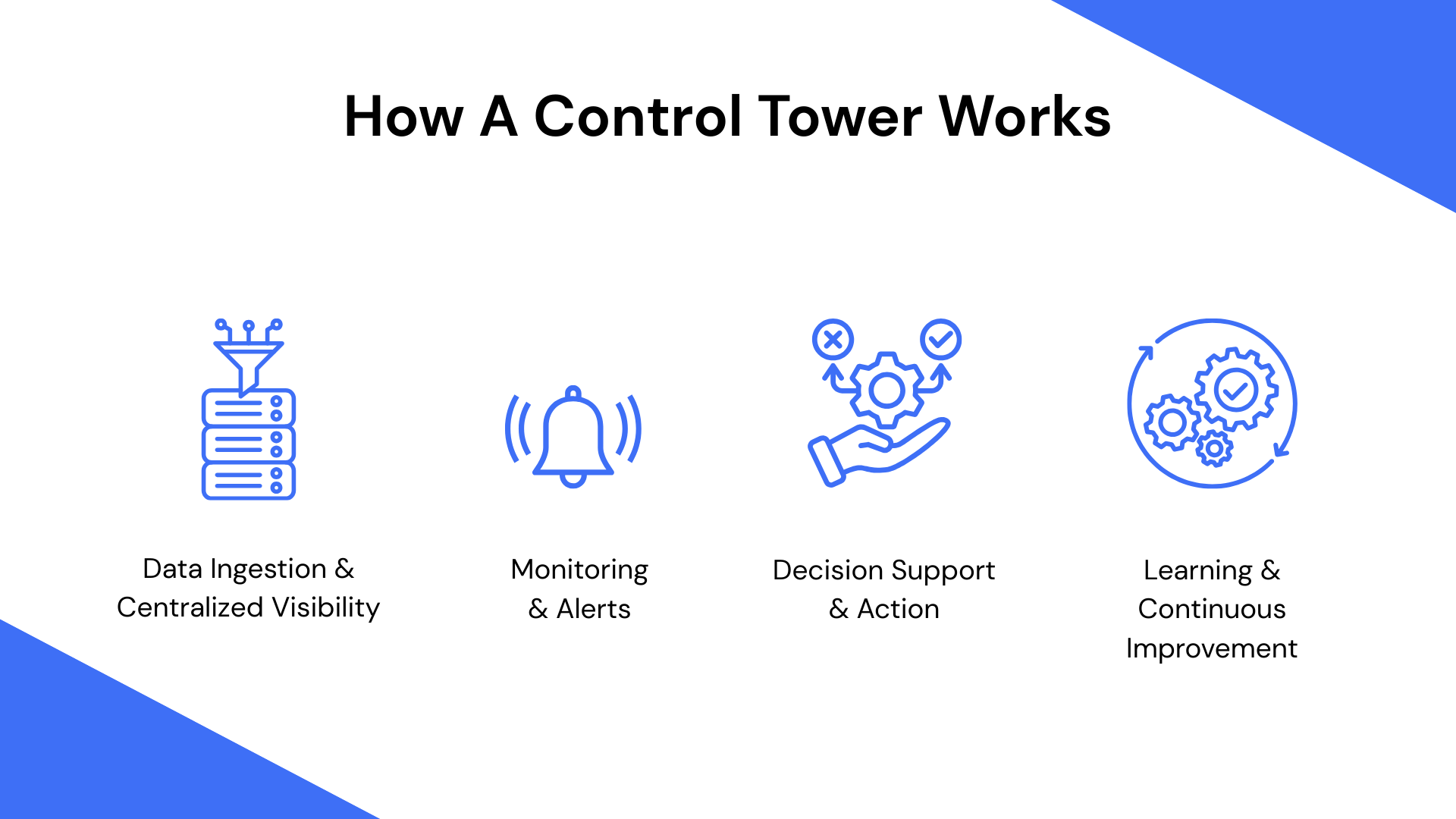
The control tower continuously pulls data from internal systems and external partners. Every activity across the supply chain is captured and organized, including:
All this information is stored in the control tower’s centralized database.
For example, if you’re an automotive OEM, the tower collects:
This creates a real-time digital twin of the supply chain, giving stakeholders complete visibility into operations.
A practical example comes from the 2024 Diwali season, when a Top-10 Indian FMCG brand used a control tower to monitor transportation capacity, shipment movements, and network performance in real time. By consolidating data from transporters and logistics partners into a single view, the company identified a developing capacity crunch on the Mumbai–Delhi corridor nearly 72 hours in advance. This early visibility enabled proactive rerouting and capacity reallocation, helping maintain a 98% OTIF (On-Time In-Full) rate while reducing peak-season freight costs by an estimated 18%.
Key takeaway: Centralized visibility ensures that all stakeholders work from the same real-time data, enabling faster decisions and better coordination across the supply chain.
Once data is centralized, the control tower continuously monitors it against predefined plans and thresholds.
When deviations occur–such as:
…the system automatically triggers alerts or exceptions.
Modern control towers use AI to detect risks early. As noted by FourKites, the goal is to “flag exceptions before they become crises.”
These alerts are:
For example, a plant manager may receive an alert that a critical inbound shipment will be delayed by 8 hours, allowing proactive rescheduling.
Key takeaway: Real-time monitoring enables early detection and proactive response.
When an alert is triggered, the control tower enables quick and informed decision-making.
The system may provide:
At this stage, people and processes come into play. The control tower team, or in some cases the system itself, evaluates options and takes action, such as:
Control towers also offer collaboration tools so all stakeholders, including procurement, logistics, suppliers, carriers, and customer service, can coordinate in one place.
Automation is playing a growing role. For instance, FreightFox enables automatic trip creation and tracking as soon as an order is confirmed, without manual intervention.
The goal is a “zero-touch” workflow for routine events, where human involvement is only required for complex exceptions.
Key takeaway: Faster, data-driven decisions minimize disruption and improve efficiency.
Over time, the control tower evolves from reactive problem-solving to proactive optimization.
By combining historical and real-time data, it helps organizations:
These insights feed into strategic decision-making, such as:
Some control towers go beyond operations and influence both tactical and strategic planning, bridging the gap between daily execution and long-term goals.
Key takeaway: Continuous learning turns operational data into strategic advantage.
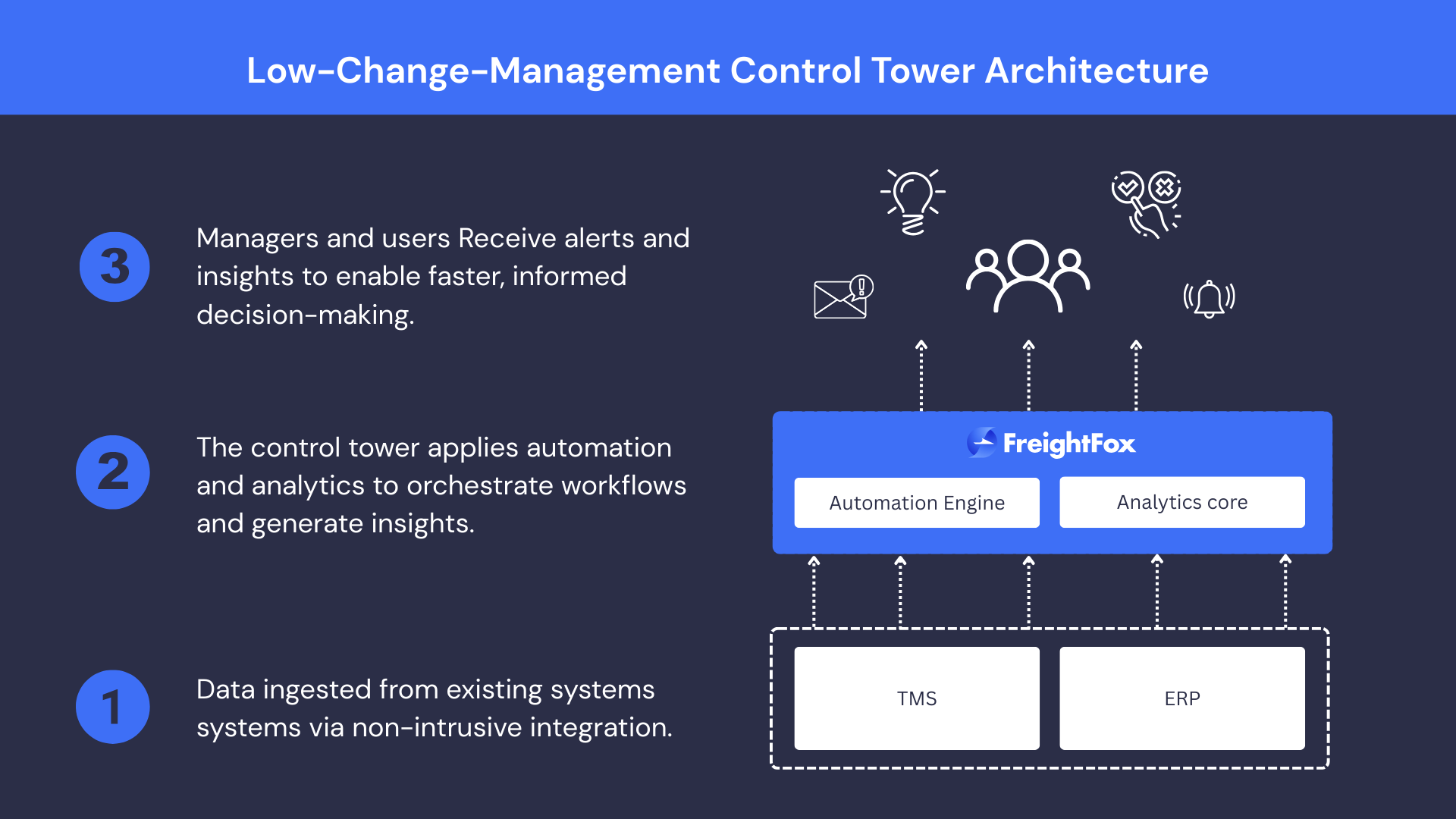
A low-change-management control tower architecture is designed to integrate directly with existing systems while minimizing disruption.
This approach reduces manual effort and avoids large-scale system overhauls.
FreightFox follows this model by overlaying on current systems (no rip-and-replace) and automating processes end-to-end.
Supply Chain Control Towers support decision-making across three levels:
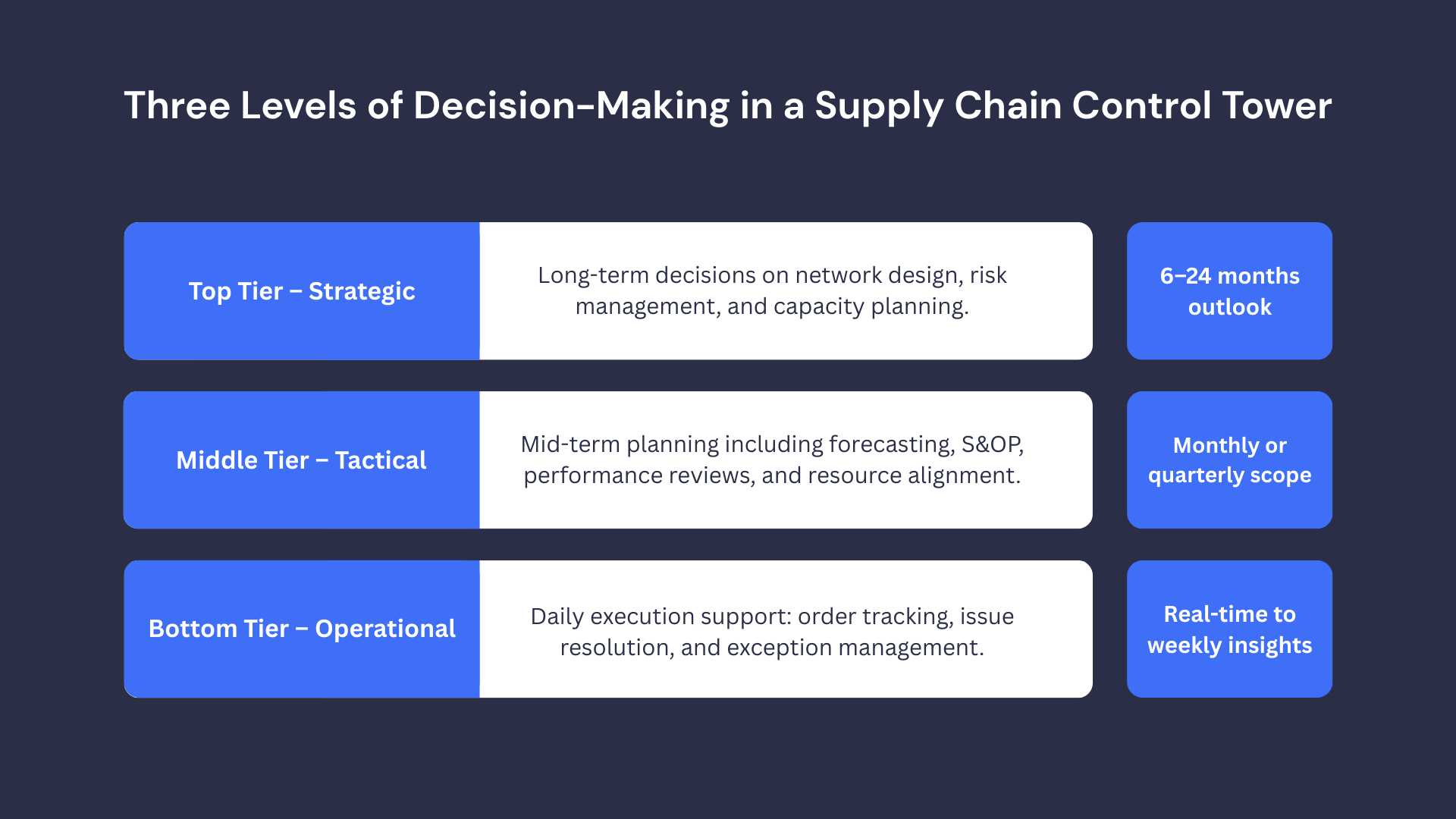
This is the core, real-time function of a control tower-monitoring shipments, orders, and production as they happen.
In FMCG distribution, for example, an operational control tower tracks every truck heading to regional distribution centers and ensures on-time delivery.
If disruptions occur such as:
…the system immediately alerts logistics coordinators to take corrective action, such as dispatching a backup.
Focus Areas:
Many companies begin their control tower journey with operational visibility, often using transportation visibility tools as the foundation.
At the tactical level, control towers aggregate and analyze data to support better decision-making over weeks and months.
This includes tracking KPIs such as:
The control tower helps identify trends and improvement opportunities.
Example:
If expedited freight spending spikes in a quarter, the control tower highlights this trend, enabling teams to:
It also supports Sales & Operations Planning (S&OP) by providing a unified view of demand, supply, and inventory.
Additionally, control towers enable “what-if” simulations, such as:
With historical and real-time data, companies become more agile and proactive, not just reactive.
Focus Areas:
At the strategic level, control towers drive long-term decision-making and supply chain transformation.
Insights from the tower can support:
During the early months of the COVID-19 pandemic, many organizations rapidly built control towers to manage disruptions and later used them to rethink global supply chain strategies.
A strategic control tower acts as a central nerve center, integrating inputs from:
Example:
In the automotive sector, a control tower can coordinate a new model launch by aligning procurement, production, and logistics, ensuring a smoother ramp-up.
Focus Areas:
FreightFox is an emerging next-generation supply chain control tower solution, designed for automation and minimal change management. It’s tailored for large enterprises in industries like automotive and FMCG, delivering end-to-end automation and actionable visibility without complex IT overhauls.
Here’s how FreightFox achieves this:
FreightFox’s control tower is an overlay platform that connects with existing systems (ERP, TMS, etc.) via APIs and middleware.
Key Benefits:
Example:
A manufacturing company can pull orders, shipments, and master data from SAP or Oracle in near real-time, while pushing insights back, without a big-bang IT transformation.
FreightFox emphasizes “zero-touch” automation, eliminating tasks that previously required human intervention.
Examples of Automated Processes:
Impact:
FreightFox provides real-time dashboards and rich analytics with an emphasis on action.
Features:
Predictive Insights:
Customer Feedback:
While FreightFox started in transportation, its control tower covers end-to-end supply chain visibility.
Use Cases:
Sustainability Tracking:
Benefit:
FreightFox focuses on user-friendly design and minimal disruption:
Key Features:
Benefit:
During the 2024 Diwali season, a Top-10 Indian FMCG brand used a supply chain control tower to manage logistics operations during one of the busiest periods of the year. With demand surging and transportation networks under pressure, maintaining visibility across the supply chain became critical.
The control tower provided a centralized view of logistics operations, enabling planners, transport partners, and supply chain teams to work from the same real-time data.
When the system detected a developing two-day capacity crunch on the Mumbai–Delhi corridor nearly 72 hours before it could impact deliveries, the team quickly responded by rerouting shipments and dynamically reallocating capacity across the transporter network.
As a result, the company maintained a 98% OTIF (On-Time In-Full) service level while reducing peak-season freight costs by an estimated 18% during the festive fortnight.
This example demonstrates how a control tower helps organizations move beyond visibility to proactive supply chain orchestration, minimizing disruptions while maintaining service performance during high-demand periods.
A large FMCG company producing packaged foods faced challenges sourcing potatoes from thousands of farms across multiple regions.
This supply chain was highly seasonal, with fluctuating demand, capacity constraints, and pricing pressures.
Control Tower Implementation
The company partnered with FreightFox to build a control tower focused on farm-to-factory logistics.
The solution provided real-time visibility from farm pickup to factory delivery.
Supply chain control towers are no longer optional. They are essential for navigating today's complex and unpredictable logistics environment. By combining visibility, automation, and intelligence, they help businesses reduce costs, improve speed, and build resilience.
Solutions like FreightFox take this a step further with zero-touch automation and low-change integration, enabling companies to capture value quickly without heavy IT disruption.
A. A supply chain control tower is a centralised platform that aggregates real-time data from across the supply chain (ERP, TMS, WMS, supplier systems) to provide end-to-end visibility, predictive insights, and orchestration of supply chain decisions.
A. Real-time visibility, proactive disruption alerts, 10-15% lower transportation costs, faster decision-making, single source of truth, and stronger supplier SLA enforcement.
A. Visibility (real-time data aggregation), decision support (predictive analytics and alerts), and orchestration (automated re-routing and reallocation).
A. FreightFox deploys a fully functional control tower in 60 days with minimal IT integration, versus 6-12 months for traditional global platforms.
A. Yes. A TMS focuses on transportation execution. A control tower sits on top of TMS, WMS, ERP and provides cross-functional visibility and decision-making.

See how leading enterprises are optimizing freight costs, performance, and emissions with FreightFox — all in one platform.
FreightFox is a full-stack TMS and Control Tower platform that helps enterprises streamline freight procurement, execution, visibility, settlement, and sustainability—from Procure-to-Pay