
Third issue

Hello.
again.

A word before the festive rush eats everyone's calendar.
Freddie Foxwell - Chief of Entertainment presenting FreightFox freight intelligence newsletter

Three issues in and I've accepted my fate. Apparently this is a "series" now.

Someone called me a recurring character in a Slack thread. I'm choosing to take that as flattery.

Anyway, festival season is underway. Onam wrapped up last month, and if past years are anything to go by, this is just the opening stretch.

This month I went looking at three things: where the festive pressure actually shows up first (it's not where most people are watching), a fuel clause that quietly overcharges anyone who never rereads their contract, and why most TMS shortlists ask the wrong question before the demo call even starts.

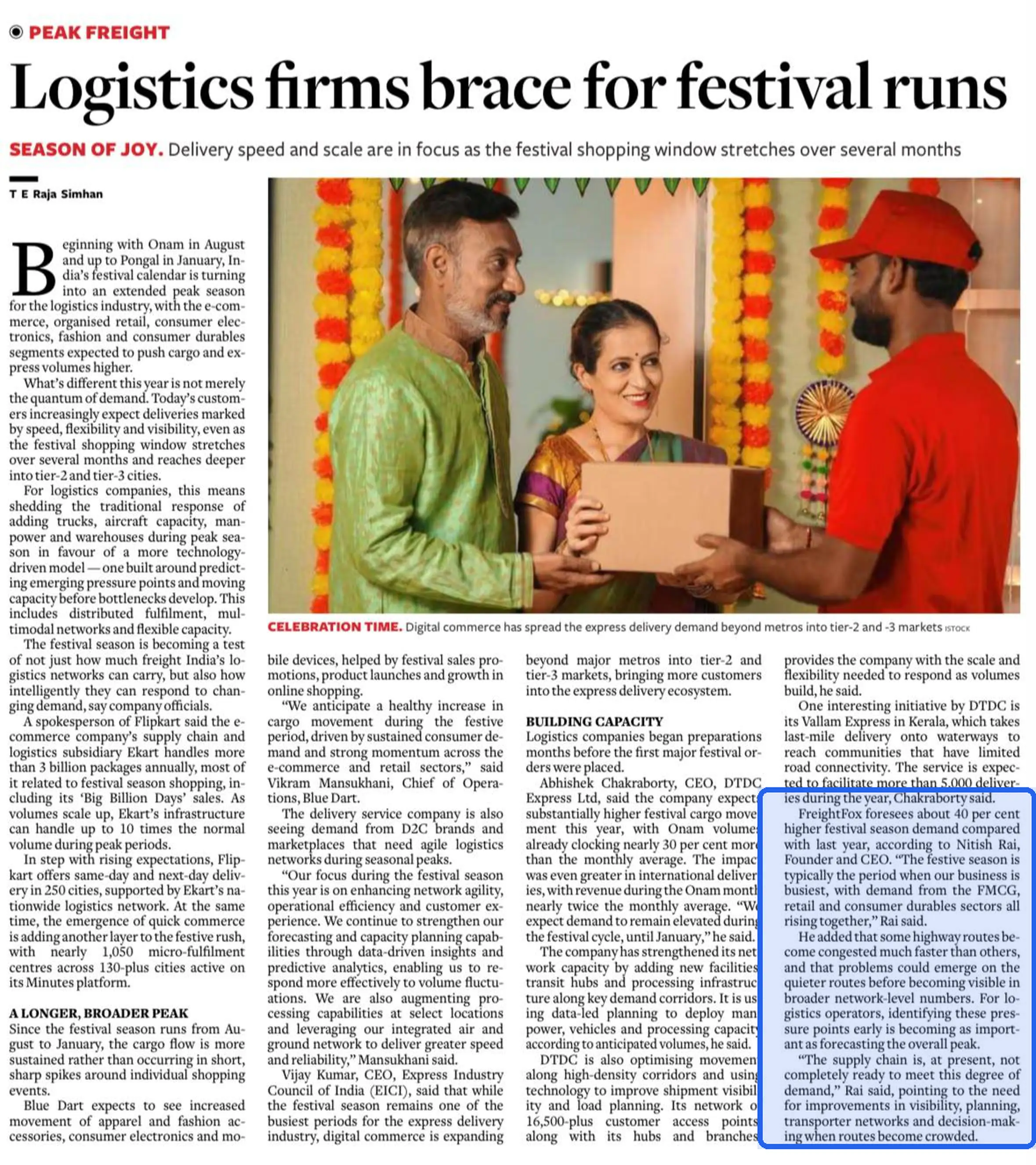
We made it to the newspapers this month. Nitish said the smart things, I'm just proud of him.

Let's get into it.

Freddie Foxwell
Chief of Entertainment, FreightFox
Freddie's Field Notes

Diesel isn't priced the same everywhere. Your FAF clause probably assumes it is.

Most Fuel Adjustment Factor clauses lean on one number: a national average diesel price, refreshed monthly, applied the same way across every lane in the contract.

Convenient. Also wrong.

State VAT on diesel varies enough that the same fuel costs meaningfully more in one state than the one next door. Price your FAF off a single national benchmark, and you're overcompensating transporters on the cheap-fuel lanes while undercompensating the ones stuck on expensive ones. Nobody notices, until one lane's margins quietly outperform another for no operational reason at all.

DELHI — ₹95/litre · ~17% VAT
TELANGANA — ₹104/litre · ~27% VAT

The Gap

~₹8.6/litre, before the higher VAT even compounds on the higher base price

One national FAF number can't hold both of these at once.

This one's the sequel to a piece we ran on distance-based FAF. Same broken clause, different axis: this time it's state lines, not highway miles.

Small thing nobody assigned me to do: I went and typed two random states into our diesel price tool just to see the gap for myself. It's bigger than you'd guess. The tool's linked inside the piece if you want to try your own states before you finish reading.
The News I Didn't Write Myself

This time, it was The Hindu BusinessLine paying attention.

The Hindu BusinessLine ran a feature on India's stretching festival season, Onam to Pongal, and the pressure it's putting on logistics networks. Nitish (yes, our Nitish) told them we're expecting festive demand to run about 40% higher than last year, with FMCG, retail and consumer durables all climbing together.

The part I found more useful than the number: pressure doesn't build evenly. Some highway routes clog up weeks before others. Catching that early matters more than forecasting the season's total.

Foxwell Explains

You're only evaluating half the TMS you're about to buy.

Here's the pattern I keep running into. Everyone evaluates a TMS the same way: track and trace, check. Automated freight audit, check. Carrier management, check. Then they sign.

That covers maybe half of what actually matters. A TMS worth its contract should hold up across six stages of the freight lifecycle, not three:
  • Procure: RFQs, spot auctions, contract rates, in one place
  • Execute: allocation, dispatch, route optimisation
  • Track: real-time visibility, GPS, predictive ETA alerts
  • Settle: invoice reconciliation, ePOD, freight audit
  • Pulse: the analytics layer most vendors bolt on later, if at all
  • Decarbonise: emissions tracking, which barely comes up until someone asks for it
53
criteria a real TMS evaluation actually covers, across all six stages plus integrations, pricing, implementation and support. Most sales decks walk you through maybe a third of that before asking for a signature.
Most shortlists get thorough about the first two or three and assume the rest just works. It usually doesn't, and you find that out mid-contract instead of before signing one.
30 Seconds With Nitish

I get thirty seconds with the founder. He spent them quoting a man who died in 399 BC.

Freddie Foxwell × Nitish Rai, Founder & CEO

00:30

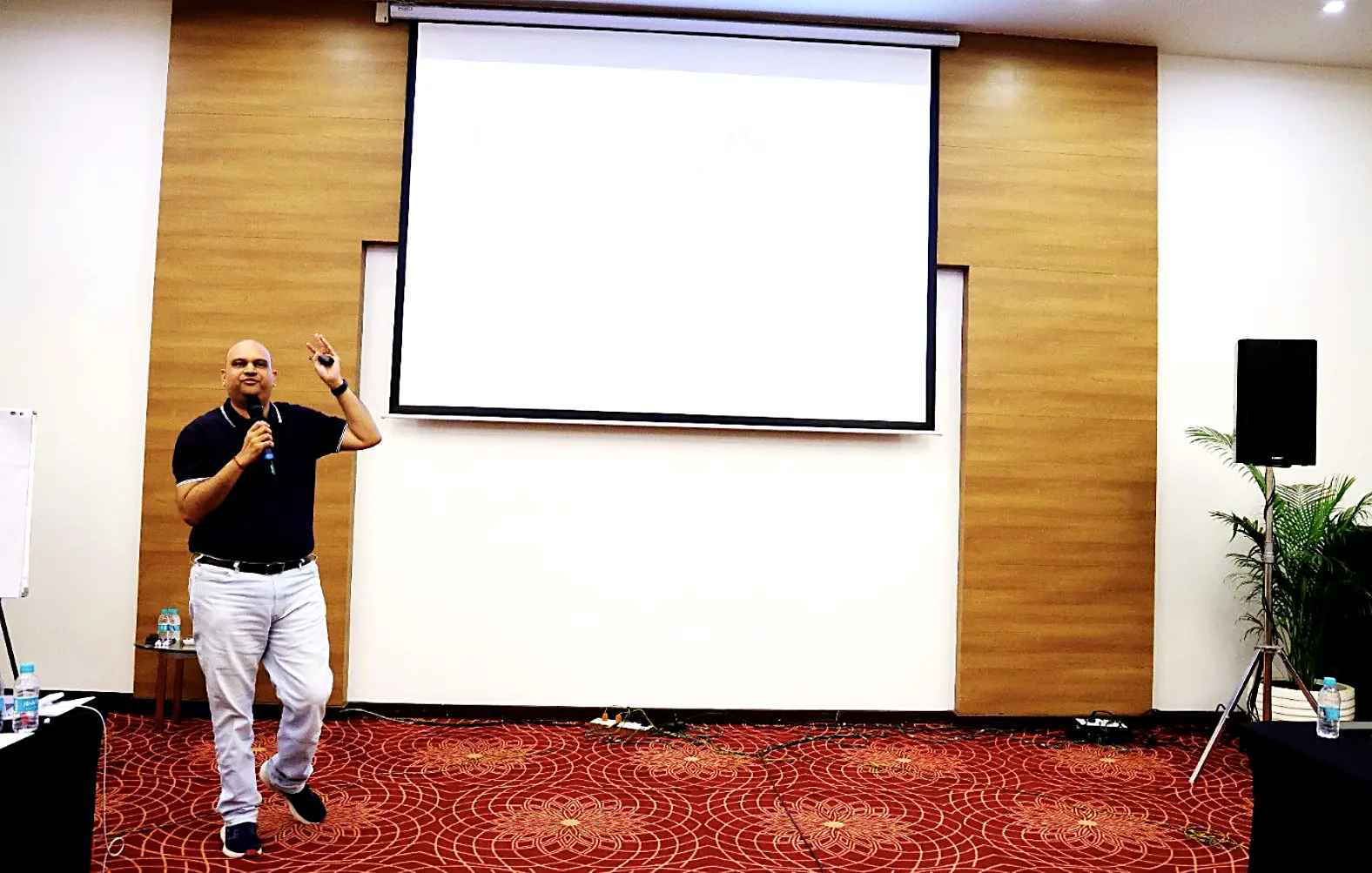
You just ran an AI session for a room full of procurement leaders in Hyderabad. I assume you opened with a slide full of tools.

Not one tool slide. Split the room into five teams, gave each one a real problem, no prescribed answer. Every team used AI differently and landed somewhere different. That was the point.

So what’s the actual takeaway, for people who weren’t in the room?

Stop asking “what can AI do.” Start asking “what could I do differently if I had it working with me.” Completely different question, completely different outcome.

And your big personal takeaway from teaching a room full of experts?

Socrates. The only true wisdom is knowing you know nothing.

You went in to teach and came out quoting a philosopher who’s been dead for over two thousand years.

Translation, for those of you who skimmed: the shift Nitish is pointing at isn’t a tools problem. Most procurement teams already have AI access. What’s missing is reframing the question they’re asking it.
Sniffed Out

Things I found. Brief opinions attached.

India's exports jumped 26% in August

To $43.81 billion, the sharpest rise since 2022. Trade deficit fell to a five-month low. Petroleum shipments did most of the heavy lifting. Read more →

Indian Railways moved 137.9 million tonnes of freight in August

Up 5.4% year on year. Iron and domestic containers led the growth. The corridors keep paying off. Read more →

NHAI rolled out a ₹350 monthly toll pass

For people living within 20km of a plaza, no physical documents, all through an app. Small change, but it's the kind of friction removal freight networks could use more of. Read more →

Kerala broke ground on India's first electric truck corridor

A 622km stretch of NH 66. Ambitious. Also a 26-fold jump in charging demand by 2050, so ask me again in a few years. Read more →

Flipkart just announced Big Billion Days 2026

October 9, early access October 8. Mark your calendars, and possibly your warehouse capacity plans. Read more →
Ask Freddie

You ask. I answer. Occasionally usefully.

"We're already adding trucks for the festive season. Why do we need to fix our TMS right now, of all times?"

asked by someone who thinks more capacity fixes everything, including problems capacity didn't cause

More trucks solve a shortage. They don't solve not knowing where the shortage actually is.

Adding fleet without fixing visibility just means you're moving faster toward the same blind spots: congested routes, mismatched loads, invoices nobody's reconciling until December. Scale usually makes an existing gap louder, not smaller.

Worth doing before the peak hits, not after. Fixing a TMS mid-October, when volumes are already climbing, is a much worse time to be finding out what it can't do.

Got a question? Just hit reply. I read everything, mostly out of curiosity, occasionally out of boredom.
Follow me on LinkedIn!
Still posting. Still haven't figured out how to make a poll about pallet weights go viral.

If you're new here, this is your sign. If you've been following a while, you're the reason I haven't been quietly deleted by the marketing team.
Come say hello →
FreightFox - AI Powered Transportation Management System and Supply Chain Platform
Freddie 🦊
Chief of Entertainment, FreightFox
P.S. Someone asked how they ended up on the FreightFox mailing list. Honestly, fair question, I don't fully know how any of you got here either.
You're getting this because you care about freight, or because you met a fox at a conference.

freightfox.ai · Say hello to Freddie
Thank you! Your submission has been received!
Oops! Something went wrong while submitting the form.
INSTANT ACCESS

Get Full Access to Newsletter

Enter your work email to get instant access.