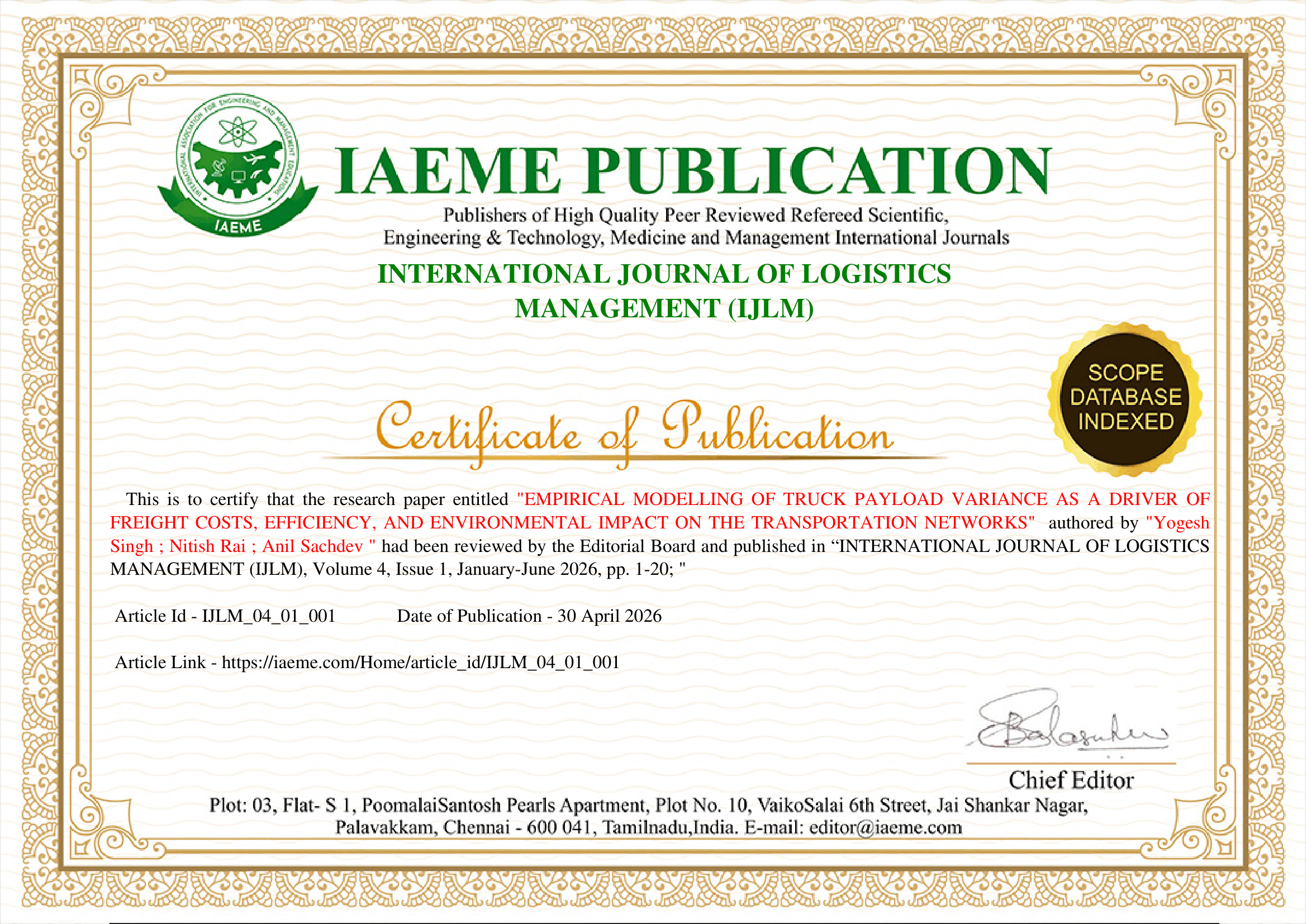
Empirical Modelling of Truck Payload Variance as a Driver of Freight Costs, Efficiency, and Environmental Impact on Transportation Networks

Yogesh Singh, Nitish Rai, Anil Sachdev

This research paper, published in the International Journal of Logistics Management, explores how truck payload variance impacts freight costs, operational efficiency, and carbon emissions across India’s transportation networks. Using large-scale freight and vehicle data processed through FreightFox, the study analyzes loading patterns across 10-tyre and 14-tyre trucks to understand how inconsistent payload utilization affects logistics performance.

Get Instant Access
Complete the form to download your free toolkit
Thank you! Your submission has been received!
Oops! Something went wrong while submitting the form.
The research finds that even within the same truck category, significant payload variance exists due to differences in vehicle age, OEMs, BS norms, and operational practices. This underutilization directly increases freight costs per ton and raises emissions intensity. The paper further introduces empirical modelling and predictive analysis to help manufacturers, transporters, and procurement teams make more efficient fleet and freight decisions.

Key findings include:

Payload variance can increase freight cost per ton by ~7.5%
Underutilization leads to ~7.7% higher CO2 emissions intensity
OEMs and emission norms influence payload consistency
Standardized trucking practices can improve efficiency and sustainability
The study provides actionable insights for freight procurement, fleet optimization, logistics planning, and ESG-focused transportation strategies.