

Consider a scenario where a tech company, trying to keep up with changing market demand, faces delays in receiving crucial components. These delays hinder the production process and result in dissatisfied customers and missed opportunities.
This is especially relevant in the auto ancillary supply chain, where component availability directly impacts production schedules and customer commitments. It is part of a broader effort to help businesses stay responsive and adapt quickly to changing market conditions.
In this blog, we’ll look at the importance of lead time reduction, the benefits it can deliver, and practical strategies businesses can use to improve it. By the end, you’ll understand how reducing supply chain lead time can improve operational efficiency and customer satisfaction.
With that said, let’s get right in!
Prolonged supply chain lead times can create several operational and financial challenges for businesses. Long lead times can lead to:
Understanding these consequences is the first step toward reducing lead time in supply chain operations and improving overall business performance.
Lead time reduction means making the supply chain faster and more efficient by reducing delays in procurement, production, and delivery.
The key components of lead time reduction include careful planning, streamlined processes, and better coordination across the supply chain network. For companies operating in the auto ancillary supply chain, reducing lead times is critical to maintaining uninterrupted manufacturing operations and meeting OEM requirements.
To understand the importance of reducing delays, businesses must first understand what is lead time in inventory management. Lead time refers to the duration between initiating an order and receiving the goods, making it a critical metric for inventory planning, procurement, and production scheduling.
Lead time reduction helps companies respond faster to demand, improve planning, and reduce disruptions across the supply chain. In environments where delays directly affect production schedules and customer commitments, shorter lead times can make a significant difference.
Prolonged lead times are a common challenge in supply chain management, impacting production schedules and customer satisfaction. Below are some of the key factors that contribute to longer lead times across the supply chain.
When critical raw materials are in short supply, they create bottlenecks in production. Suppliers may struggle to meet demand, resulting in longer manufacturing timelines and delayed deliveries.
Addressing material shortages is an important step to reduce lead time in supply chain operations and maintain consistent production flow.
Products with intricate designs or specialised components require more time to manufacture. This complexity can slow down production processes, from sourcing custom parts to conducting quality checks.
Organisations looking to reduce manufacturing lead time often focus on simplifying designs and improving production planning wherever possible.
Fluctuations in customer demand, particularly when not forecasted properly, can lead to overstock or stock outs. Both scenarios strain the supply chain and cause delays in order fulfilment.
Accurate forecasting plays a major role in efforts to reduce lead time and improve inventory availability.
Outdated technology, poor process management, or labor shortages can reduce production speed. These inefficiencies often result in longer lead times and affect the overall supply chain flow.
Process optimisation and automation are effective ways to reduce manufacturing lead time and improve operational efficiency.
Suppliers located far from manufacturing sites add extra time due to longer shipping durations and potential customs delays. This geographical distance can significantly slow down the supply chain.
Businesses aiming to reduce lead time in supply chain operations often evaluate supplier locations and sourcing strategies to minimise transportation delays.
Relying on several suppliers for different components can complicate supply chain operations. Delays from even one supplier can disrupt the entire production process and prolong lead times.
Effective supplier collaboration and communication are essential for companies seeking lead time reduction and better management of supply chain lead times.
Reducing lead time can improve both supply chain efficiency and overall business performance. When businesses manage production and distribution more effectively, lead time reduction becomes an important lever for lowering costs, improving service levels, and responding faster to demand.
Before exploring the benefits, it is important to understand what is lead time in inventory management. Lead time refers to the period between placing an order and receiving the goods or finished products. Businesses that successfully reduce lead time can improve operational performance, lower costs, and strengthen customer relationships.
Below are some of the key benefits businesses can achieve by reducing the time it takes for products to move through procurement, production, and delivery.
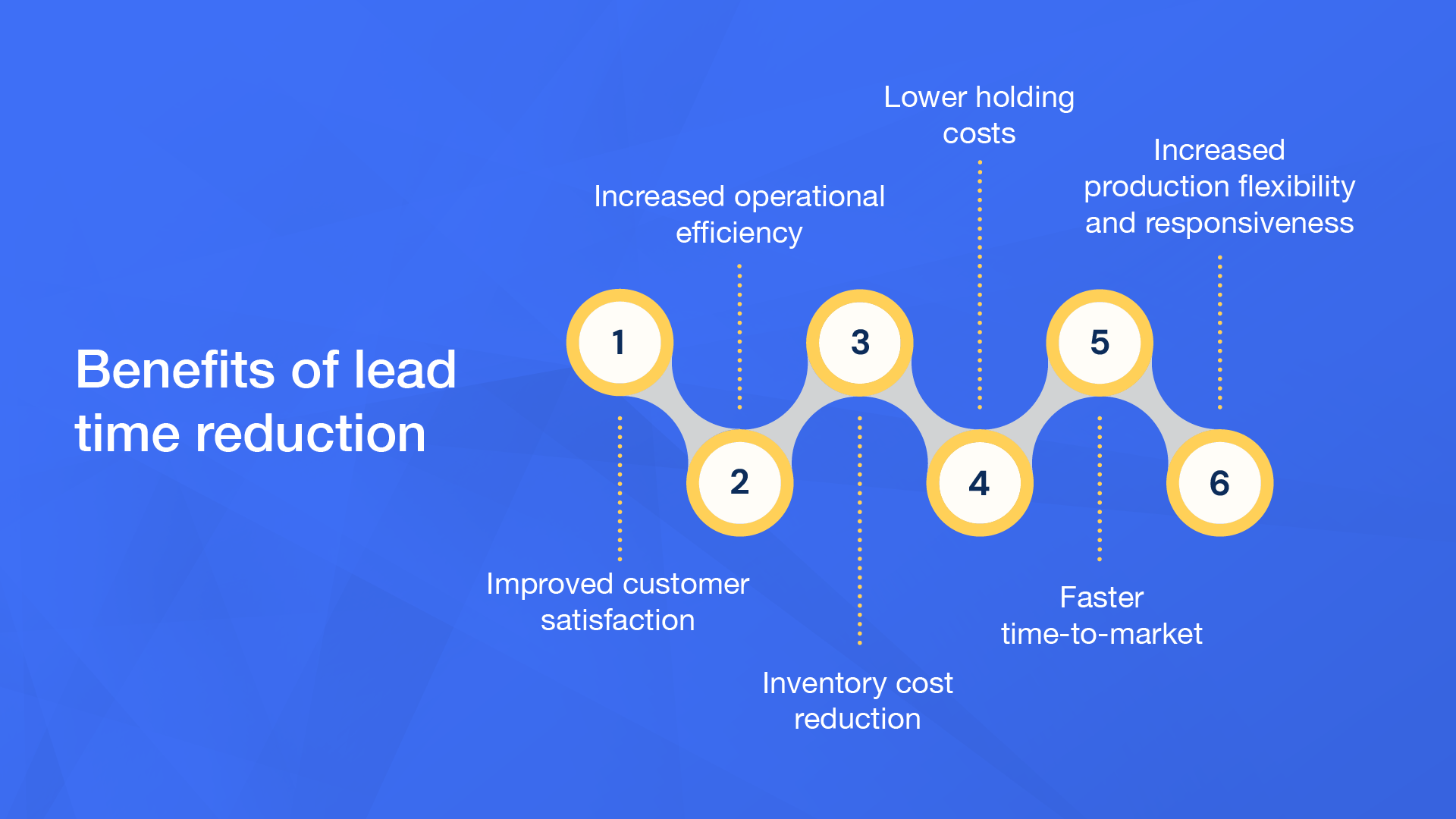
Swift and reliable deliveries contribute to customer satisfaction, loyalty, and stronger brand trust. With lead time reduction, businesses can create a more reliable customer experience by fulfilling orders faster and more consistently.
Shorter supply chain lead times help companies fulfil orders faster, resulting in improved customer retention and stronger brand trust.
Streamlining processes and reducing unnecessary delays result in a leaner, more efficient supply chain. From optimised production schedules to better-coordinated logistics, lead time reduction helps improve supply chain performance and productivity.
Companies looking at how to reduce lead time in supply chain operations often focus on process improvements that eliminate bottlenecks and improve productivity.
By minimising the time products spend in warehouses, businesses can cut down on holding costs and optimise inventory management. This helps reduce inventory carrying costs while ensuring products remain available when needed.
Reducing supply chain lead time allows organisations to maintain optimal inventory levels without excessive stock accumulation.
Reduced warehouse dwell time translates to lower holding costs, freeing up working capital for other business priorities. The capital saved can be redirected toward inventory, production, or other operational needs.
Businesses that successfully reduce lead time in supply chain operations often experience significant reductions in storage and inventory carrying costs.
Faster response to market demand helps businesses introduce products sooner and respond more quickly to changing customer needs. Lead time reduction supports faster prototyping, testing, and product launches, helping companies bring products to market with fewer delays.
Organisations that reduce manufacturing lead time can launch products faster and capitalise on market opportunities ahead of competitors.
A streamlined supply chain improves the ability to adapt to market changes and respond quickly to unexpected disruptions. Whether it involves adjusting production volumes or changing suppliers, greater flexibility helps businesses respond faster to demand and supply-side changes.
Efforts to reduce manufacturing lead time also improve responsiveness to changing customer demands and production requirements.
Shorter lead times allow for better monitoring and quicker decision-making, giving businesses more control over their supply chain processes. This leads to smoother operations and reduced risk of disruptions.
Managing supply chain lead times effectively enables organisations to identify issues early and take corrective action before delays escalate.
By cutting lead times, businesses can optimise inventory levels and reduce the risk of overproduction or excess stock. This leads to better resource utilisation and lower storage costs.
Companies that consistently reduce lead time can allocate resources more efficiently while minimising waste across the supply chain.
Faster lead times help companies restock inventory more rapidly, allowing them to recover quickly from stock outs. This minimises downtime and prevents revenue loss due to unavailable products.
Organisations focused on how to reduce lead time in supply chain operations can significantly improve inventory availability and maintain business continuity during periods of high demand.
Before implementing any strategies to reduce supply chain lead time, organisations must first understand the current speed of their supply chain. This assessment is crucial because it highlights areas that need improvement and helps teams identify bottlenecks, inefficiencies, and delays across operations.
Knowing how long it takes for products to move from the initial order placement to final delivery allows businesses to assess where delays occur and what is causing them. Understanding what is lead time in inventory management and measuring the current supply chain lead time are essential first steps toward improvement.
Without this understanding, attempts to streamline processes or implement new technologies may be ineffective. A structured approach to lead time reduction helps businesses address supply chain challenges and improve overall performance.
In this section, we’ll look at eight practical strategies businesses can use to reduce lead time in supply chain operations, improve efficiency, and build a more responsive supply chain.
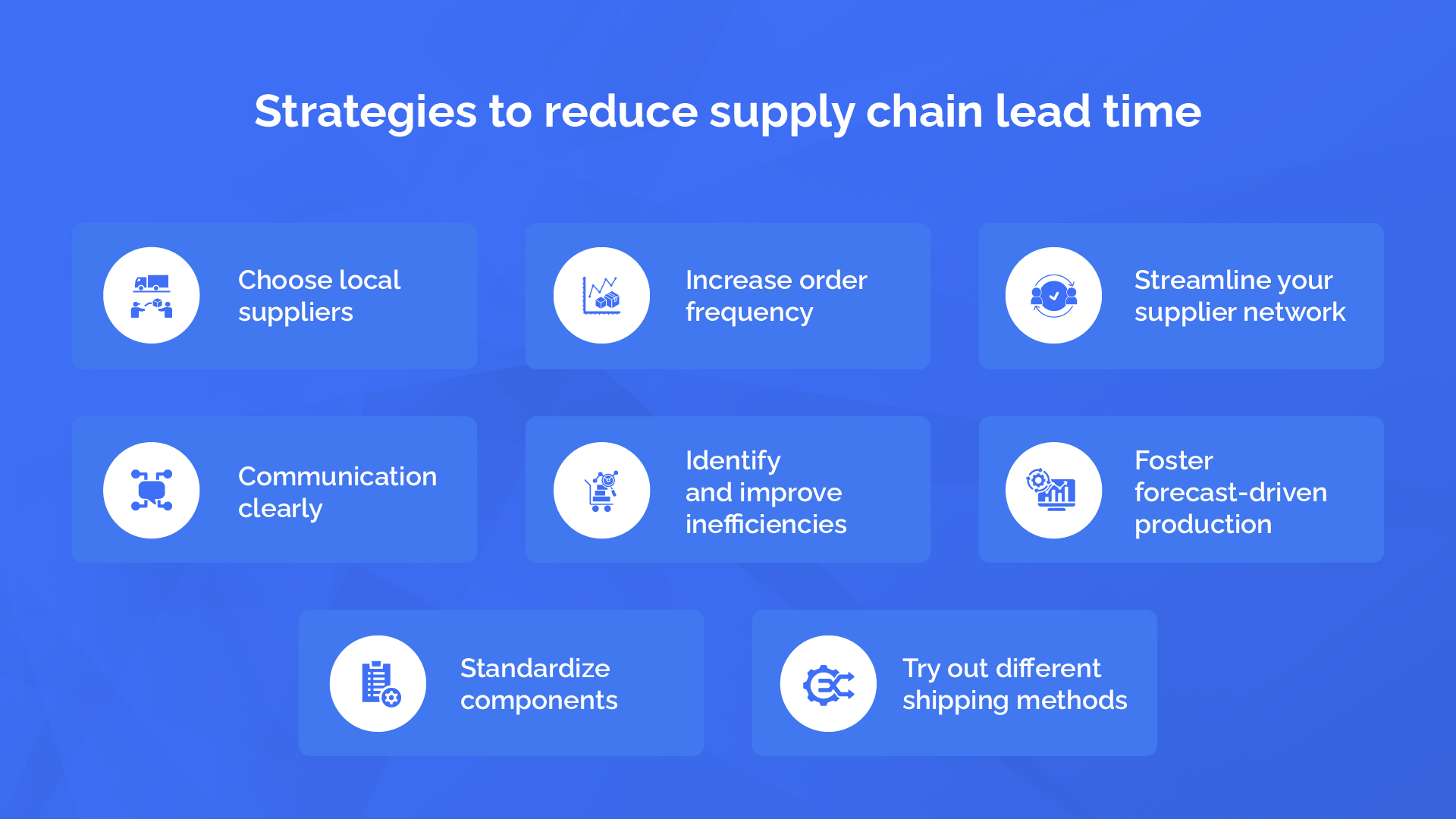
Working with local suppliers can help minimise shipping delays and improve coordination across the supply chain.
In addition to reducing international logistics challenges, local sourcing can improve communication, coordination, and responsiveness. Closer collaboration with local suppliers can also support more reliable deliveries while strengthening regional supply networks.
The closer your suppliers are to your warehouses, the easier it is to reduce lead time. Even when prioritising domestic suppliers, businesses may still experience delays if materials are sourced from distant locations. The closer suppliers are to the production facility, the easier it becomes to receive supplies on time and shorten supply chain lead times.
Placing smaller, more frequent orders can make production and delivery cycles more responsive.
This approach can also make the supply chain more flexible and responsive. It encourages more frequent coordination with suppliers, helping businesses respond faster to demand changes and maintain better supplier alignment.
Increasing order frequency is an effective way to reduce lead time in supply chain operations by improving inventory replenishment cycles and reducing dependency on large shipments.
Simplifying the supplier network can improve coordination and operational efficiency.
By consolidating supplier relationships, businesses can reduce coordination complexity and improve alignment across procurement and production. It can also strengthen supplier collaboration and make it easier to resolve issues, improve planning, and reduce delays across the supply chain.
A streamlined supplier network helps businesses reduce supply chain lead time by minimising communication gaps and reducing supplier-related delays.
A responsive supply chain depends on clear communication across suppliers, manufacturers, and logistics partners.
Timely information exchange helps teams coordinate faster and respond to issues before they turn into delays. Maintaining consistent communication across multiple stakeholders can be difficult, especially when suppliers, production teams, and logistics providers operate on different timelines.
Businesses can address this by investing in reliable communication systems, improving transparency, and aligning stakeholders on timelines, priorities, and expectations.
Clear communication supports lead time reduction by ensuring that suppliers, manufacturers, and logistics providers can respond quickly to changing requirements and potential disruptions.
Regularly evaluating the supply chain for inefficiencies is essential for improving performance and reducing delays.
The challenge lies in both identifying inefficiencies and fixing them effectively. Businesses can address this by building a culture of continuous improvement, using data to identify bottlenecks, and encouraging feedback from frontline teams.
Involving suppliers in this process can help address recurring issues faster and support efforts to reduce manufacturing lead time and improve overall supply chain performance.
Software designed for supply chain management can help businesses identify inefficiencies in production processes. It can also reveal patterns in recurring errors, making it easier to implement solutions that reduce lead time and eliminate production delays.
Moving from reactive to forecast-driven supply chain management requires sharing accurate sales forecasts with suppliers.
One challenge is balancing forecast accuracy with changing market conditions. To address this, businesses should invest in better forecasting tools, collaborate closely with suppliers, and share real-time market information.
A forecast-driven production model helps reduce lead time in supply chain operations by minimising stock outs, reducing excess inventory, and improving production planning.
This approach strengthens supplier collaboration while creating a supply chain that moves in sync with market demand.
Using standardised components can simplify production and improve operational efficiency.
The benefits go beyond faster manufacturing processes. Standardisation can improve supplier coordination, maintain product consistency, and reduce complexity across the production cycle.
Companies seeking to reduce manufacturing lead time often standardise components to simplify procurement, reduce production variability, and accelerate assembly processes.
Businesses can often improve delivery speed by adopting alternative shipping methods and logistics strategies.
The value of this approach goes beyond faster delivery. Exploring multiple shipping options gives businesses more flexibility, improves reliability, and helps them respond to changing customer and market requirements.
Collaborating with logistics partners helps ensure that shipping decisions balance speed and cost-effectiveness. This strategic approach can significantly reduce supply chain lead time while improving overall customer satisfaction.
Advanced technologies are becoming central to lead time reduction efforts. These technologies improve operational efficiency while also making the supply chain more responsive, collaborative, and adaptable.
As businesses look for ways to reduce lead time in supply chain operations, technologies such as Transportation Management Systems (TMS), automation, Artificial Intelligence (AI), the Internet of Things (IoT), and cloud-based platforms are becoming essential tools. These solutions help organisations optimise processes, improve visibility, and accelerate decision-making, ultimately reducing overall supply chain lead times.
By using these technologies, companies can improve supply chain speed, visibility, and decision-making while also strengthening customer satisfaction and operational performance.
A Transportation Management System (TMS) helps businesses reduce supply chain lead time by improving transportation planning, execution, and monitoring.
TMS solutions analyse multiple transportation routes and identify the most efficient options, helping businesses reduce transit times. Dynamic scheduling allows real-time route adjustments based on traffic, weather conditions, and other disruptions to support timely deliveries.
Real-time shipment tracking and automated alerts provide complete visibility into shipment locations and statuses. This allows businesses to proactively manage delays and maintain control over their supply chain lead time.
Performance analytics help organisations evaluate carrier performance and select the most reliable transportation partners. Automated tendering also speeds up carrier assignment processes, reducing delays.
Shipment consolidation improves truck utilisation and minimises the number of trips required. This helps reduce both lead time and transportation costs.
Automated documentation, invoicing, and billing processes reduce manual work and eliminate administrative bottlenecks. This leads to faster turnaround times and improved operational efficiency.
Predictive analytics and performance dashboards provide insights that help businesses make better decisions. These insights support continuous lead time reduction initiatives and process optimisation.
Integration with suppliers, logistics providers, and other supply chain partners enables faster communication and coordination, which is critical for managing and improving supply chain lead times.
By optimising freight costs and transportation operations, businesses can reinvest savings into initiatives designed to reduce lead time in supply chain processes and improve overall performance.
Scenario planning and contingency strategies help organisations prepare for potential disruptions. This helps minimise the impact of delays and supports more reliable lead times.
Automation reduces manual intervention, minimises errors, and accelerates workflows across procurement, inventory management, order processing, and logistics operations.
Organisations seeking to reduce manufacturing lead time often implement automation to streamline production processes, improve consistency, and increase throughput.
By eliminating repetitive tasks and reducing processing delays, automation helps shorten overall lead times.
Artificial Intelligence (AI) enables advanced predictive analytics, helping businesses forecast demand more accurately and identify potential supply chain disruptions before they occur.
By anticipating challenges early, companies can take steps to prevent delays and reduce lead time across their operations.
AI-driven insights also support smarter inventory planning, helping organisations better understand what is lead time in inventory management and optimize stock levels accordingly.
The Internet of Things (IoT) provides real-time visibility into the movement of goods, assets, and inventory throughout the supply chain.
With continuous monitoring and tracking capabilities, businesses can quickly identify issues and respond to disruptions before they impact delivery schedules.
IoT technology plays an important role in helping organisations reduce supply chain lead time while improving transparency and operational control.
Cloud-based platforms improve communication and collaboration among supply chain stakeholders.
By ensuring that suppliers, manufacturers, logistics providers, and customers have access to the same information, cloud solutions help businesses respond quickly to changes and challenges.
Improved collaboration supports efforts focused on how to reduce lead time in supply chain operations and create a more agile supply chain network.
Advanced technologies do more than improve operational efficiency. They also help businesses build a more connected and collaborative supply chain ecosystem.
Organisations that invest in digital transformation can:
These benefits collectively support lead time reduction and help businesses remain competitive in a changing market.
FreightFox is a Transportation Management System (TMS) designed to build a more efficient and responsive supply chain.
FreightFox streamlines and optimises key aspects of supply chain management, from route planning and scheduling to real-time tracking and automated alerts. This improves visibility, reduces transit times, and supports organisations looking to reduce lead time in supply chain operations.
By minimising administrative tasks and improving operational efficiency, FreightFox helps businesses gain better control over their supply chain lead times while ensuring timely deliveries.
Businesses can reduce supply chain lead time by optimising transportation routes, improving supplier collaboration, automating manual processes, leveraging demand forecasting, and implementing advanced technologies such as Transportation Management Systems (TMS).
FreightFox helps organizations reduce lead time in supply chain operations through AI-driven route optimization, real-time shipment visibility, automated workflows, and data-driven decision-making. By streamlining logistics processes and improving collaboration across stakeholders, FreightFox enables businesses to achieve faster and more reliable deliveries.
A Transportation Management System (TMS) plays a critical role in lead time reduction by improving transportation planning, optimizing routes, automating carrier allocation, and providing real-time tracking capabilities.
FreightFox’s AI-powered TMS helps businesses shorten supply chain lead times by reducing administrative delays, improving carrier management, and enabling proactive responses to disruptions. Its advanced analytics and visibility capabilities help organisations build more efficient and responsive supply chains.
Reducing lead time helps businesses improve customer satisfaction, lower inventory carrying costs, increase operational efficiency, and respond more quickly to market demand. Shorter lead times also improve supply chain resilience and provide a competitive advantage.
FreightFox enables organizations to reduce manufacturing lead time and optimize transportation processes through intelligent automation, predictive analytics, and real-time visibility. This helps companies maintain high service levels while controlling costs and improving overall supply chain performance.
FreightFox provides an AI-driven Transportation Management System that streamlines transportation planning, automates workflows, improves shipment visibility, and optimizes freight operations.
With capabilities such as real-time tracking, route optimization, automated alerts, advanced analytics, and collaborative workflows, FreightFox helps organizations reduce supply chain lead time, improve inventory availability, and strengthen operational efficiency. By enabling faster and smarter logistics decisions, FreightFox supports more resilient and responsive supply chains.

See how leading enterprises are optimizing freight costs, performance, and emissions with FreightFox — all in one platform.
FreightFox is a full-stack TMS and Control Tower platform that helps enterprises streamline freight procurement, execution, visibility, settlement, and sustainability—from Procure-to-Pay