Transportation Management System vs ERP: What's the Difference?
Written By:
Vikas Singh
August 27, 2026
An ERP (Enterprise Resource Planning) system manages a company's core business processes and acts as its enterprise-wide system of record - covering finance, inventory, and procurement. A TMS (Transportation Management System) is purpose-built to plan, execute, track, and settle the physical movement of freight. The two aren't competitors: most mid-size and large enterprises run both together, with the ERP as the system of record and the TMS as the system of execution for transportation.
It's a question that comes up constantly in planning meetings: "Wait, doesn't our ERP already do this?" The confusion is understandable. Most ERPs added basic logistics modules over the years, and most TMS platforms added invoicing and reporting, so the line between them looks blurrier than it is. The two systems also often have different owners: IT and finance champion the ERP, while operations and logistics push for a TMS, and neither side always knows what the other system can and can't do.
This post draws that line clearly: what a TMS does, what an ERP does, where they overlap, what signs suggest your ERP alone isn't covering freight, and how enterprises typically run both systems together in practice.
TMS vs ERP: What's the Difference?
Here's the short version:
ERP - the enterprise-wide system of record for finance, inventory, procurement, manufacturing, and more.
TMS - a specialized system for transportation planning, procurement, execution, tracking, settlement, and freight analytics.
TMS and ERP are complementary rather than competing systems - each is built to do a different job well, and most enterprises need both.
What Is a Transportation Management System (TMS)?
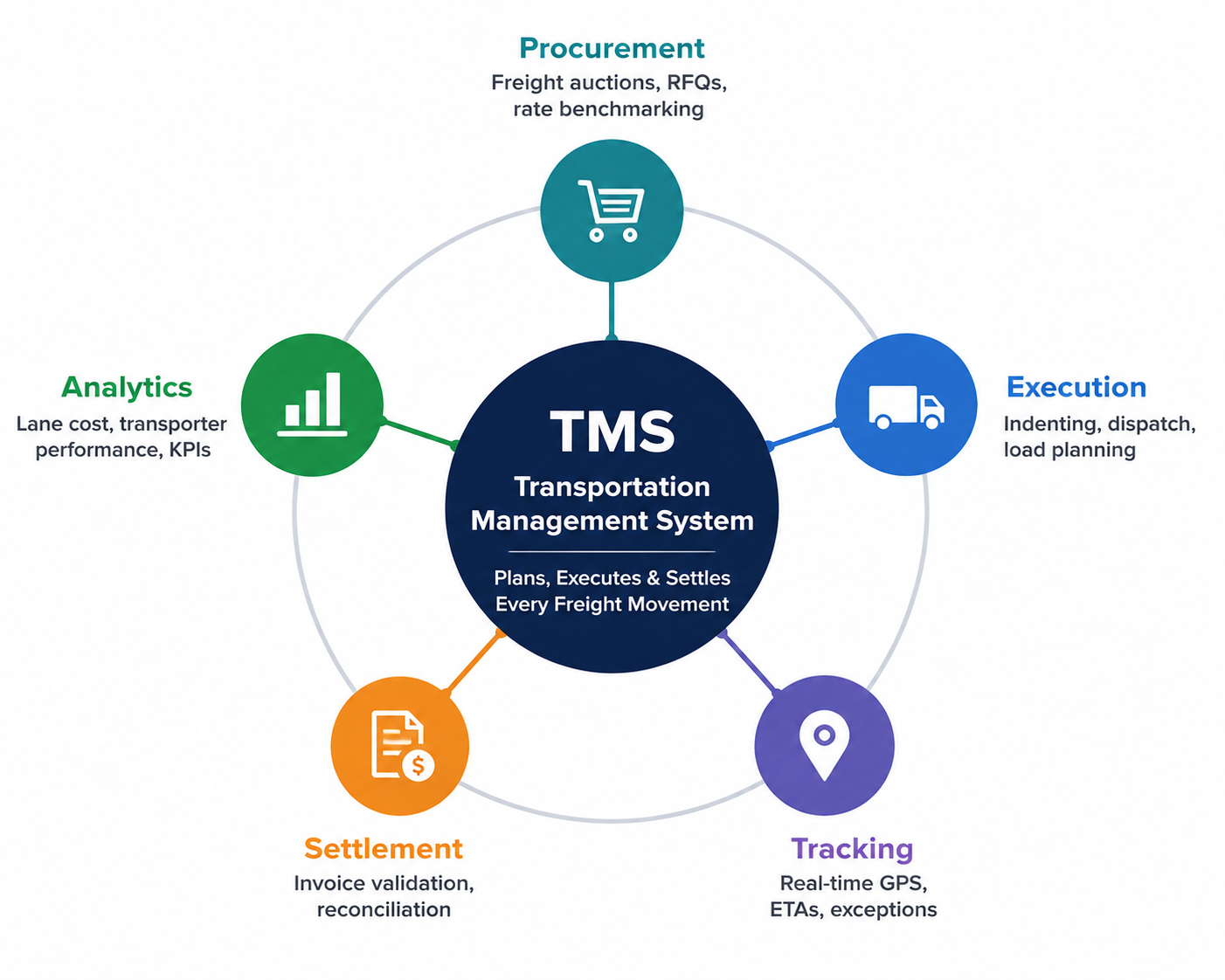
A Transportation Management System is purpose-built software that plans, executes, tracks, and settles the physical movement of freight. It lives inside the day-to-day operations of a logistics or supply chain team and is designed to handle the volume and speed of transportation decisions - often hundreds or thousands of shipments a day.
A TMS typically covers:
Procurement - running freight auctions, RFQs, and rate benchmarking across transporters using freight procurement software
Execution - indenting, dispatch, gate management, and load planning
A mature TMS usually goes a step further than these basics, adding:
Carrier and transporter scorecarding - tracking on-time performance, tender rejection rates, and reliability by transporter over time
Dynamic re-planning - reallocating loads in real time when a transporter rejects a tender, a dock delay hits, or volumes shift mid-day
Control tower visibility - a single dashboard where exceptions across every lane and transporter surface automatically, rather than requiring someone to chase updates by phone
The core users of a TMS are logistics managers, transport planners, procurement teams, dispatch teams, and finance teams who are responsible for the entire lifecycle of freight right from getting the right truck at the right price at the right time until reconciliation and settlement. For these users, the system needs to reflect what's happening right now - not what was planned last week.
What Is an ERP (Enterprise Resource Planning) System?
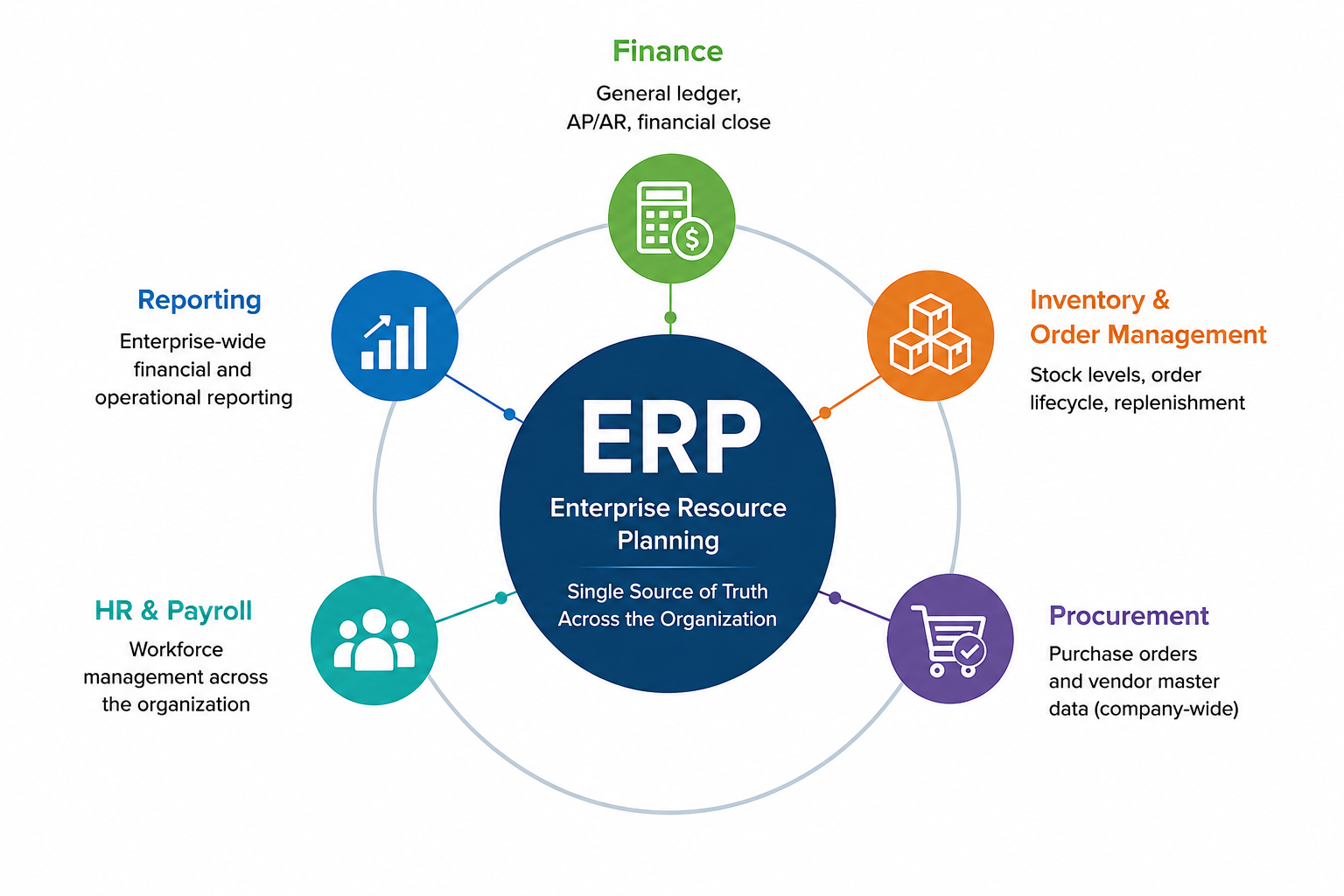
An ERP system is the backbone of a company's overall business operations. It centralizes data across finance, procurement, inventory, HR, sales, and manufacturing into a single system of record. Its job isn't to manage how a truck moves from Point A to Point B - it's to make sure every department is working off the same numbers. Where freight shows up at all, it's usually through a basic ERP transportation management module, not a dedicated execution system.
An ERP typically covers:
Finance - general ledger, accounts payable/receivable, financial close
Inventory & Order Management - stock levels, order lifecycle, replenishment
Procurement - purchase orders and vendor master data at a company-wide level
HR & Payroll - workforce management across the organization
Reporting - enterprise-wide financial and operational reporting
A mature ERP deployment typically also includes:
Master data management - a single source of truth for vendor, customer, and material data shared across every department
Compliance and audit trail - statutory reporting, tax filings, and audit records maintained at the enterprise level
Long-range planning - production schedules, demand forecasts, and capital planning that look months or years ahead, not hours
The core users of an ERP are finance controllers, plant heads, supply chain planners, and company leadership who need a single, stable source of truth for what the business owns, owes, and has committed to. Unlike a TMS, an ERP isn't optimized for minute-by-minute change - it's optimized for accuracy and consistency across the whole organization.
TMS vs ERP: Side-by-Side Comparison
Transportation Management System (TMS)
Enterprise Resource Planning (ERP)
Focus area
Focus area Freight and logistics execution
Company-wide business operations
Data type
Data type Real-time - live freight rates and bids, dispatch and load status, GPS location and ETAs, ePOD and invoice data, and lane-level cost and transporter performance analytics
Transactional: purchase orders, invoicing, general ledger, inventory, procurement, HR, and production records
Primary users
Logistics managers, transport planners, procurement teams, dispatch and freight finance teams
Finance controllers, plant managers, supply chain planners, procurement leaders, IT teams, and company leadership
Core function
Plan, execute, track, and settle freight movement
Record, plan, and report on enterprise resources and transactions
Update frequency
Continuous - updates by the minute as trucks move
Periodic - updates as transactions are entered or closed
Depth on freight
Deep - lane-level, transporter-level, shipment-level detail
Shallow - freight typically appears as a cost line, not an operational record
Implementation speed
Faster, modular rollout
Longer, often multi-quarter rollout
In short: an ERP tells you what was ordered and what it should cost. A TMS tells you where the shipment actually is, what it actually cost, and whether the invoice matches reality. To see how this plays out in cost terms, read Reduce Freight Costs with Transportation Management Software.
Common Signs Your ERP Alone Isn't Enough for Freight
An ERP may be sufficient for simply recording that a freight transaction happened. But most businesses start considering a dedicated TMS - and ERP transportation management modules alone stop being enough - once they need real-time shipment visibility, structured transportation procurement, carrier performance management, freight analytics, and automated settlement.
Many companies don't set out to buy a TMS - they simply hit a point where managing freight inside the ERP (or outside it, in spreadsheets) stops working. These are the most common signs:
Freight costs are tracked in spreadsheets outside the ERP because the ERP has no live rate or lane data
Finance only finds out about a freight cost overrun at month-end close, not when it actually happens
There's no way to see where a shipment is right now without calling the transporter directly
Adding a new transporter or lane requires IT tickets or manual master-data updates inside the ERP
Freight KPIs - on-time percentage, cost per tonne-km, transporter performance - don't exist anywhere as a standing report
If two or three of these sound familiar, that's usually the clearest signal that transportation has outgrown what the ERP was ever meant to handle.
For most mid-size and large enterprises, the answer is yes - by design, not duplication. The ERP stays the single source of truth for finance, inventory, and company-wide transactions, while the TMS is the transportation execution system that plans, runs, tracks, and settles freight movement - owning everything between "order placed" and "invoice paid" on the freight side.
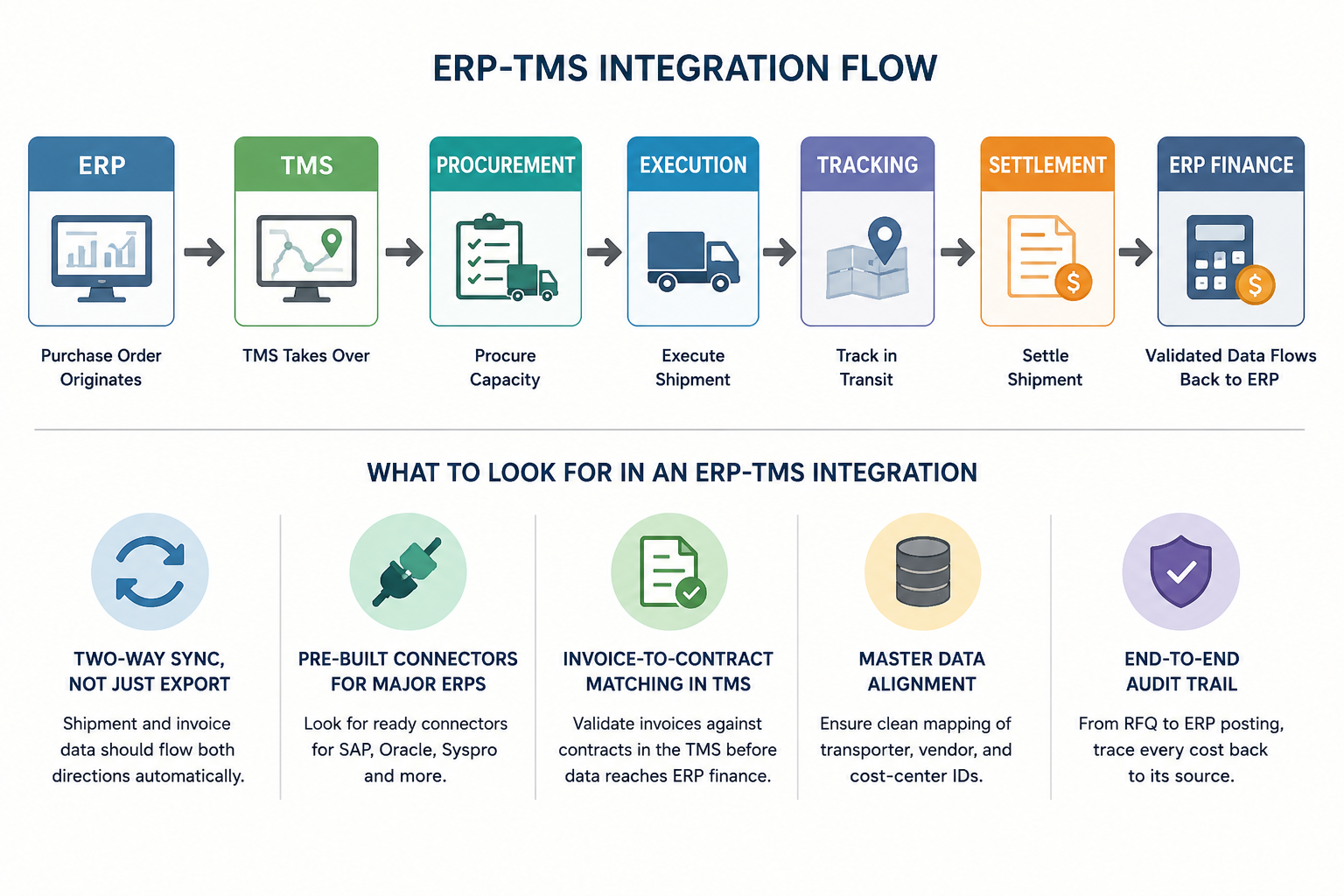
The real value shows up in the integration between the two. When a TMS is ERP-integrated, validated invoices, reconciled freight costs, and shipment-level data flow straight into the ERP's finance modules - instead of someone re-keying numbers from a freight spreadsheet into SAP or Oracle every month. A planner books a shipment in the TMS, which runs carrier bidding and dispatch; once the transporter's invoice is validated against the contracted rate, the TMS pushes a clean, audit-ready record into ERP finance - removing the manual reconciliation step that causes overbilling and disputes in almost every enterprise freight operation.
Why not choose just one system?
Trying to force everything into one system usually means losing depth on one side or the other - either freight execution suffers, or company-wide financial reporting does
Keeping the systems separate but integrated lets each team use the tool built for their job, without forcing logistics teams to work around finance-first software, or finance teams to work around operations-first software
What to Look for in an ERP-TMS Integration
Not every "integration" is built the same way. Look for:
Two-way sync, not just export - shipment and invoice data flows both directions automatically
Pre-built connectors for major ERPs like SAP, Oracle, and Syspro
Invoice-to-contract matching inside the TMS, before data reaches ERP finance
Master data alignment - transporter, vendor, and cost-center IDs map cleanly between systems
A preserved audit trail end to end, from RFQ to ERP posting
The difference comes down to this: a TMS and an ERP aren't competitors - they're built for different jobs. The ERP keeps your business's financial and operational data consistent. The TMS keeps your freight moving, visible, and accurately billed. The enterprises that get the most value are the ones that stop trying to force one system to do the other's job, and instead connect the two so freight data flows cleanly from execution to finance.
Book a demo to see how FreightFox connects freight execution with your existing ERP, end to end.
Frequently Asked Questions
A TMS (Transportation Management System) plans, executes, tracks, and settles the physical movement of freight, while an ERP (Enterprise Resource Planning) system manages a company's finance, inventory, and procurement as its enterprise-wide system of record. The TMS runs day-to-day transportation operations; the ERP keeps company-wide records accurate and consistent.
Not by default. Most ERP suites include only a basic ERP transportation management module - enough to record that freight was purchased, but not enough to run live carrier bidding, real-time GPS tracking, or automated invoice validation. Enterprises typically run a dedicated TMS like FreightFox alongside their ERP for that level of detail.
No. A TMS isn't designed to manage finance, HR, or company-wide inventory - that's the ERP's job. A strong TMS should make the ERP's job easier instead: FreightFox handles procurement, execution, tracking, and settlement end-to-end, then pushes clean, validated freight data straight into the ERP so finance gets accurate numbers automatically.
Because each system does a different job well. The ERP stays the single source of truth for financial and statutory reporting, while the TMS gives operations a live, granular view of freight that ERP dashboards were never built to show. Keeping the two separate but integrated lets each team use the right tool without compromise.
A good TMS connects to your ERP through pre-built connectors and syncs data in both directions. Shipment and invoice data flows automatically, invoices are matched against the contracted rate inside the TMS before they reach ERP finance, and transporter, vendor, and cost-center IDs map cleanly between the two systems. That removes the monthly re-keying from freight spreadsheets into SAP or Oracle and keeps an audit trail from the original RFQ to the ERP posting.
Usually when freight is tracked in spreadsheets outside the ERP, finance only learns about cost overruns at month-end, nobody can see where a shipment is without calling the transporter, or there are no standing reports for freight KPIs like cost per tonne-km and transporter performance. If two or three of these sound familiar, transportation has likely outgrown what the ERP was built to handle.