
India's freight and logistics market crossed roughly USD 289 billion in 2025 and is on track to top USD 315 billion in 2026, growing at over 8% a year through 2031. E-commerce, manufacturing growth under production-linked incentive schemes, and steady exports are driving that growth, and freight is moving faster than road, rail, and port infrastructure can comfortably absorb. For enterprises moving thousands of truckloads a month across a fragmented trucking network, phone calls, WhatsApp updates, and Excel rate cards no longer scale.
Digital freight management in India is the shift from manual, relationship-driven trucking operations to platforms that handle procurement, tracking, invoicing, and emissions reporting in one system. For enterprises shipping at scale, it has become a competitive necessity rather than an upgrade.
The results show why. Enterprises running their freight on FreightFox report freight cost reductions of 8-15%, about 70% fewer man-hours spent on procurement, and close to 95% real-time shipment visibility.
This piece looks at what is changing, the trends driving it, how different industries are adopting it, what still holds enterprises back, and where the market is headed over the next two years.
For decades, freight in India ran on relationships. A logistics manager at a plant would call a handful of trusted transporters, negotiate rates over the phone, track trucks by calling drivers, and reconcile invoices against paper challans weeks after delivery. It worked, but it was opaque. Rates varied widely between plants, cost leakage went unnoticed for months, and nobody had one reliable view of where freight spend was going.
Several forces have converged to break that model:
The result is a structural shift from fragmented, person-dependent freight management to platform-based, procure-to-pay systems that connect procurement, execution, tracking, settlement, and sustainability reporting. This is not one tool replacing a phone call. It is a change in the operating model for how freight is bought, moved, tracked, and paid for.
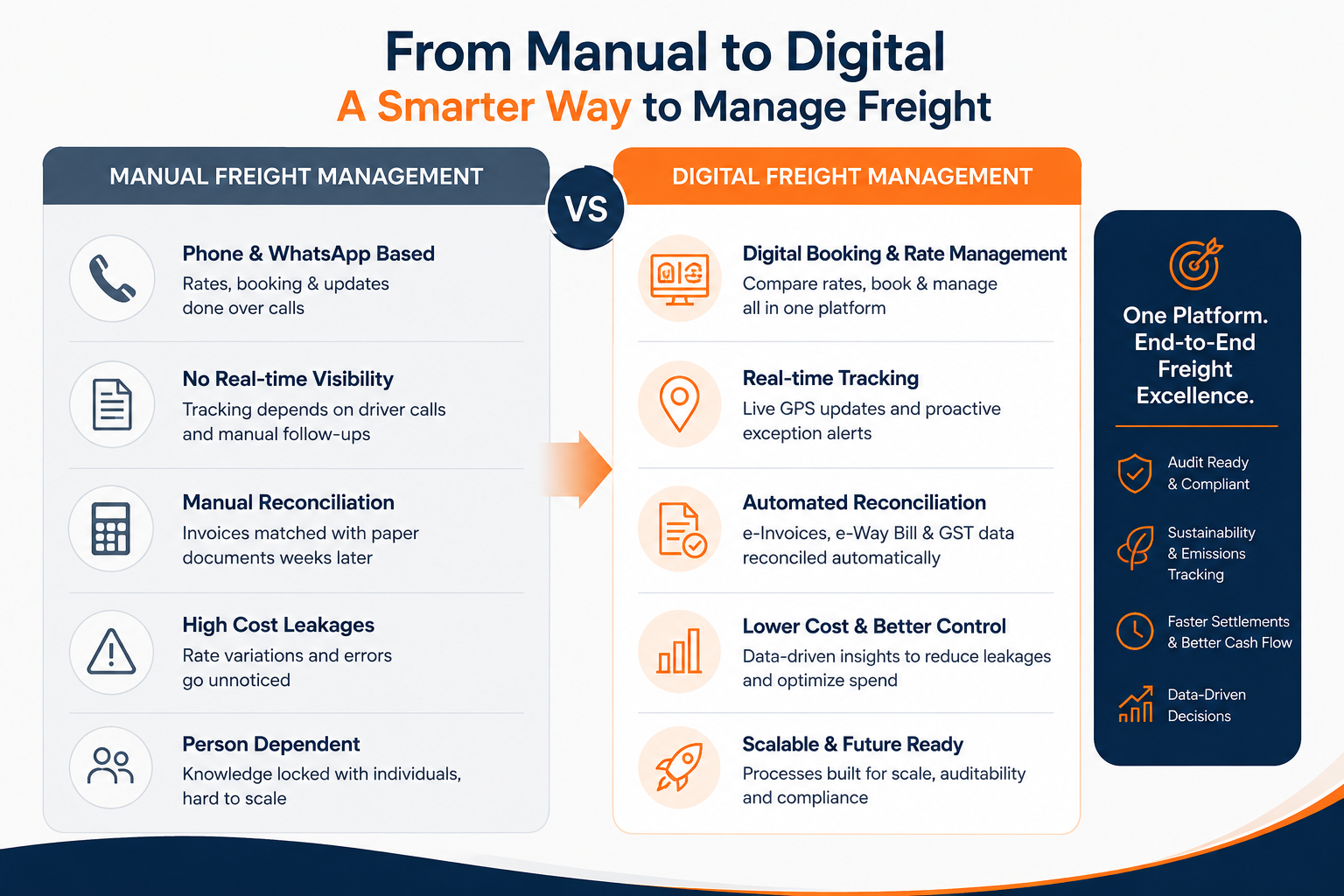
India's trucking market is dominated by small, independent fleet owners rather than a few large carriers. That fragmentation used to mean opacity, and enterprises negotiated with a fixed panel of transporters at rates that had not been benchmarked in months. Freight procurement software changes this by running spot, contract, and reverse auctions across thousands of lanes and suppliers at once, and benchmarking every bid against live market rates instead of last quarter's contract.
The effect is a wider transporter pool, faster bid evaluation, and procurement decisions based on price and service rather than personal relationships. For a closer look at how this works, see our guide on how freight procurement software helps Indian manufacturers, and how it translates into savings in reducing freight costs with TMS.
A supply chain control tower pulls live location data from GPS, SIM tracking, and FASTag toll pings into one dashboard showing every shipment's status, ETA, and exceptions. The gain is not only convenience, it is risk management. Teams see the shipments that are delayed, off-route, or at SLA risk, and can reroute, expedite, or warn customers before a delivery window is missed.
FASTag data is one of the richest and least used signals in Indian freight. Our analysis of roughly 349 million FASTag transactions shows how freight corridors are shifting, at a level of detail shippers did not have five years ago. It now powers dynamic ETAs and route-level cost benchmarking.
Invoice reconciliation is where a lot of freight budgets quietly leak. Checking hundreds of invoices a month against contract rates and proof-of-delivery documents by hand is slow and error-prone, and finance teams often do not see the problem until quarter-end.
Automated settlement validates each invoice against the contracted rate and the executed load as soon as it is raised, flags overbilling and duplicates before payment, and connects to ERPs such as SAP and Oracle so finance and logistics work from the same numbers. Faster approval cycles also improve relationships with transporters, who value predictable payment.
Freight is one of the largest and least visible contributors to a manufacturer's carbon footprint, and Indian enterprises selling into global supply chains are under growing pressure to report it. Scope 3 emissions tools now calculate transporter-wise and lane-wise emissions using frameworks like LEAP (Logistics Emissions Abatement Platform), turning an annual estimate into a shipment-level data feed.
That matters for three reasons:
Once procurement, tracking, and settlement data sit in one place, platforms can combine historical lane performance, seasonal demand, weather, and traffic to answer questions proactively:
A less visible but equally important shift is the digitization of the paperwork freight runs on. E-Way Bills, e-invoicing under GST, and electronic proof of delivery (ePOD) are replacing paper challans and manual sign-offs.
Adoption is not even across industries. It is concentrated where freight complexity, compliance requirements, or cost pressure make manual processes unsustainable.
FMCG companies run some of the highest-frequency, most distributed freight networks in the country, moving product from a few plants to thousands of distributors and retail points. The main needs are last-mile visibility, reverse logistics management, and a live view of fulfilment so teams do not learn about a stockout after it happens. With volumes this high, small per-trip savings compound quickly. FreightFox's commodity flow analysis for potato freight procurement cut logistics costs and improved farm-to-fork efficiency for one of the world's largest potato chip brands. For a deeper look, see TMS for FMCG.
Component manufacturers work to just-in-time schedules, where one delayed truck can stop an OEM's production line. That makes real-time tracking and multi-vendor consolidation essential, and it is why control tower adoption has moved fastest here. Consolidation also combines partial loads from different suppliers into fuller trucks, reducing both cost and the number of shipments to track. FreightFox works with auto ancillary and tyre manufacturers including Hero MotoCorp, JK Tyre, CEAT, and Bridgestone.
Chemical shippers deal with hazmat-compliant workflows, bulk liquid and dry cargo tracking, and strict documentation requirements, which make manual processes both slow and risky. Digital tools give plant-level dispatch control and the audit trail regulators increasingly expect, while automated documentation lowers the risk of a hazmat shipment being held at a checkpoint over paperwork. Atul Limited, a chemical manufacturer with nationwide operations and global exports, reported 3-5% better freight rates after expanding its transporter network on FreightFox. Read the Atul Limited testimonial.
This industry combines temperature-controlled freight with some of the most complex state-by-state compliance in Indian logistics. A shipment crossing a state line without the right documentation can cost far more than a cost overrun, so digital freight management here focuses on compliance-ready workflows and distributor network visibility. See the Alcobev logistics case study for the cost, sustainability, and operational results.
Across all four sectors the pattern is the same: as freight complexity and regulatory scrutiny rise, manual processes stop scaling long before volume does. Enterprise manufacturers, not just logistics-native companies, are the ones leading adoption.
Digitization has not been frictionless. These are the barriers enterprises run into most often, and they shape how a rollout should be approached:
None of these are reasons to avoid digitization. They are reasons a phased, well-supported rollout tends to outperform a rushed one.
If you are weighing whether your operation has reached that point, our guide on when it is time to invest in freight management software is a useful starting point.
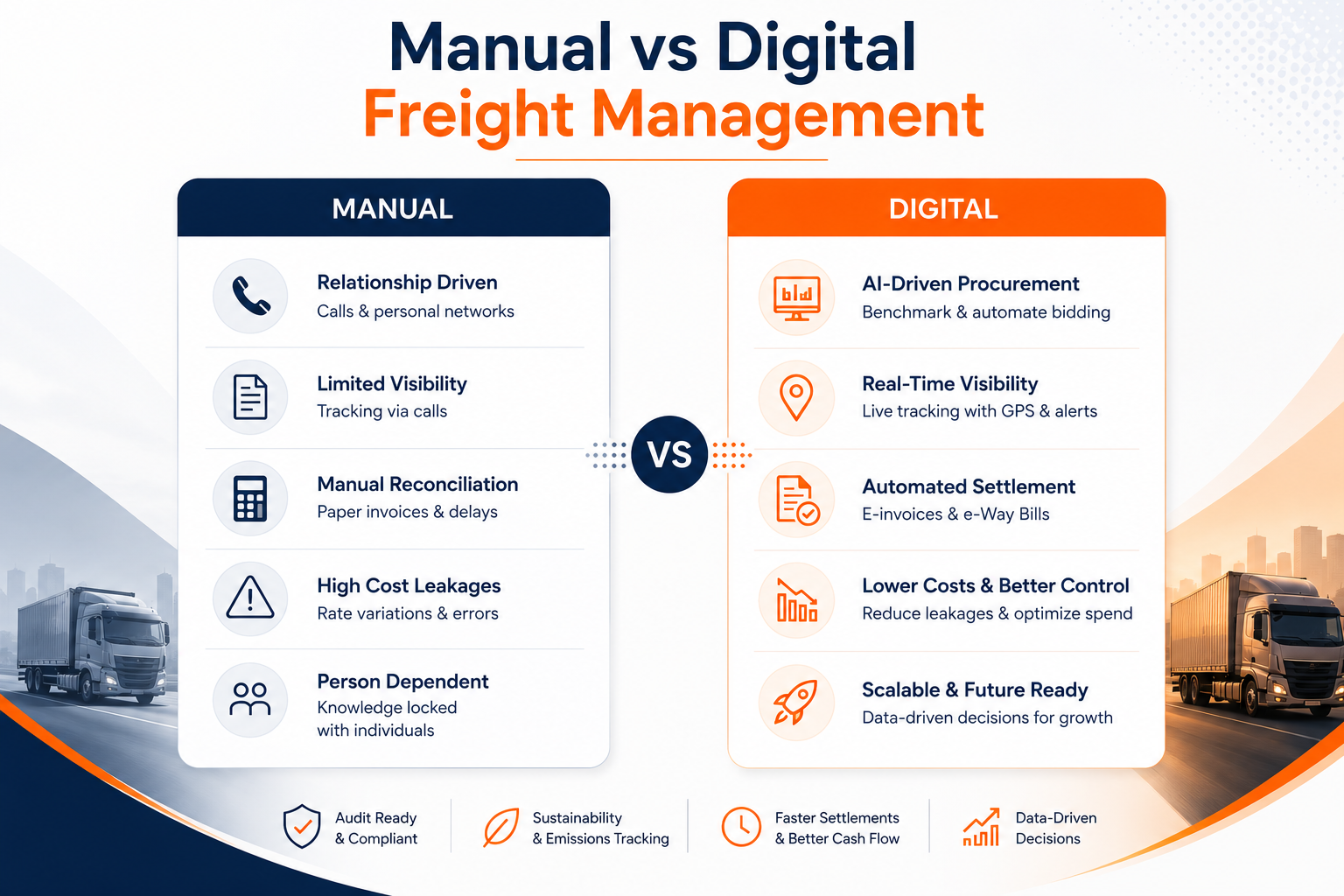
Businesses that adopt digital freight management now will be better placed to cut costs, improve visibility, and respond to changing market demands. Replacing manual processes with AI-powered procurement, real-time tracking, automated settlement, and ESG reporting builds a more resilient supply chain, and a platform designed for India's freight realities is now a strategic necessity.
Book a demo with FreightFox to see how enterprises like Coca-Cola, PepsiCo, Hero MotoCorp, and Atul Limited run their freight operations on one platform, from procure to pay.

See how leading enterprises are optimizing freight costs, performance, and emissions with FreightFox — all in one platform.
FreightFox is a full-stack TMS and Control Tower platform that helps enterprises streamline freight procurement, execution, visibility, settlement, and sustainability—from Procure-to-Pay