
"Where is this shipment right now? I've already called the transporter twice and still don't have a clear update."
"Why did our freight costs jump again this month? We're paying more, but I can't see exactly what's driving the increase."
"Can you check the latest freight sheet? I'm not sure which version is correct, and we're still tracking updates across WhatsApp."
None of these moments happen overnight. They build slowly, shipment by shipment, until manual processes simply can't keep up with the scale and complexity of the business. That's the point at which most enterprises start seriously evaluating a freight management system to bring procurement, tracking, and settlement together.
It's time to invest in freight management software when manual processes can no longer keep up with your volume and complexity, usually when three or more of the signs below apply.
This guide walks through the 10 clearest signs your business has outgrown manual freight operations, what each sign actually costs in real terms, and what to look for when choosing freight management software that solves the problem properly, not just partially.
Enterprises like Coca-Cola, PepsiCo, Hero MotoCorp, CEAT, Bridgestone, and P&G already run their freight operations on FreightFox. FreightFox customers report roughly 95% real-time shipment visibility and an 8-15% reduction in freight costs.
As freight networks have grown more complex, with more plants, more transporters, and more compliance requirements, freight management software in India has moved from a nice-to-have to a default part of the enterprise logistics stack. This is especially true for manufacturers, FMCG companies, and industrial shippers running high shipment volumes across multiple states.
This is one of the clearest signs that your logistics operation may lack adequate shipment visibility. If your team has to call transporters, wait for WhatsApp updates, or switch between multiple carrier portals to find out where a shipment is, tracking is still largely dependent on manual coordination rather than a centralized system.
The impact goes beyond the time spent requesting updates. Limited visibility means potential disruptions may remain unnoticed until a customer raises a concern. By that stage, the ability to proactively address the delay has already been significantly reduced.
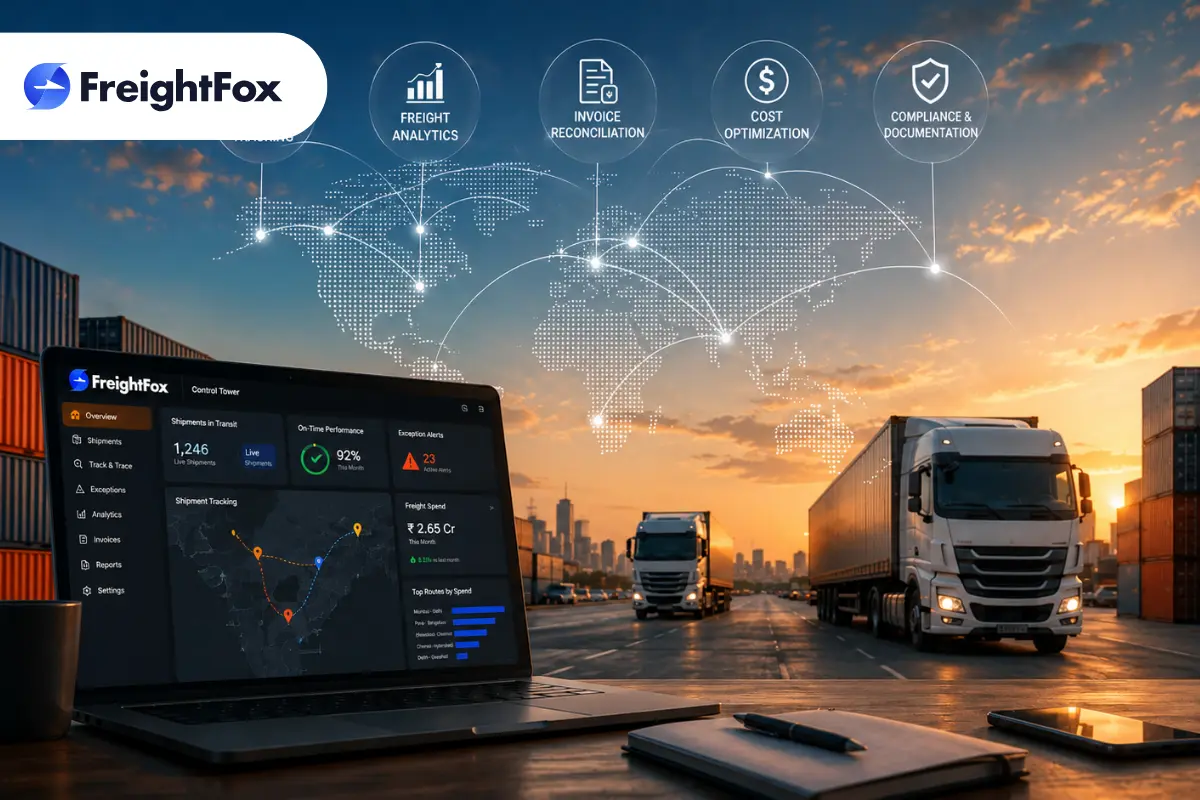
Freight management software enables real-time visibility across shipments, routes, vehicles, and transporters. A control tower acts as a centralized layer within this setup, bringing shipment information into a single dashboard. Logistics teams can use it to monitor consignments, identify exceptions, detect delays, and take corrective action before they escalate.
This visibility can be strengthened by combining multiple tracking sources, including FASTag data, GPS signals, and SIM-based location information. Using these inputs together reduces dependence on transporter-provided updates and provides a more comprehensive view of shipment movement.
The operational savings can also be substantial. Consider a coordinator spending just 30 minutes each day following up with transporters for shipment updates. Over a year, assuming about 260 working days, that can amount to approximately 130 hours spent on status checks alone.
Across a team of ten, this translates into roughly 1,300 hours that could otherwise be dedicated to exception management, transporter performance, customer service, or process optimization.
DID YOU KNOW?
67% of Indian shippers cite visibility gaps as their top cost leak, according to a FreightFox industry survey.
That visibility gap makes proactive exception management harder and leaves teams reacting after problems occur.
Freight spend rarely spikes all at once; it creeps. A few extra detention charges here, some empty-return trips there, transporters quoting above market rate because there's no competitive benchmark to check them against. Without lane-level cost visibility, these small leaks accumulate into a significant, hard-to-diagnose cost problem.
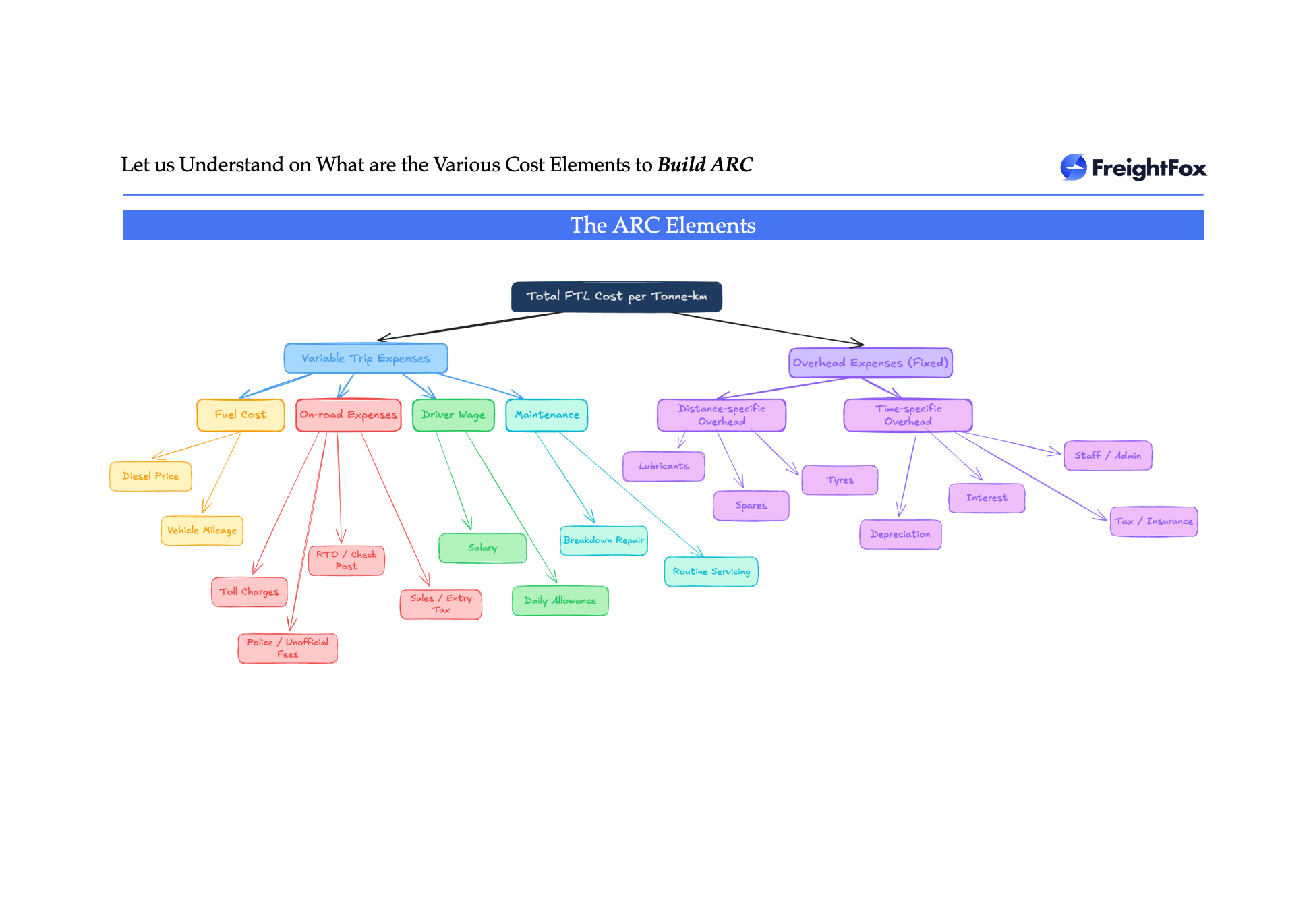
One practical way to understand what is driving that cost is Zero-Based Costing (ZBC). Instead of treating a transporter quote as a flat market rate, ZBC breaks freight cost into components such as fuel, tolls, driver wages, vehicle maintenance, and margin. This gives procurement teams a clearer basis for evaluating whether a quoted rate is justified.
Once the cost structure is clear, procurement teams can act on it through rate benchmarking, broader RFQs, and competitive spot or contract auctions. The result is a shift from negotiating against a single quoted number to making freight decisions using actual cost drivers and market data. For a lever-by-lever look at how this turns into savings, see Reduce Freight Costs with Transportation Management Software.
There's also a hidden cost multiplier: reactive, last-minute freight bookings. When teams lack visibility into upcoming demand or transporter availability, they end up booking capacity at a premium, close to dispatch time, simply to keep goods moving. Better planning and procurement visibility is a major reason FreightFox customers report roughly a 10% drop in unplanned transportation costs, since those costs are, by definition, avoidable with the right planning tools.
Spreadsheets are static, don't sync in real time, and are painfully easy to break. One overwritten formula or a version conflict between two team members, and hours of tracking data are gone. WhatsApp groups, meanwhile, bury critical delivery updates under general chatter, with no searchable history and no accountability trail.
This setup doesn't just slow teams down; it creates dangerous single points of failure. If the one person who "knows the system" leaves, that institutional knowledge leaves with them. New hires spend weeks being manually walked through undocumented processes instead of being productive from day one.
Freight management software replaces this patchwork with structured, role-based workflows. Indenting, tracking, and invoicing all live in one system, accessible to the right people with the right permissions, with a full audit trail.
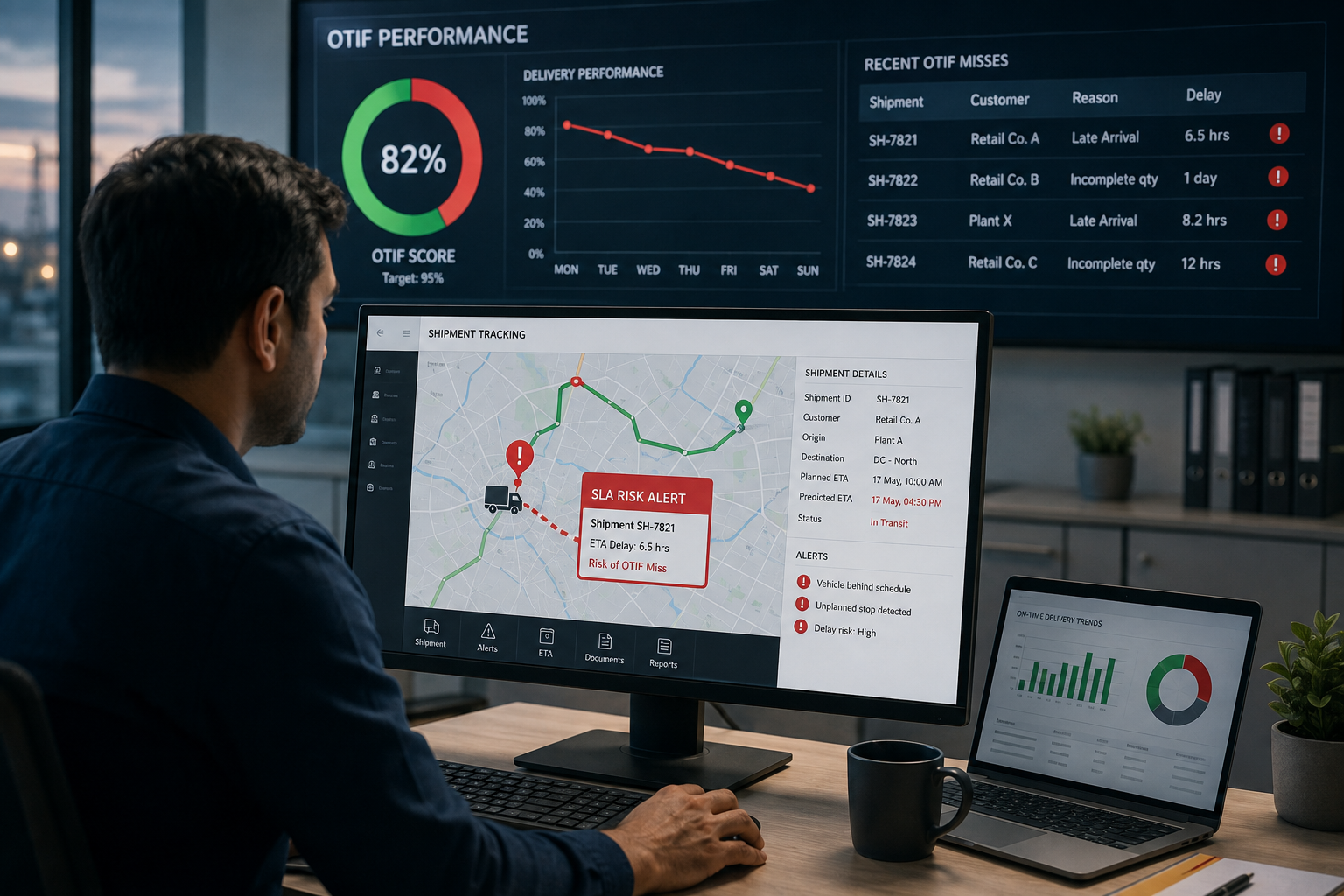
On-time-in-full (OTIF) delivery is one of the most closely tracked KPIs in enterprise supply chains, and one of the most commercially consequential. Missed OTIF targets mean penalty clauses in customer contracts, stockouts at retail or plant locations, and steadily eroding trust with key accounts.
The root cause of most OTIF misses isn't bad transporters; it's a lack of early warning. Freight management software flags SLA risk hours in advance through predictive ETAs and automated exception alerts (a vehicle running behind schedule, an unplanned stop, a route deviation), giving dispatch teams time to intervene: reroute, expedite, or proactively notify the customer before a delivery window is actually blown.
QUICK STAT
QUICK STAT64% of Indian businesses have faced stockouts due to supply chain disruptions, according to a 2023 Assocham study.
When issues are detected this late, teams lose the opportunity to reroute, expedite, or protect the delivery window before the customer is affected.
When freight invoices are matched against contracted rates manually, errors slip through constantly: duplicate entries, incorrect weight slabs, unapproved accessorial charges, mismatched trip details. Each one takes time to catch and time to dispute, and in the meantime, payments to transporters get delayed.
This isn't just a financial inconvenience. Slow, error-prone settlement damages relationships with your best transporters, the ones with options elsewhere, and can quietly erode capacity availability during peak season, exactly when you need it most.
Freight management software automates this end-to-end: every invoice is validated against contracted rates and actual executed loads before it reaches an approver, catching discrepancies automatically instead of relying on someone manually cross-checking line items. For more on invoice checking and payment, see The Shared Language Your Freight Invoices Are Missing.
A tracking process built for 50 shipments a day across two plants will not survive being stretched to 500 shipments across ten locations. The usual response is to simply hire more people to run the same manual process at a larger scale, but that means your cost-to-serve grows in lockstep with volume instead of improving with scale the way it should.
This is one of the clearest signals that it's time for freight management software: platforms are built to scale through configuration. Adding a new plant, region, or transporter network is a setup task, not a hiring exercise. The infrastructure that supported 2 plants can support 20 without proportionally more headcount.
This matters even more for businesses expanding into new geographies, since freight complexity in India in particular isn't just about volume. It's about navigating state-level variations in compliance, a fragmented transporter market, and inconsistent digital adoption among smaller carriers. A platform designed for this environment, with a large connected transporter network already onboarded, shortens the ramp-up time for entering a new region considerably compared to building transporter relationships and tracking processes from scratch each time.
SAP, Oracle, and most large ERPs are built primarily for finance, procurement, and inventory management. Freight and transportation functionality is typically a secondary module bolted onto that core, with limited real-time tracking, weak procurement tooling, and reporting that wasn't designed with logistics teams in mind.
If your team maintains parallel spreadsheets just to get the freight visibility your ERP doesn't provide, that's a clear sign you need a purpose-built freight management layer, one designed to integrate with your existing ERP (SAP S/4HANA, Oracle EBS, Syspro) rather than replace it, feeding clean freight data back into finance and operations automatically. For a full comparison of the two systems, see TMS vs ERP: What's the Difference?.
Ask any logistics team which transporters consistently deliver on time, and the answer is often a gut feeling, not a number.
Freight management software changes that with data-driven transporter scorecards built from real shipment history - including on-time performance, transit times, claims, disputes, and lane-wise reliability.
But visibility goes beyond transporter performance.
These systems give every team a dashboard built around the KPIs that matter to them. Procurement teams can track RFQs and compare transporter rates. Warehouse and gate teams can monitor vehicle status and waiting times. Finance teams can track invoice approvals. Dispatch teams get daily reports and location-wise analytics.
With GPS-based vehicle tracking, utilization data, and network-wide freight analytics, teams get a single view of what's happening across their freight operations.
So instead of allocating freight based on relationships and habit, you can make decisions based on performance, cost, and service data - while giving every team the visibility they need to act faster.
E-way bills, GST timelines, and proof-of-delivery documentation are all areas where manual, paper-based processes are slow and error-prone, and the risk isn't just operational inefficiency, it's financial and legal exposure. Inaccurate delivery timestamps can create real problems under GST compliance rules, and premature or delayed revenue recognition tied to unclear delivery proof can create audit risk under accounting standards.
Advanced freight management software closes this gap with digital ePOD (electronic proof of delivery): accurate, timestamped, and automatically logged for every shipment, creating an audit-ready trail without manual paperwork. For a closer look at how this plays out in practice, see our breakdowns of time-of-supply under GST 2.0 and revenue recognition under Ind AS 115. For the latest limits and rules, see E-Way Bill Rules and Limits: What's Actually Costing Indian Manufacturers in 2026.
This is one more reason compliance-ready freight software is quickly becoming a baseline requirement, not an optional upgrade.
ESG disclosure requirements are tightening, both globally and in India, and Scope 3 emissions, which include freight and transportation, are increasingly under regulatory and investor scrutiny. Yet most enterprises still can't report transporter-wise or lane-wise emissions data with any real precision; it's typically a rough annual estimate rather than tracked, verifiable data.
If sustainability reporting for freight is still a manual exercise, that's a growing compliance gap. Freight management platforms with built-in emissions tracking measure Scope 3 emissions continuously, by lane, by transporter, by shipment, turning ESG reporting into a byproduct of daily operations instead of a quarterly scramble.
Tick the signs that apply to your operation, then check the guide below.
The ten signs apply broadly, but the operational stakes, and how urgently each one needs solving, vary a lot by industry:
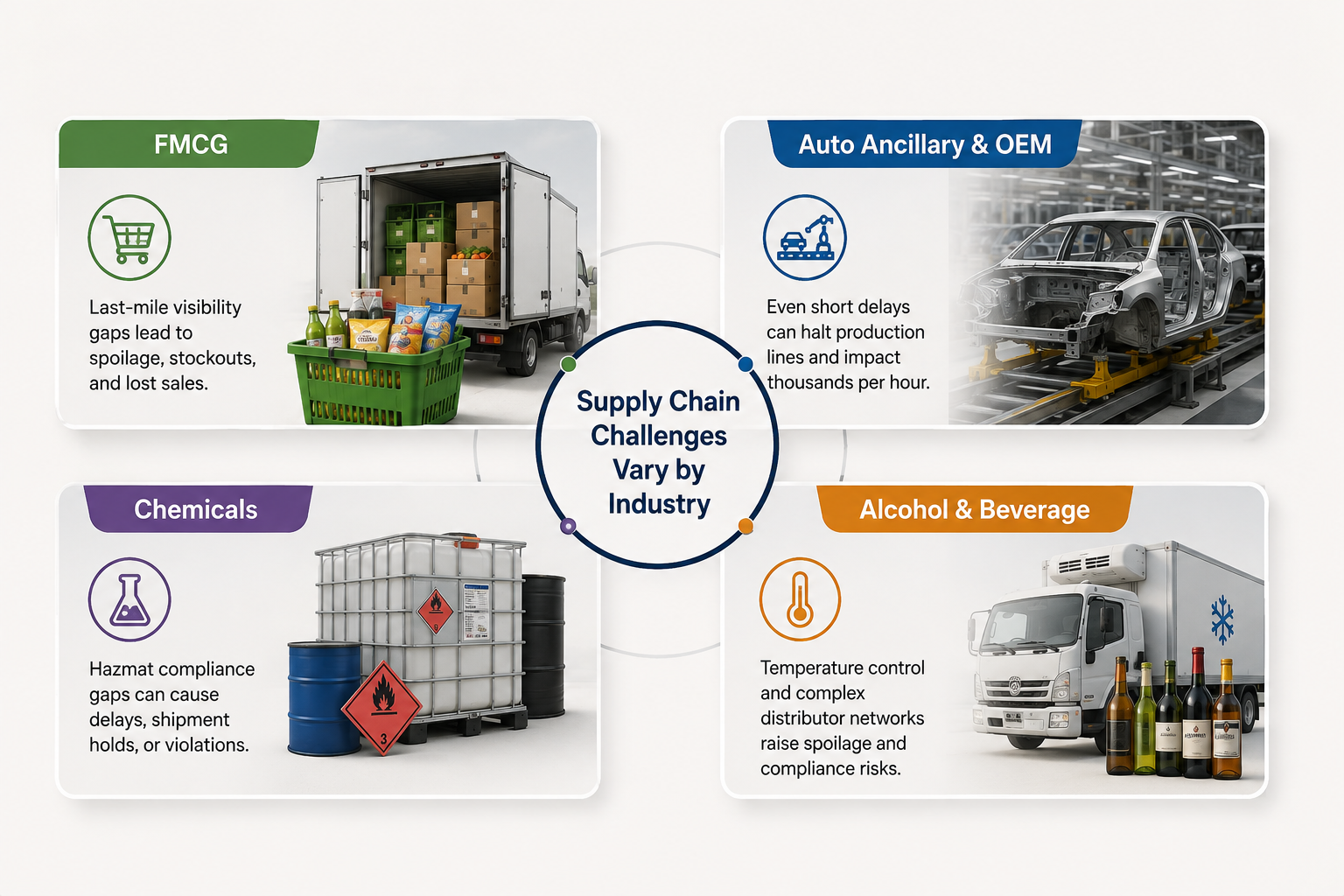
If your business sits in one of these categories, the signs above usually appear earlier and cost more to ignore, simply because the operational stakes of a missed delivery or compliance gap are higher.
Across every one of these sectors, the common thread is the same: freight software needs to account for local compliance and distribution realities, not just generic tracking.
Not all platforms solve all ten problems above. When evaluating freight management software, prioritize:
For a step-by-step approach, see How to Evaluate Transportation Management Software for Your Business, or use the TMS Evaluation Checklist.
FreightFox is an AI-powered Transportation Management System built specifically for large Indian enterprises managing complex, high-volume freight networks. Rather than a bolted-on ERP module or a spreadsheet workaround, it brings every stage of the freight lifecycle onto one platform:
Together, these modules cover the ten signs above.
If several of these signs sound familiar, the cost of waiting is usually higher than the cost of switching. Book a demo to see how FreightFox works for your freight operation.
As freight operations become more complex, manual processes can lead to higher costs, limited visibility, delays, and compliance challenges. Freight management software helps businesses bring procurement, execution, tracking, settlement, analytics, and sustainability together on one platform.
For enterprises looking to improve cost control, visibility, efficiency, and scalability, moving from fragmented processes to a dedicated freight management platform can help create more streamlined and data-driven freight operations. For the wider picture, see How Digital Freight Management Is Transforming Supply Chains in India.
FreightFox is a full-stack TMS and Control Tower platform that helps enterprises streamline freight procurement, execution, visibility, settlement, and sustainability—from Procure-to-Pay