
Three trucks leave your plant half-empty today. A transporter invoice with a rate that no longer matches your contract slips through unnoticed. Nobody catches either one until next month's freight bill lands well above budget. None of this shows up as a single alarming number - it just quietly eats into your margins, shipment after shipment.
For most manufacturers, freight is one of the largest line items outside of raw materials - and one of the least visible. Industry benchmarks put freight at roughly 5-12% of cost of goods sold (COGS) for manufacturers, climbing to 15-20% of ex-factory price in bulk-moving sectors like cement and steel. Yet very few operations teams can say, with confidence, what they pay per ton-kilometre, whether that rate is competitive, or where the leakage is happening.
That gap is exactly what a transportation management system (TMS) is built to close. This guide breaks down, lever by lever, how manufacturers use a TMS to reduce freight costs and bring logistics costs under control - from procurement and consolidation to routing and invoice audit - and what to look for when evaluating one for your plant network.
Most manufacturing operations manage freight the same way they did a decade ago. That approach breaks down at scale for a few specific, recurring reasons:
None of these are dramatic failures on their own. They are small, repeated inefficiencies - and that is precisely why they are so expensive: they compound across thousands of shipments a year without ever showing up as a single line item anyone can point to. A TMS exists to make that invisible leakage visible, and then to close it systematically.
A Transportation Management System is software that plans, executes, and audits the physical movement of freight - inbound raw materials and outbound finished goods - across a manufacturer's transporter network. In practice, a modern TMS sits between your ERP and your transporters, handling everything a spreadsheet or a transport desk used to manage manually, including:
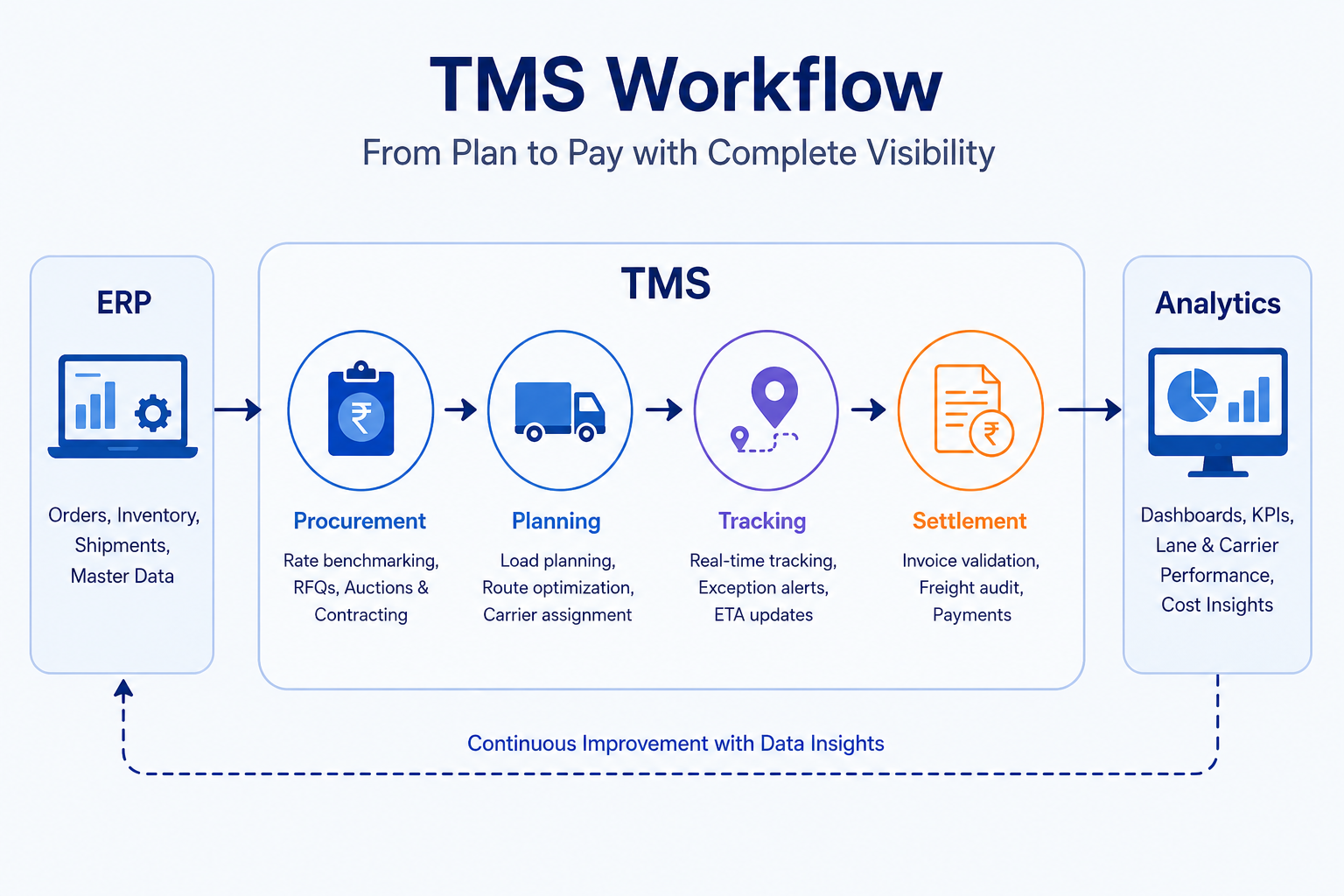
Newer AI-native platforms are modular and lighter to deploy than the heavy, ERP-style modules bolted onto SAP or Oracle, covering the full procure-to-pay freight lifecycle without a multi-year implementation.
A useful way to think about it: an ERP tells you what needs to move and when it is meant to arrive. A TMS is what actually gets it there at the lowest possible cost, with a paper trail to prove it. For a fuller comparison, see TMS vs ERP.
Freight cost reduction rarely comes from one big fix. It comes from tightening four specific levers that manufacturing operations control every day - this is what freight optimization looks like in practice.
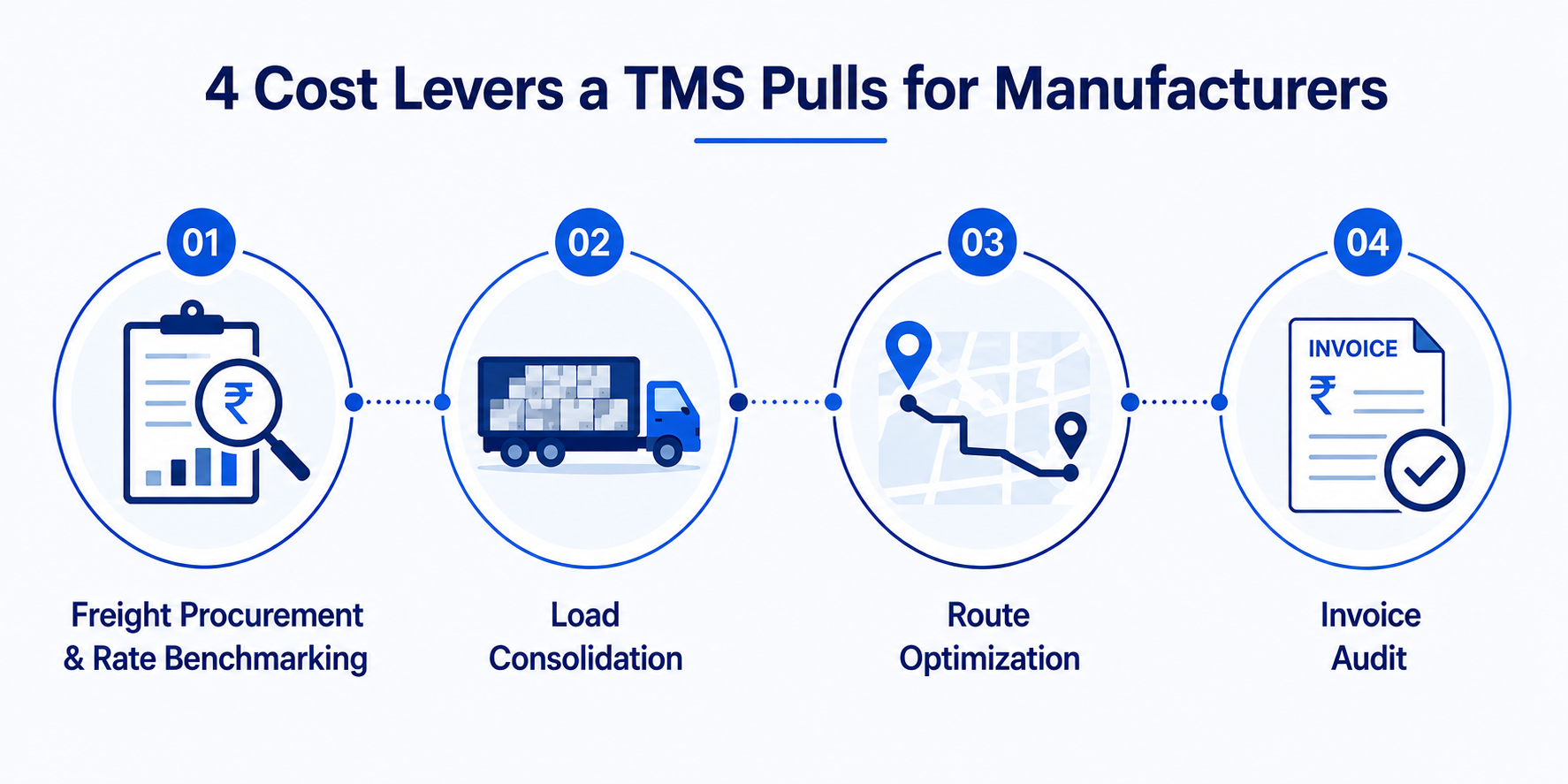
Most manufacturers still negotiate transporter rates once a year and then pay whatever is invoiced for the next twelve months, with no ongoing benchmark against the market. A freight procurement software layer changes that by running rate discovery continuously - through spot auctions, contract auctions, and RFQs issued across your entire lane and transporter base rather than a handful of incumbent vendors.
Why manual procurement quietly costs more over time:
What a TMS changes:
The effect compounds: you stop overpaying on lanes where the market has moved, and a broader transporter pool improves your leverage on every renewal. Manufacturers that move from static annual contracts to continuous rate benchmarking typically report a 3-5% improvement in freight rates once their transporter network expands and bids become competitive again. For example, on several hundred crore of annual freight spend, even a 3-5% improvement is a meaningful, recurring saving that needs no change to day-to-day operations.
Partial truckloads are one of the most common - and most invisible - sources of freight overspend on a factory floor. When dispatch is planned manually by shift, plants tend to send trucks as orders come in rather than batching compatible loads, leaving trucks often running well below capacity on lanes that could easily be consolidated.
Why this happens even with a capable dispatch team:
What a TMS changes:
For manufacturers running high shipment volumes across a plant network, consolidation is usually the single fastest lever to pull because it requires no rate renegotiation - it simply reduces the number of trucks needed to move the same volume of goods.
To see what a single trip really costs before you start consolidating, read Truck Cost Calculator: Understand the Real Cost of Running a Truck in India.
Route selection directly drives fuel cost, detention charges, and turnaround time - three of the biggest hidden costs in a freight budget. Manual route planning tends to default to "the way we've always sent it," even when better paths, transshipment points, or carrier combinations exist. Habitual routing also means nobody is actively watching for road closures, congestion patterns, or seasonal detours until a shipment is already delayed.
Where manual routing loses money:
What a TMS changes:
Over hundreds of lanes, incremental routing gains add up to a measurable drop in unplanned transportation cost. Manufacturers using modern TMS platforms have reported around a 10% reduction in unplanned transportation costs from tighter routing and exception handling alone.
Dedicated route optimization software inside the TMS is what makes this possible - it factors in live traffic, distance, and historical transit patterns to recommend the best path for every shipment, instead of leaving routing to habit.
Freight invoice errors are common and easy to miss at scale: duplicate billing, rates that don't match the contracted tariff, charges for services that weren't actually rendered. Without automated audits, finance teams either pay everything as invoiced or spend enormous man-hours manually cross-checking freight bills against purchase orders and proof of delivery - and even careful manual review can't realistically catch every discrepancy across thousands of invoices a month.
Common gaps in manual invoice reconciliation:
What a TMS changes:
That time saving is significant on its own: it lets teams shift from chasing paperwork to negotiating better contracts and planning ahead.
This is where transport billing software built into the TMS earns its keep - matching every invoice against the contracted rate and the executed load before it ever reaches an approver, instead of after the payment has already gone out.
Not every TMS is built for a manufacturer's specific mix of inbound raw-material and outbound finished-goods freight. Use this checklist when evaluating options:
For a step-by-step approach, see our guide on how to evaluate transportation management software, or download the TMS Evaluation Checklist.
Two capabilities are worth stress-testing before you decide: how well the platform handles routing across multi-stop, multi-plant networks, and whether it matches invoices against contracted rates automatically or still relies on manual sign-off. A weak version of either quietly puts your freight costs back where they started.
If you are unsure whether your current setup is holding you back, it is worth reviewing the signs you need freight management software before you evaluate vendors - and if you are comparing a dedicated TMS against extending your existing ERP, our breakdown of TMS vs ERP covers where each one actually fits.
Freight doesn't have to be the cost centre nobody can fully explain. Manufacturers that move procurement, execution, tracking, and settlement onto a single AI-powered TMS typically cut freight costs by 8-15%, without the implementation overhead of a legacy system. For the wider picture of how this is changing Indian supply chains, see how digital freight management is transforming supply chains in India.
See what a TMS built for manufacturers can do for your freight bill. Book a demo with FreightFox and get a tailored breakdown of where your freight costs can come down.

See how leading enterprises are optimizing freight costs, performance, and emissions with FreightFox — all in one platform.
FreightFox is a full-stack TMS and Control Tower platform that helps enterprises streamline freight procurement, execution, visibility, settlement, and sustainability—from Procure-to-Pay