
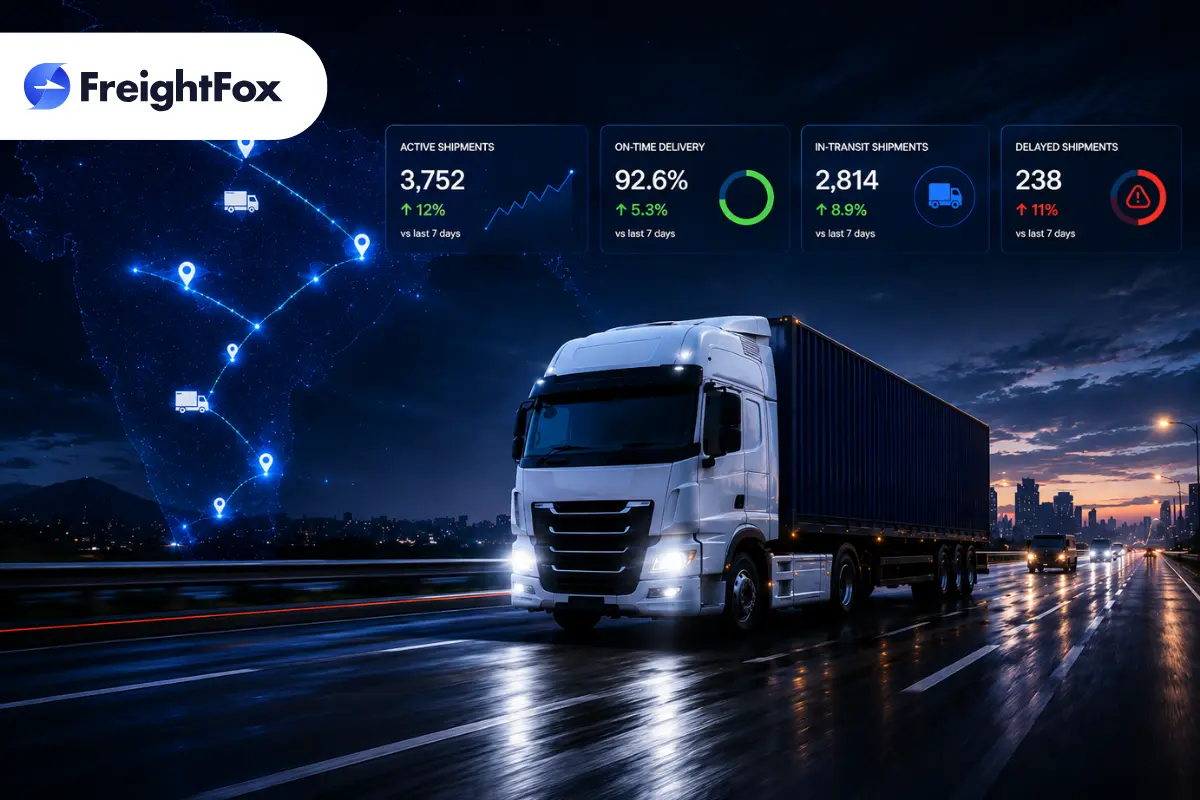
What happens when a critical shipment is delayed, but your team finds out only after the delivery window has already been missed? For enterprise shippers, the challenge is often not a lack of data, but the lack of a connected view of it.
Shipment updates can be scattered across transporter calls, emails, spreadsheets, ERP records, and tracking systems, making it difficult to identify delivery risks early, understand shipment status, or pinpoint where freight costs are leaking. As shipment volumes and transporter networks grow, these visibility gaps can quickly turn into higher costs, delayed deliveries, and reactive decision-making.
India's logistics ecosystem is rapidly becoming more digital and connected. As of August 2025, the Government of India's Unified Logistics Interface Platform (ULIP) had facilitated more than 160 crore digital transactions across over 30 digital systems, while the Logistics Data Bank had tracked more than 75 million EXIM containers across 101 Inland Container Depots, enabling greater visibility into cargo movement. This growing digital infrastructure is increasing demand for freight management software in India, as enterprise shippers look to turn that data into real-time visibility. For more on this shift, see How Digital Freight Management Is Transforming Supply Chains in India.
Businesses adopting a Transportation Management System (TMS) have reported logistics cost reductions of up to 20% and planning time improvements of up to 66% through automation and real-time visibility. This is why more businesses are turning to TMS software to manage day-to-day operations and gain stronger supply chain visibility.
If these challenges sound familiar, your business may have outgrown manual freight operations. In this guide, we'll cover what freight management software is, six ways it improves supply chain efficiency, what to look for when choosing one, and how to tell whether it's time to invest.
Key Takeaways
Freight management software - often called transportation management software, a freight management system, or a TMS - is a platform that centralizes and automates the freight lifecycle: procurement, execution, real-time tracking, invoice settlement, analytics, and emissions reporting, all in one system, in place of separate spreadsheets, inboxes, and phone logs.
It's not the same as an ERP. An ERP (like SAP or Oracle) runs a company's broader finance, inventory, and operations data, while a TMS is purpose-built for freight and typically integrates with your ERP rather than replacing it. For a full side-by-side comparison, see TMS vs ERP: What's the Difference?.
When transportation data is fragmented and processes rely heavily on manual intervention, the resulting inefficiencies directly affect freight costs, delivery performance, and the time teams spend managing exceptions. The hidden costs of manual freight management often include:
These hidden costs are exactly what freight management software is designed to remove. For growing enterprises, they don't stay isolated - they compound as operations expand. What starts as a manageable process eventually becomes a bottleneck for costs, service levels, and growth. For a lever-by-lever look at how this turns into savings, see Reduce Freight Costs with Transportation Management Software.
Freight management software brings procurement, execution, tracking, settlement, and analytics together, giving logistics teams a connected view of freight operations that directly supports supply chain efficiency. In practice, that improvement plays out through six concrete mechanisms:
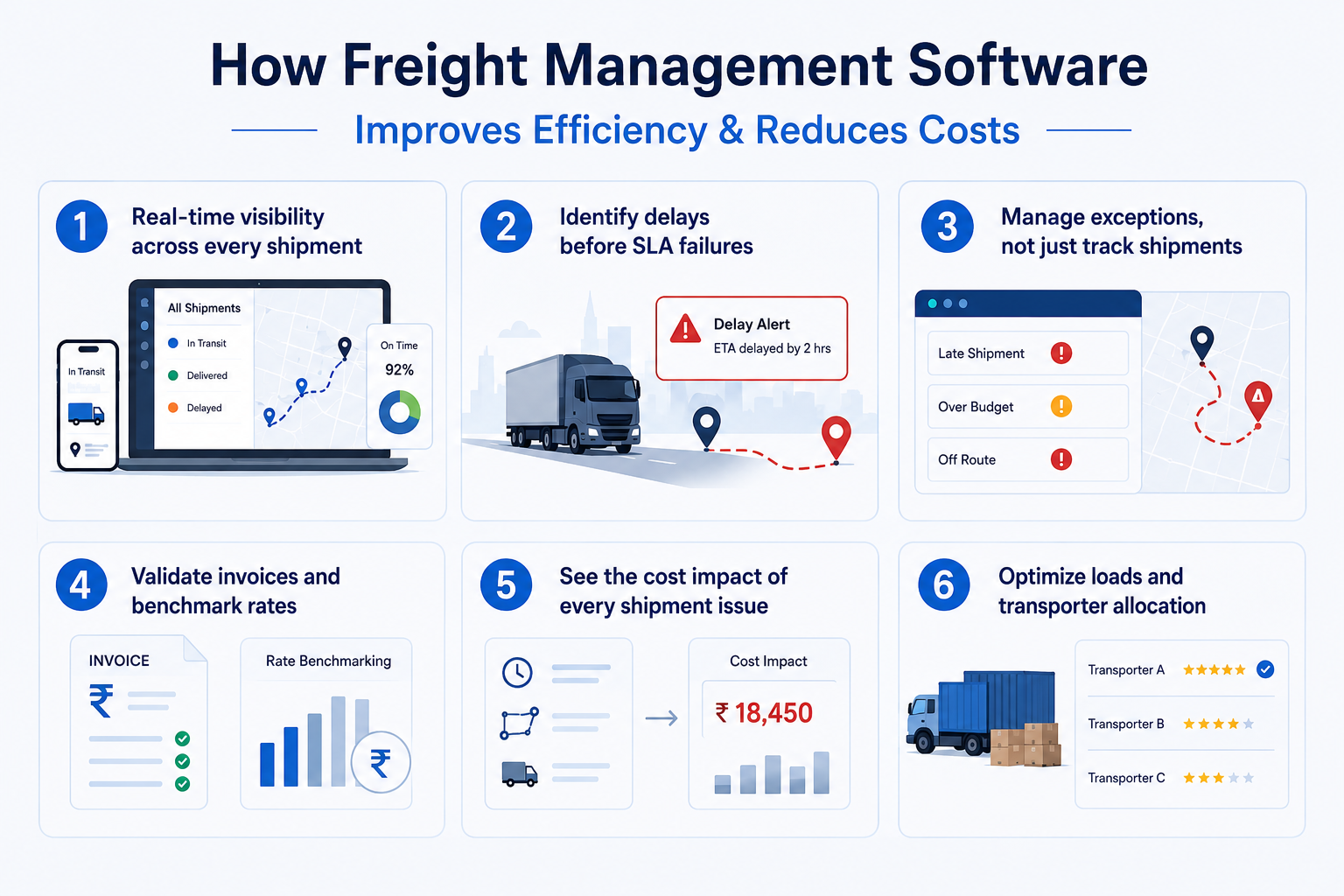
Instead of checking transporter calls, emails, and spreadsheets separately, teams get a single dashboard showing every shipment's status, location, and risk level in real time - across lanes and transporters.
Real-time tracking, automated alerts, and route optimization flag deviations and delays as they happen, giving teams a window to intervene before a delay turns into a missed delivery commitment.
Rather than monitoring every shipment as it moves through its lifecycle, dashboards surface only the shipments that need attention - the ones running late, over budget, or off-route - so teams spend their time on exceptions instead of routine status checks.
Automated invoice validation compares freight bills against contracted rates and executed loads, helping identify overbilling and duplicate charges, while rate benchmarking gives procurement teams market-based insight into which lanes and transporters perform reliably - and which don't.
Because execution data - what actually happened on a shipment - and cost data - invoices, rates, benchmarks - sit in the same system, teams can see the direct cost impact of delays, detours, or transporter issues instead of treating operations and finance as separate conversations.
Instead of booking each shipment in isolation, the system surfaces opportunities to consolidate partial loads, match shipments to the right vehicle type, and allocate transporters based on rate and performance data - cutting empty miles and per-shipment freight costs.
For a closer look at how the visibility piece works in practice, see our guide on supply chain control towers.
Not sure whether your operation has outgrown manual processes? Our guide on When Is It Time to Invest in Freight Management Software? lists the 10 signs to look for.
If you're evaluating freight management software, a few things are worth checking before you commit:
For a step-by-step approach, see How to Evaluate Transportation Management Software for Your Business, or use the TMS Evaluation Checklist.
Everything covered so far describes what goes wrong when freight runs on manual coordination - and what a freight management system fixes in principle. Here's what that actually looks like day-to-day if you're running your freight operations on FreightFox:
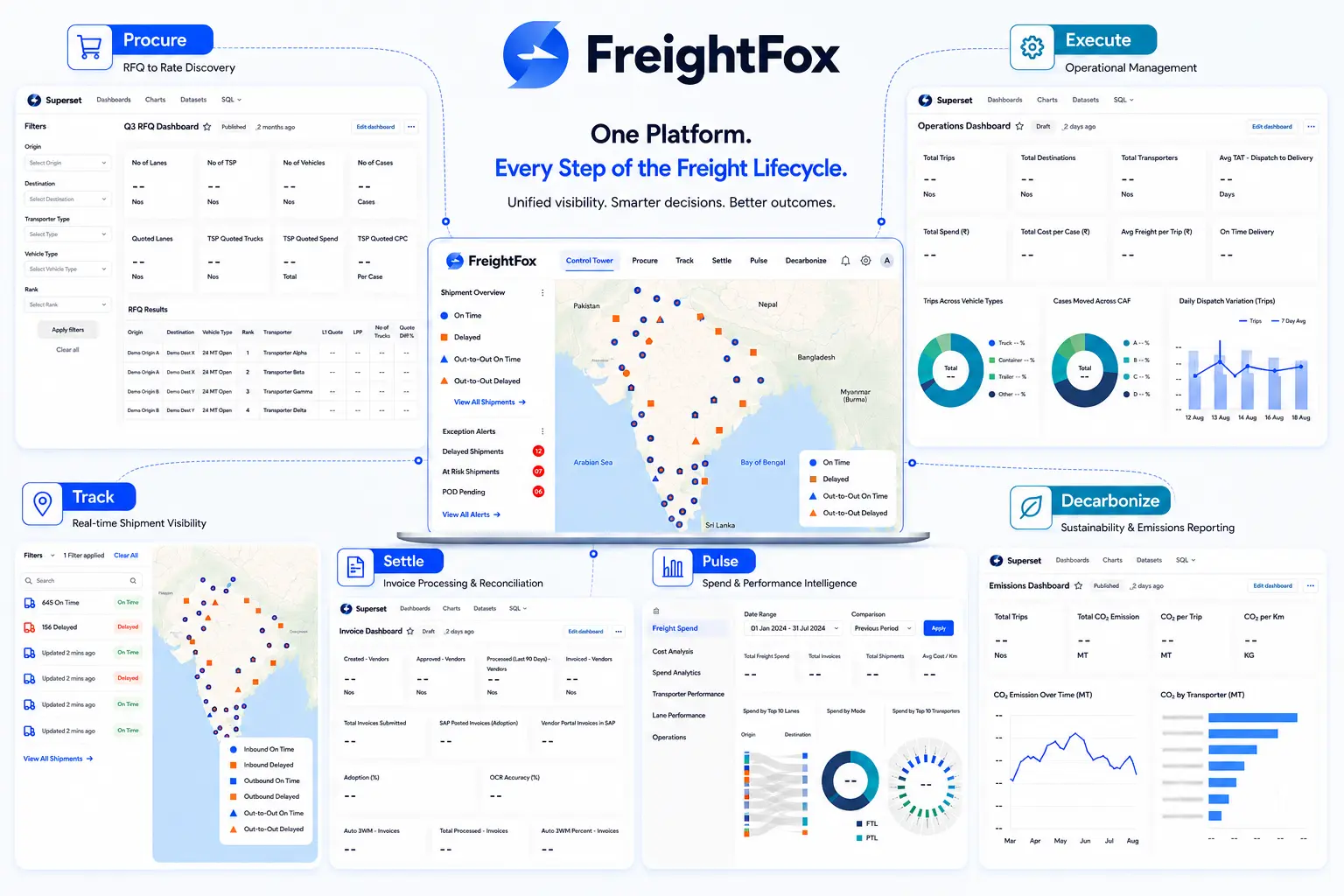
As freight networks become more complex, enterprises need greater control over costs, shipment visibility, and delivery performance. FreightFox gives enterprise shippers one platform for AI-powered procurement, real-time visibility, automated settlement, analytics, and Scope 3 tracking, across multiple plants.
Book a demo to see how FreightFox works for your freight operation.

See how leading enterprises are optimizing freight costs, performance, and emissions with FreightFox — all in one platform.
FreightFox is a full-stack TMS and Control Tower platform that helps enterprises streamline freight procurement, execution, visibility, settlement, and sustainability—from Procure-to-Pay