
Your truck is carrying a ₹2 crore shipment. The invoice is correct. The E-Way Bill is valid. Yet it spends four hours at a checkpoint because one field doesn't match, or the validity expired during transit.
That's what E-Way Bill compliance looks like in 2026. It's no longer just about generating the document. It's about keeping shipments moving despite changing rules, varying state thresholds, and tighter validity requirements.
The ground under this has kept shifting all year. GSTN first said a mandatory Ship-To GSTIN field and a new voluntary closure facility would go live June 15. Then it pushed that to August 1. Then, in late July, it pulled the August 1 date entirely and told businesses to hold off on acting on the earlier advisories altogether (Free Press Journal, July 30, 2026). Teams that had already started updating ERP workflows for the earlier date are now recalibrating.
It's a useful reminder that E-Way Bill compliance works best as something you monitor continuously, not a box checked once at dispatch.
Here's what this covers: where multi-state teams tend to get the ₹50,000 threshold and state-specific limits wrong, what the current validity and extension rules mean for a shipment running behind schedule, and how the E-Way Bill data you're already generating can double as a way to track where your consignments actually are.
And here's the part worth sitting with: the document sitting in your compliance folder is also one of the more reliable location signals your shipments have. It's a connection most teams haven't made yet. By the end of this, you will have.
When the E-Way Bill process sits entirely with finance or compliance, supply chain teams often hear about changes after they've already affected a shipment, a GSTIN error, a missed field, a validity window that closed, showing up as a detained truck or an unresolved delivery dispute.
It's worth looking at how much e-way bill rules have shifted in the past two years: extension windows tightened, authentication requirements changed and, as covered above, an entire rule got announced, delayed twice, then paused indefinitely. Each of these touched shipments somewhere in motion.
There's a practical upside to closing that gap. When supply chain has visibility into what's changing and why, a rule update becomes something the team can plan around instead of something they discover mid-transit. That's less about which department "owns" compliance and more about making sure the people closest to a moving shipment aren't the last to know what's changed.
That visibility gap, and what closes it, is what the next two sections get into.
For manufacturers running multi-plant, multi-state operations, E-Way Bill delays tend to come from a small, repeatable set of mistakes rather than one-off errors.
One pattern shows up often: applying a single state's threshold across the whole network. A plant in Maharashtra generates a bill at the ₹1,00,000 intrastate limit, while a shipment from a plant in a state that follows the ₹50,000 threshold gets handled the same way. The mismatch usually only surfaces at a checkpoint, by which point the shipment is already delayed.
Timing causes trouble too. The extension window is only 8 hours before or after expiry, and a delay that isn't noticed in time can mean that window closes unused. A related trap: an E-Way Bill can only be generated against an invoice dated within 180 days, so older, unbilled dispatches sitting in a queue can fall outside that window without anyone catching it until generation fails outright.
And in PTL shipments specifically, visibility tends to break down at the consignment level. When several E-Way Bills share a single truck, most systems can confirm the truck is moving without being able to say which specific consignment is delayed or whose validity is closing in.
What connects these isn't the paperwork, it's timing and visibility. Tightening the filing process doesn't fix a state-specific mismatch or a missed extension window. Knowing where a shipment is, does.
The interstate threshold is straightforward: any shipment worth more than ₹50,000 needs an E-Way Bill, flat, no state variation, under Rule 138 of the CGST Rules. Most teams get this part right.
Where it tends to get messier is intrastate. States set their own limits, and applying one state's rule across a multi-plant network is a common way teams end up either generating bills they didn't need to, or missing ones they did.
If your network spans a few of these states, the e-way bill limit that applies can change from one plant to the next.
Exemptions are worth the same attention. Certain goods categories, transport modes, and specific situations don't require a bill at all regardless of value, laid out under Rule 138(14). Knowing when e-way bill is required, and just as usefully, when e-way bill is not required, is what keeps a network from over-generating paperwork it doesn't need or under-generating what it does.
State-specific limits are set by individual state notifications, verifiable on the official E-Way Bill portal's Notifications page, filtered by state, since these do get revised.
E-Way Bill validity is distance-based, not time-based: roughly one day per 200 km for regular cargo, and one day per 20 km for over-dimensional or multimodal cargo, a rule that remains in force in 2026 under Rule 138(10) of the CGST Rules.
There's a related constraint worth knowing too: an E-Way Bill can only be generated for an invoice dated within 180 days of generation, a rule introduced under GSTN's advisory dated 17 December 2024, in effect since January 2025. Older, unbilled dispatches sitting in a queue can quietly fall outside this window without anyone noticing until generation fails.
Missing that window isn't just a paperwork inconvenience. A shipment moving without a valid E-Way Bill risks being held at the next checkpoint, with the delay and the dispute that follows landing on whoever has to explain it.
It's really the same issue as the state limit question in the previous section, just showing up at a different point in the shipment's life: e-way bill validity and extension work best when there's clear visibility into where a shipment actually is at any given moment. Which is exactly where this goes next.
Getting to that starts before tracking even begins. FreightFox pulls E-Way Bills automatically from GSTN using GSP credentials, no manual re-entry required, and links them to shipments one of three ways: through ERP API integration, GST E-Way Bill Sync, or One-Click Auto LR, where the E-Way Bill's own creation triggers the shipment record.
The FTL and PTL distinction matters here. In full truckload shipments, one E-Way Bill roughly corresponds to one truck, straightforward to track. In part truckload shipments, several E-Way Bills often share a single truck, and most tracking systems can't resolve visibility down to the individual consignment. A shipment can be technically "on a tracked truck" while still being functionally invisible on its own.
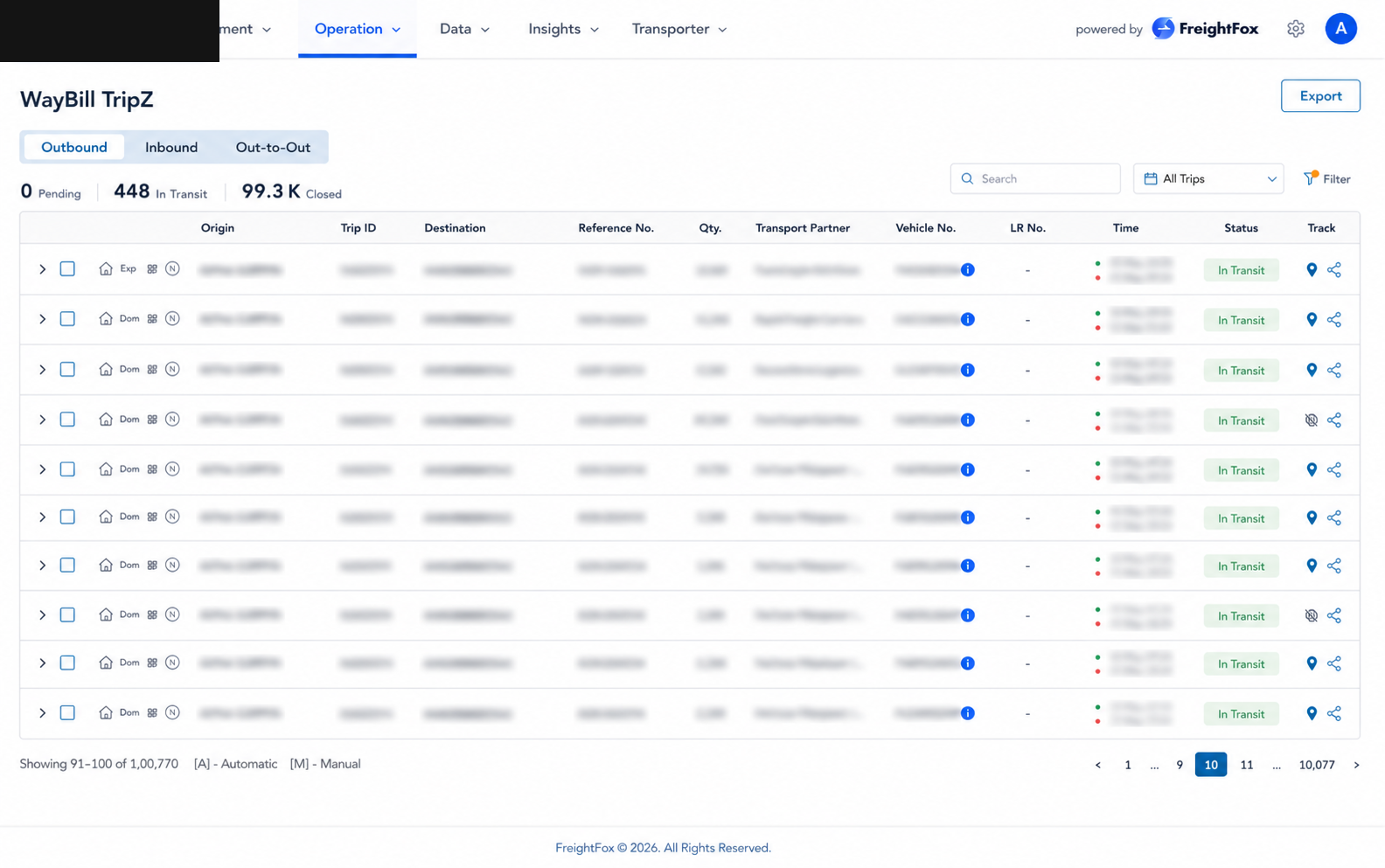
FreightFox classifies trips by matching GSTIN and PIN code against your mapped warehouses: if the destination matches, the trip is tagged Inbound; if the origin matches, it's Outbound; if only one side matches, it's Out-to-Out. Multiple E-Way Bills sharing the same vehicle, transporter, and shipment type get grouped into a single trackable consignment using an advanced machine learning consolidation model, which is what makes PTL-level visibility possible in the first place, not just FTL. The consolidation model ensures that there is no noise (having to track multiple invoices separately moving in the same shipment).
Here's what that classification looks like inside FreightFox's Control Tower, each trip automatically tagged as it comes in:
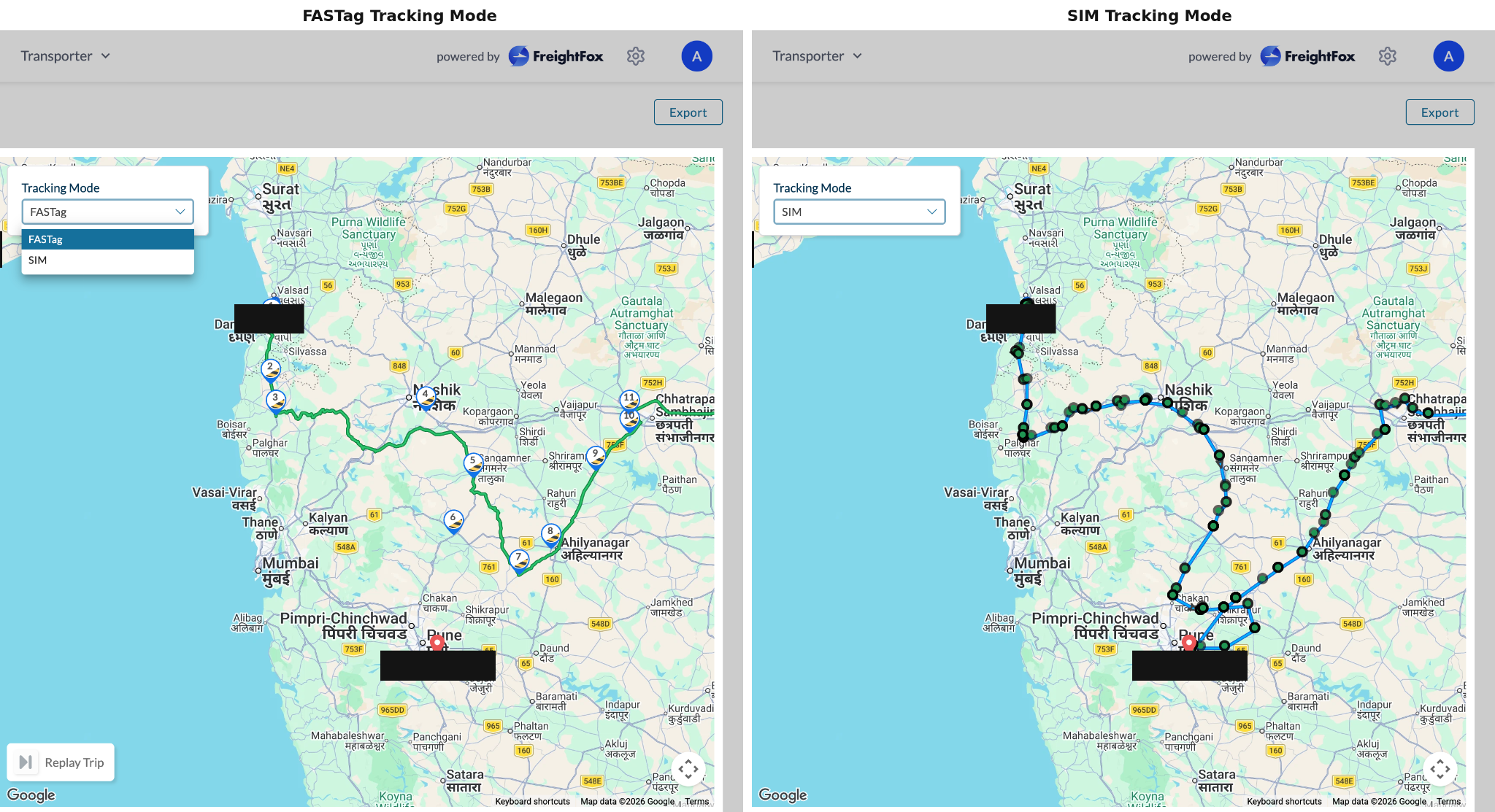
Here's the same trip tracked both ways, FASTag on the left, SIM on the right:
Atul Limited, a specialty chemicals manufacturer running four plants and over 1,000 origin-destination pairs, moved to real-time tracking as part of a broader shift onto the platform, including a wider transporter pool built through digital auctions and RFQs. Together, these changes brought 3 to 5% better freight rates. In their own words: "There used to be a dispute between the customer, or our own depots, versus our own logistics team. Now, on a real-time basis, that information is available." That's the practical difference between having the E-Way Bill and actually using it.
See where your consignments are right now →
None of this is really about paperwork. The ₹50,000 threshold, the state-specific limits, the validity window, the extension rules, they all come back to the same thing: knowing where a shipment actually is at any given point. Get that right, and the compliance side gets a lot easier to manage. Get it wrong, and even a correctly filed E-Way Bill won't stop a truck from getting held or a delivery dispute from dragging on.
2026 has made that harder to ignore. Rules have moved twice this year alone, and the Ship-To GSTIN reversal is a reminder that "compliant today" doesn't mean "compliant next quarter." The teams handling this well aren't the ones with the most airtight filing process, they're the ones who've connected E-Way Bill data to actual shipment visibility, so a rule change or a delayed truck is something they see coming, not something they find out about after the fact.
FreightFox is a full-stack TMS and Control Tower platform that helps enterprises streamline freight procurement, execution, visibility, settlement, and sustainability—from Procure-to-Pay