

If you've ever tried to coordinate freight across multiple carriers, modes, and destinations using spreadsheets, phone calls, and email threads, you already know the problem a Transportation Management System is built to solve. As shipment volumes grow and customer expectations around speed and visibility rise, manually managing transportation quickly turns into a bottleneck - one that eats into margins and slows down decision-making.
This blog breaks down what a Transportation Management System (TMS) actually is, the processes it manages, how it works behind the scenes, and why more supply chain and logistics teams are adopting one as a core part of their technology stack.
A Transportation Management System, or TMS, is a software platform that helps businesses plan, execute, and optimize the physical movement of goods - both inbound and outbound - across various modes of transportation. In simple terms, the TMS meaning centers on one core idea: giving shippers, carriers, and logistics teams a single, centralized system to manage the entire freight lifecycle instead of juggling disconnected tools and manual processes.
A TMS typically sits between a company's Enterprise Resource Planning (ERP) or Order Management System (OMS) and the actual execution of freight movement. It acts as the connective layer that turns an order into a planned, booked, and tracked shipment.
Whether a business ships full truckloads, less-than-truckload (LTL) freight, parcels, ocean containers, or air cargo, a Transportation Management System Software solution is designed to bring structure, automation, and data-driven decision-making to what is otherwise a highly fragmented and manual function.
A TMS isn't a single-purpose tool - it's built to manage transportation across four broad stages: planning, procurement, execution and payment. Understanding this scope helps clarify why a TMS is considered foundational logistics technology rather than a point solution.
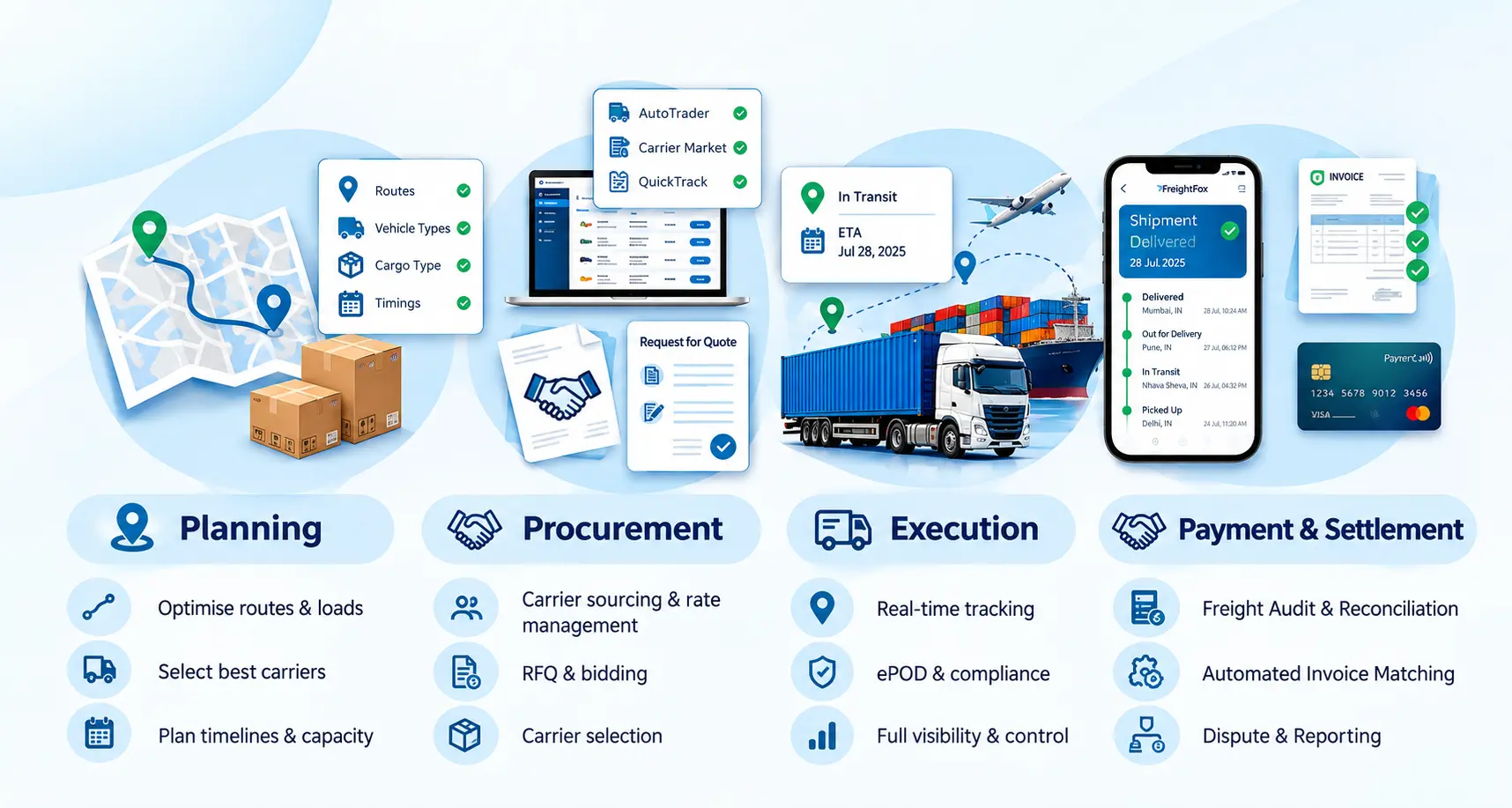
This is where the TMS helps determine the how of a shipment: which mode to use, which route to take, how to consolidate loads, and how to sequence deliveries. Planning functionality typically includes:
Once a plan is in place, the TMS supports sourcing the right carrier at the right price. This is where freight procurement software capabilities come into play, including:
This is the operational stage where the plan is put into motion. Execution capabilities generally include:
Once freight has moved, the TMS closes the loop financially. This stage ensures that what was planned, tendered, and delivered is accurately billed and paid for. Payment capabilities generally include:
Together, these four stages form the operational backbone of transportation planning software - and they set up the next question: how does all of this actually function day to day?
At a mechanical level, a TMS works by connecting data, decisions, and execution into a repeatable workflow. Here's a step-by-step look at how a shipment typically flows through the system:
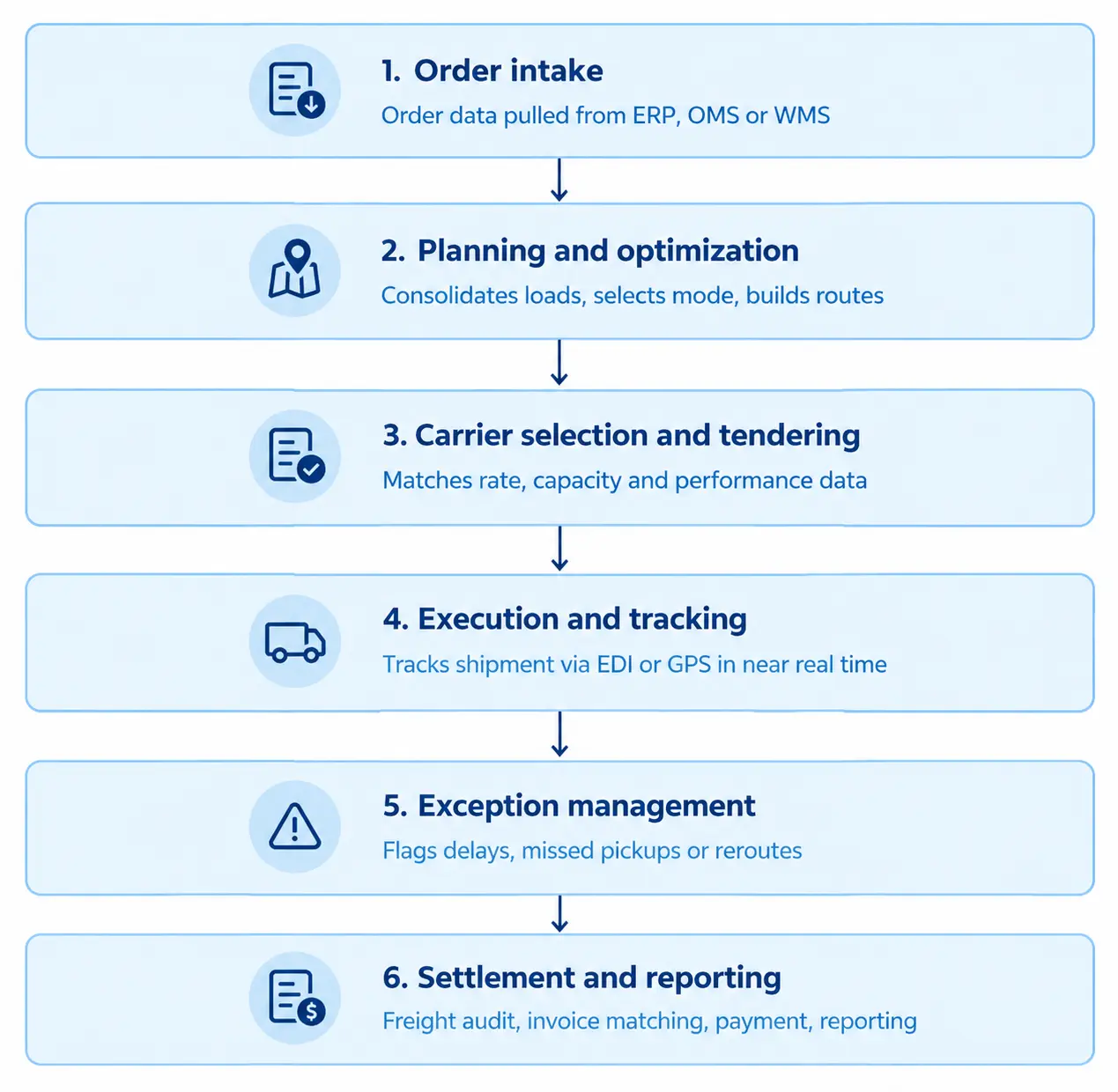
This entire flow, from order to delivery to reconciliation, happens within one connected environment rather than across a patchwork of spreadsheets, emails, and standalone tools - which is precisely what makes the difference in visibility and decision speed.
Beyond the operational steps above, one of the most significant advantages of a TMS is what it does with data. Every planning decision, carrier interaction, and shipment event generates data - and a TMS centralizes it in a way that's usable rather than scattered.
This is where the idea of a supply chain control tower comes in — a unified view where teams can see shipment status, carrier performance, costs, and exceptions across the entire network, rather than checking multiple systems or waiting on updates from partners. It's this centralized visibility that becomes the foundation for faster, better-informed decision-making.
With this level of visibility, a TMS enables businesses to:
In short, a TMS doesn't just move freight - it turns transportation activity into a continuous stream of decision-ready data.
The transportation management system benefits extend across cost, service, and scalability. While the specific impact varies by business size and shipping complexity, common benefits include:
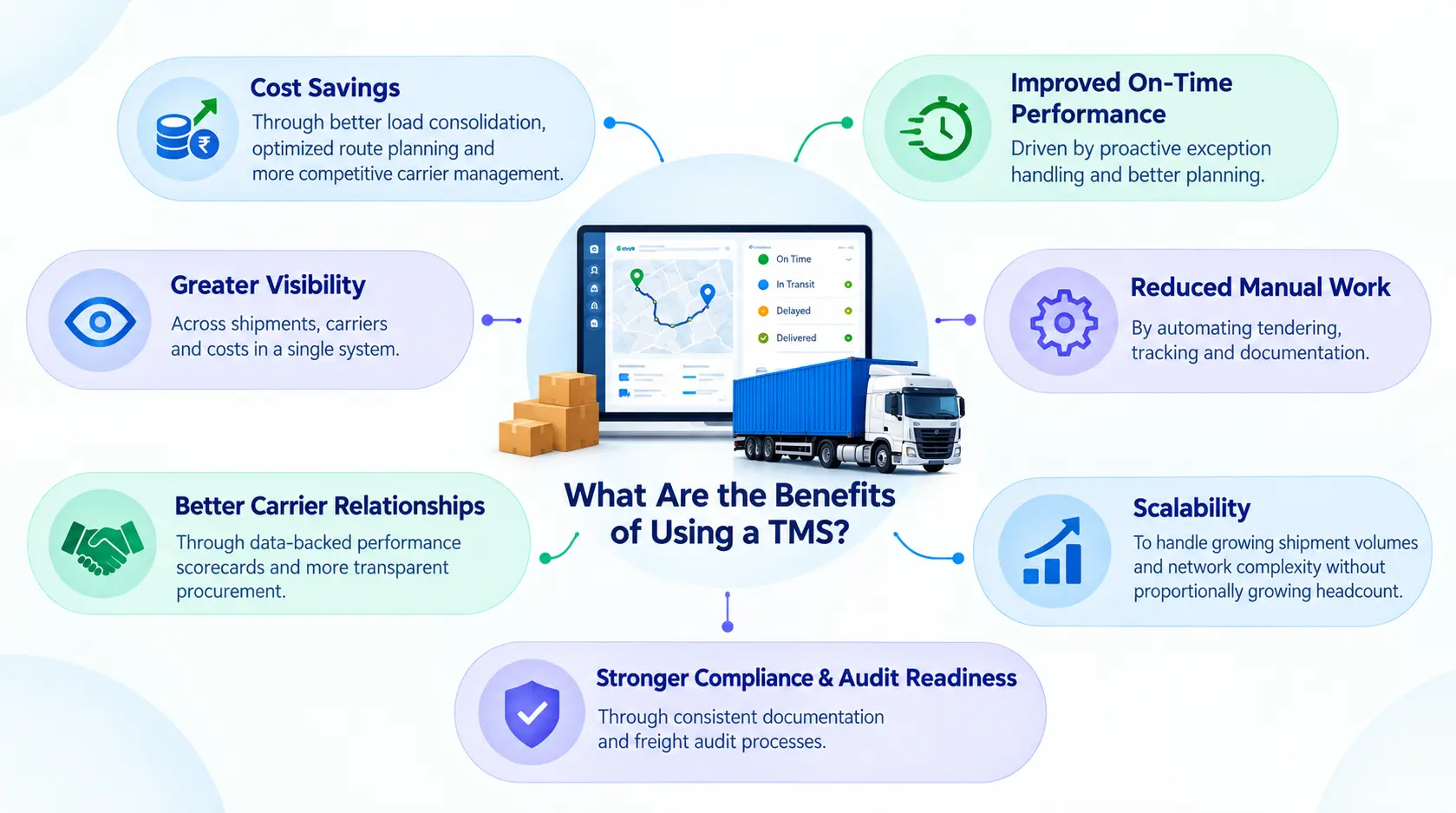
These benefits compound over time - a business that starts using a TMS primarily to save on freight cost often finds that the visibility and data it gains become just as valuable.
Not every business needs a TMS on day one, but there are common signals that indicate it's time to consider one:
If several of these sound familiar, it's usually a sign that transportation has outgrown manual management - and that a TMS, or broader freight management software. could bring the structure and visibility needed to support the next stage of growth.
A Transportation Management System brings structure, automation, and data visibility to a function that's traditionally been managed through manual, disconnected processes. From planning and procurement to execution and reporting, a TMS gives businesses the tools to move freight more efficiently, control costs, and make faster, better-informed decisions as their logistics operations scale.
If your team is ready to see how a modern Transportation Management System Software platform could bring these capabilities to your operations, Book a Demo with our team to explore what a TMS can look like for your business.
FreightFox is a full-stack TMS and Control Tower platform that helps enterprises streamline freight procurement, execution, visibility, settlement, and sustainability—from Procure-to-Pay