
FreightFox Research · April 2025 · FY2016 to FY2025 data · Source: Screener.in
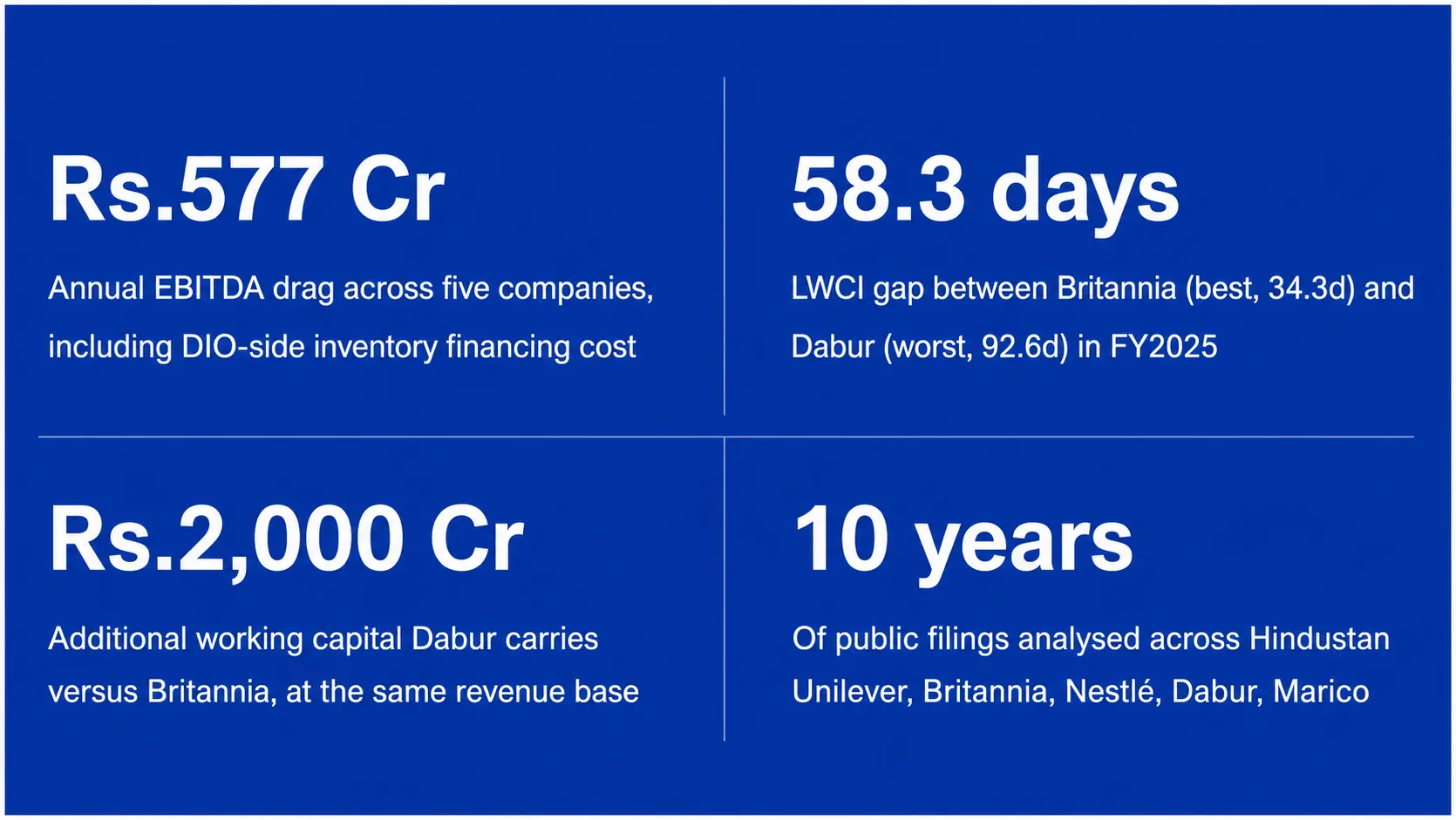
India's five largest listed FMCG companies are collectively losing Rs.577 crore of EBITDA every year to logistics inefficiency. Not one rupee of it shows up on a freight invoice. All of it is sitting in their balance sheets, hiding in plain sight.
Start with a question that most supply chain teams in FMCG never ask: how much does it cost you when your trucks arrive three days late, on average, instead of on time? Not the freight rate. Not the carrier penalty. The working capital cost. The money tied up in inventory that should have moved, or in invoices that could not be raised because the goods had not been confirmed as delivered. Most finance teams look at DSO as a credit problem. Most logistics teams look at DIO as a procurement problem. Almost nobody looks at them together as a logistics problem. That is the gap this analysis tries to close.
We spent several weeks running a decade of public financial filings from India's five largest listed FMCG companies through a model we call LADD, short for Logistics-Adjusted DSO Decomposition. The framework extracts a signal from balance sheet data that was never designed to carry it. What comes out is a direct estimate of how much EBITDA is being consumed by logistics inefficiency every year, broken down by company and by cause.
The short answer is Rs.577 crore across five companies. But the more useful answer is in the breakdown, because each company's number comes from a different place, and each requires a different response.
"Every supply chain conversation eventually gets to the rate card. The balance sheet is telling a much more expensive story, and most people are not reading it." — FreightFox Research, April 2025
Before the numbers, two definitions. We use these terms specifically to avoid confusion with standard finance metrics that mean something slightly different.
LWCI, or Logistics Working Capital Index, is DSO plus DIO — Days Sales Outstanding plus Days Inventory Outstanding. It deliberately leaves out DPO, which the standard Cash Conversion Cycle formula subtracts. This is not laziness. DPO is how long you take to pay your suppliers, and that number is driven by commercial negotiation and payment terms, neither of which you can improve by buying better logistics software or tracking your trucks more carefully. LWCI measures only what logistics can actually move: how fast inventory travels through your RM-to-FG pipeline, and how quickly you turn a delivered shipment into a collected invoice. When LWCI rises, your supply chain is getting slower. When it falls, it is getting faster. That is the metric we track across the decade.
LADSI, or Logistics-Adjusted DSO Inflation, is what the LADD model produces. It is the number of days by which logistics inefficiency is inflating your DSO above where it should be. Your structural DSO, for an FMCG company, is around 28 days — that reflects what your payment terms actually say, weighted by your customer mix. If your actual DSO is 42 days, the question the model asks is: how much of that 14-day gap is because your collectors are slow, and how much is because your trucks are late and your invoices are not getting raised? LADSI is the second number. For Marico in FY2025, it is 7.0 days. For Hindustan Unilever, it is zero, because their DSO is still below the structural baseline. That zero is not a sign of health, as we will come to.
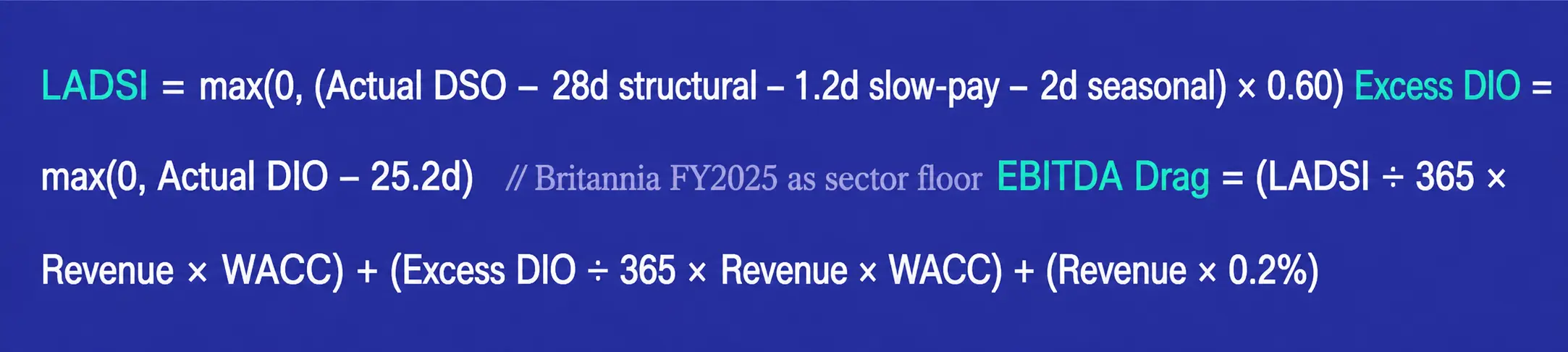
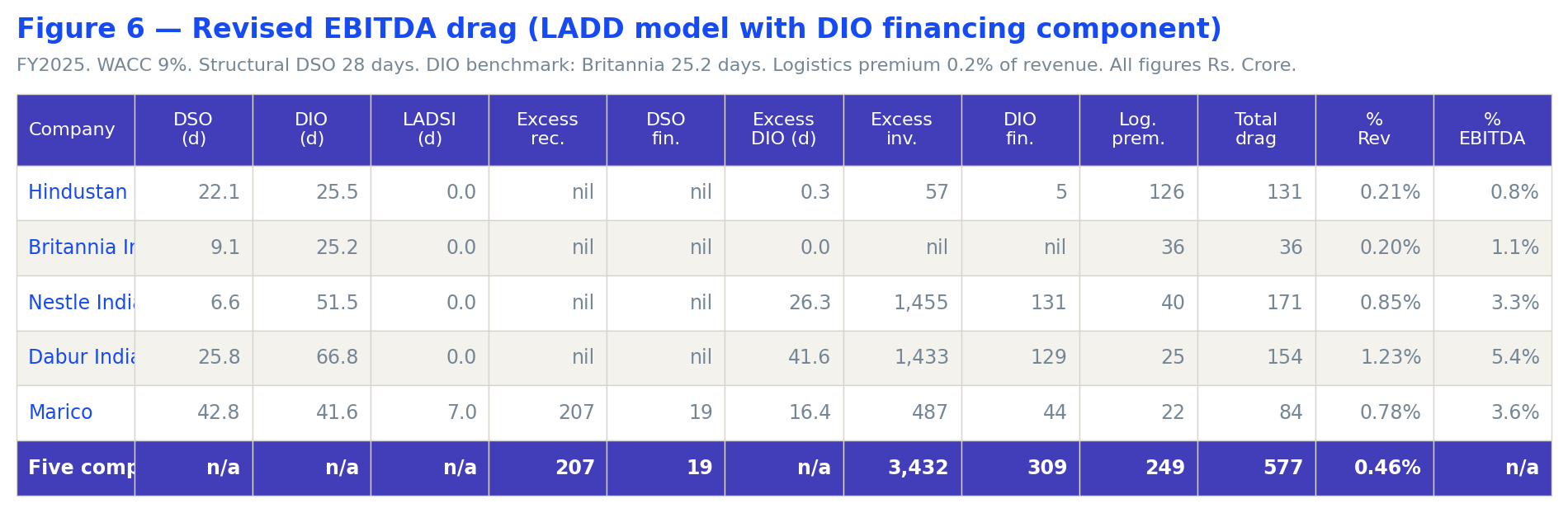
The model has three cost components. First, the receivable financing cost from LADSI: excess DSO days multiplied by daily revenue multiplied by the cost of capital. Second, the inventory financing cost from excess DIO: how many more inventory days you carry relative to Britannia, the sector's most efficient operator, costed at WACC. Third, the logistics cost premium: an estimate of operational overspend on air freight escalations and last-minute bookings, set at 0.2% of revenue for FMCG based on industry norms. The earlier version of this analysis, published with only the first and third components, produced Rs.269 crore. Adding the DIO-side inventory financing cost raises the total to Rs.577 crore.
The FY2025 LWCI range across the cohort runs from 34.3 days at Britannia to 92.6 days at Dabur. Fifty-eight days of difference, in the same industry, selling through broadly similar trade channels, operating in the same country with the same road network and the same carrier ecosystem. That gap is not explained by product complexity or market geography. It is explained by how visible and how disciplined each supply chain is.
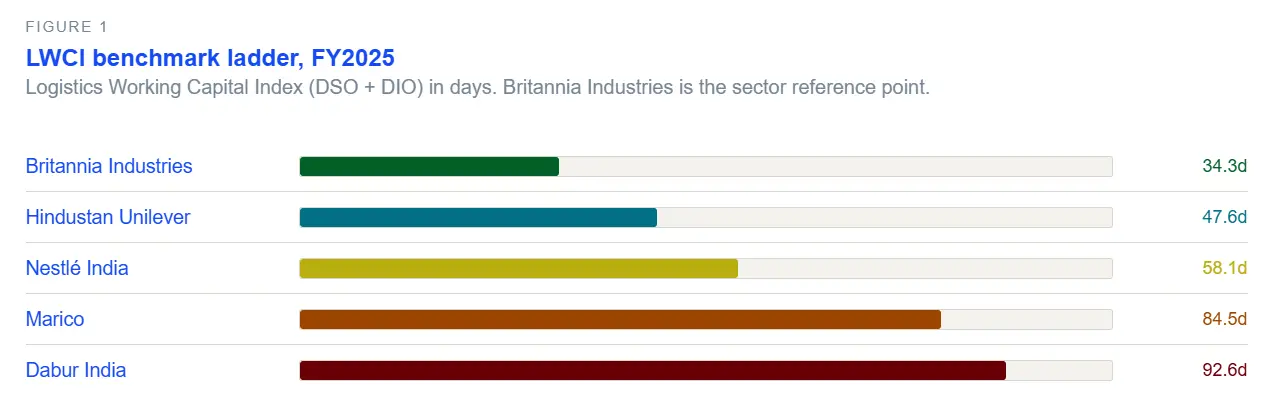
Here is where each company stands in FY2025:
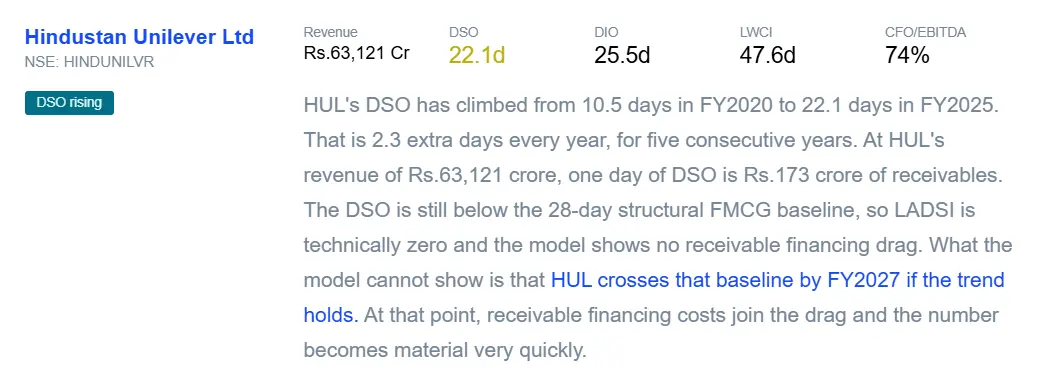
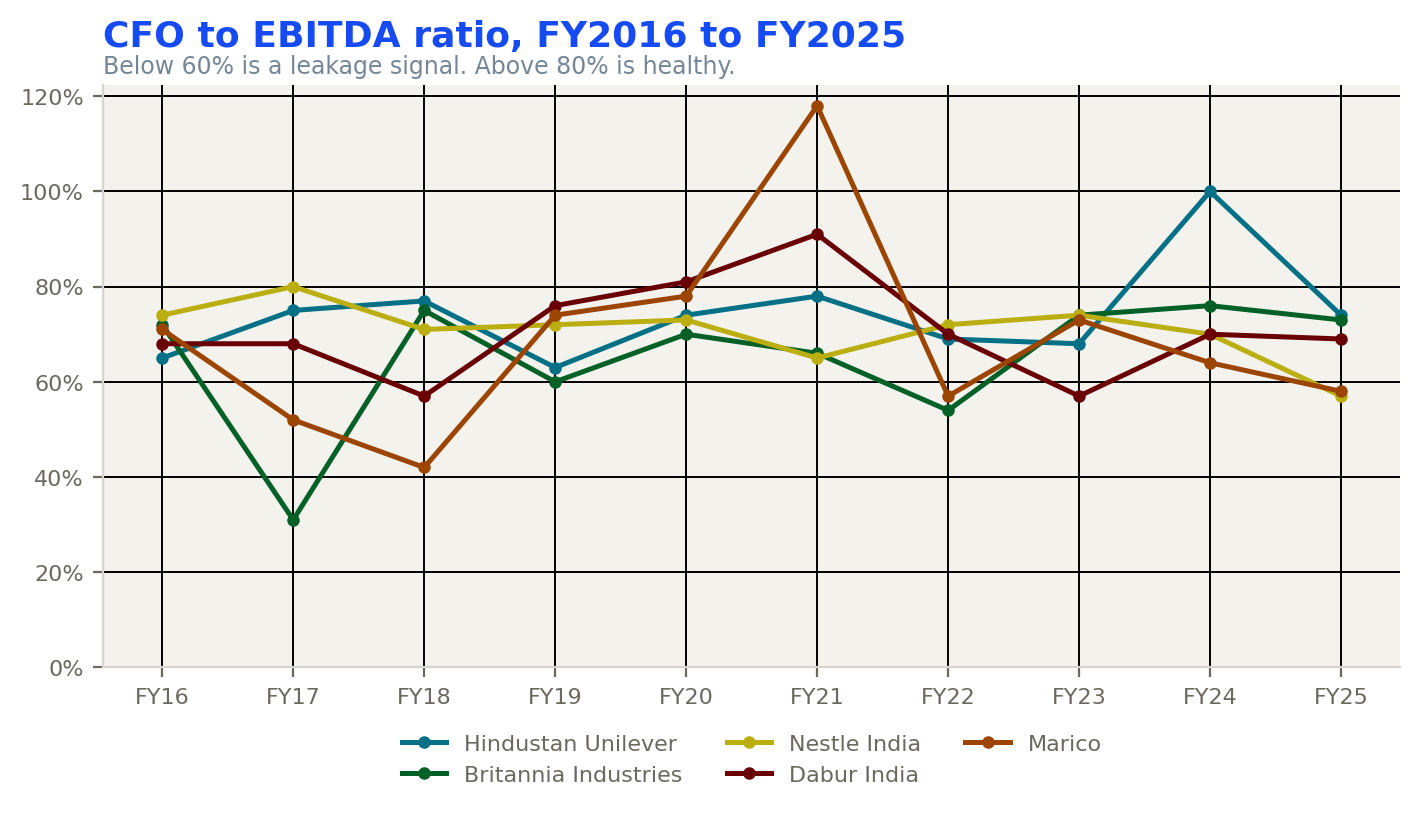
Hindustan Unilever (Revenue Rs.63,121 Cr, DSO 22.1d, DIO 25.5d, LWCI 47.6d, CFO/EBITDA 74%). HUL's DSO has climbed from 10.5 days in FY2020 to 22.1 days in FY2025 — that is 2.3 extra days every year, for five consecutive years. At HUL's revenue, one day of DSO is Rs.173 crore of receivables. The DSO is still below the 28-day structural FMCG baseline, so LADSI is technically zero and the model shows no receivable financing drag. What the model cannot show is that HUL crosses that baseline by FY2027 if the trend holds. At that point, receivable financing costs join the drag and the number becomes material very quickly.
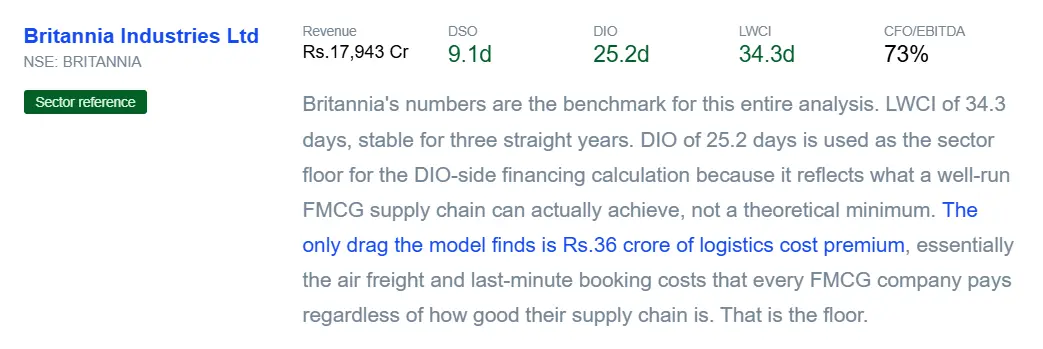
Britannia Industries (Revenue Rs.17,943 Cr, DSO 9.1d, DIO 25.2d, LWCI 34.3d, CFO/EBITDA 73%). Britannia's numbers are the benchmark for this entire analysis. LWCI of 34.3 days, stable for three straight years. Its DIO of 25.2 days is used as the sector floor for the DIO-side financing calculation because it reflects what a well-run FMCG supply chain can actually achieve, not a theoretical minimum. The only drag the model finds is Rs.36 crore of logistics cost premium — essentially the air freight and last-minute booking costs that every FMCG company pays regardless of how good their supply chain is. That is the floor.
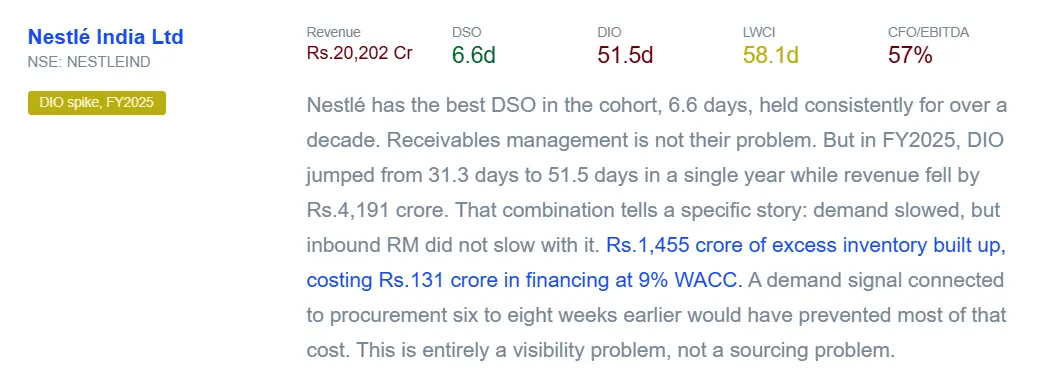
Nestle India (Revenue Rs.20,202 Cr, DSO 6.6d, DIO 51.5d, LWCI 58.1d, CFO/EBITDA 57%). Nestlé has the best DSO in the cohort, 6.6 days, held consistently for over a decade. Receivables management is not their problem. But in FY2025, DIO jumped from 31.3 days to 51.5 days in a single year while revenue fell by Rs.4,191 crore. That combination tells a specific story: demand slowed, but inbound RM did not slow with it. Rs.1,455 crore of excess inventory built up, costing Rs.131 crore in financing at 9% WACC. A demand signal connected to procurement six to eight weeks earlier would have prevented most of that cost. This is entirely a visibility problem, not a sourcing problem.
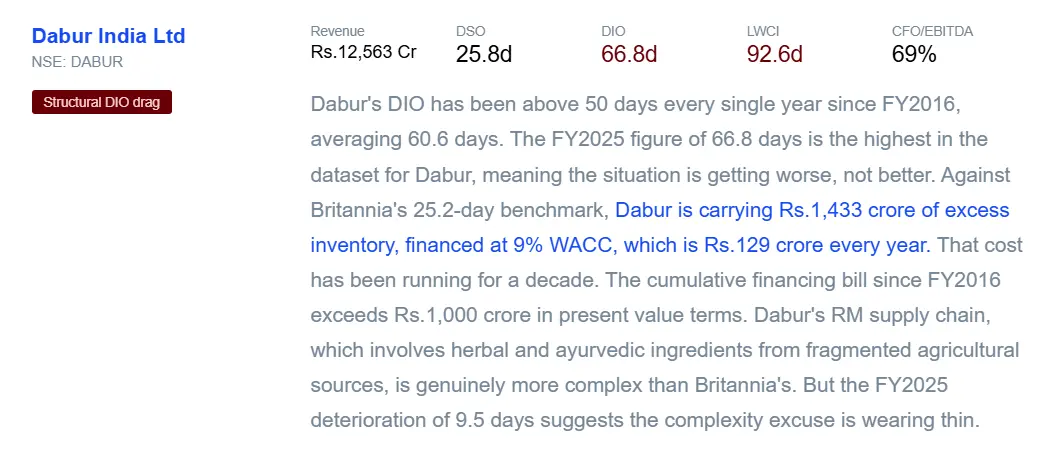
Dabur India (Revenue Rs.12,563 Cr, DSO 25.8d, DIO 66.8d, LWCI 92.6d, CFO/EBITDA 69%). Dabur's DIO has been above 50 days every single year since FY2016, averaging 60.6 days. The FY2025 figure of 66.8 days is the highest in the dataset for Dabur, meaning the situation is getting worse, not better. Against Britannia's 25.2-day benchmark, Dabur is carrying Rs.1,433 crore of excess inventory, financed at 9% WACC, which is Rs.129 crore every year. That cost has been running for a decade, and the cumulative financing bill since FY2016 exceeds Rs.1,000 crore in present value terms. Dabur's RM supply chain, which involves herbal and ayurvedic ingredients from fragmented agricultural sources, is genuinely more complex than Britannia's. But the FY2025 deterioration of 9.5 days suggests the complexity excuse is wearing thin.
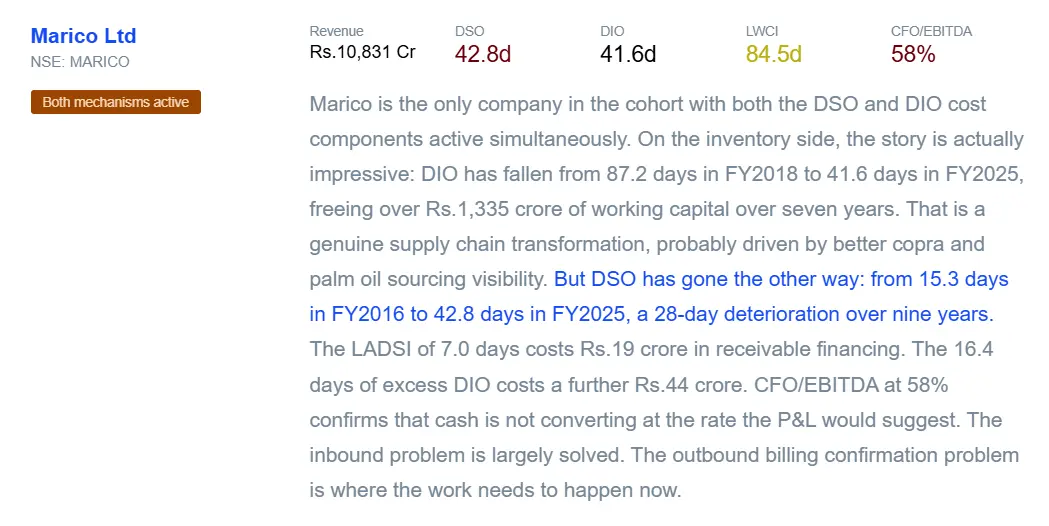
Marico (Revenue Rs.10,831 Cr, DSO 42.8d, DIO 41.6d, LWCI 84.5d, CFO/EBITDA 58%). Marico is the only company in the cohort with both the DSO and DIO cost components active simultaneously. On the inventory side, the story is actually impressive: DIO has fallen from 87.2 days in FY2018 to 41.6 days in FY2025, freeing over Rs.1,335 crore of working capital over seven years. That is a genuine supply chain transformation, probably driven by better copra and palm oil sourcing visibility. But DSO has gone the other way: from 15.3 days in FY2016 to 42.8 days in FY2025, a 28-day deterioration over nine years. The LADSI of 7.0 days costs Rs.19 crore in receivable financing. The 16.4 days of excess DIO costs a further Rs.44 crore. CFO/EBITDA at 58% confirms that cash is not converting at the rate the P&L would suggest. The inbound problem is largely solved. The outbound billing confirmation problem is where the work needs to happen now.
Looking at a single year's numbers is almost always misleading in logistics analysis. FY2022 was a commodity disruption year that inflated DIO across the sector. FY2020 saw HUL achieve its best-ever DSO of 10.5 days, probably driven by channel dynamics rather than operational improvement. FY2024 gave Nestlé a DIO of 31.3 days, the best in their decade, before FY2025 reversed it dramatically. The trends matter more than any individual year, and three of those trends deserve particular attention.
The first trend is Marico's DIO trajectory. From 87.2 days in FY2018 to 41.6 days in FY2025 is a 45-day compression over seven years. That is remarkable. It demonstrates beyond any doubt that the 50-plus-day DIO that Dabur has been running for a decade is not an industry inevitability. It is a management choice, or the absence of one.
The second is HUL's DSO trend: 10.5 days in FY2020, 22.1 days in FY2025, with no clear year of reversal. This is a slow deterioration that has probably not triggered serious internal review because the absolute number still looks fine. The structural FMCG baseline is 28 days, and HUL is still below it. But the direction is unambiguous and the pace is steady. At 2.3 additional days per year, HUL has three years before this becomes a receivable financing cost problem at scale.
The third is Nestlé's FY2025 DIO spike. Going from 31.3 days to 51.5 days in a single financial year, alongside a 17% revenue decline, is a supply chain that did not see what was coming. The inbound RM pipeline was not connected to the demand signal. That is a solvable problem, but it requires Layer 1 visibility, which most Indian FMCG companies do not yet have in any systematic way.
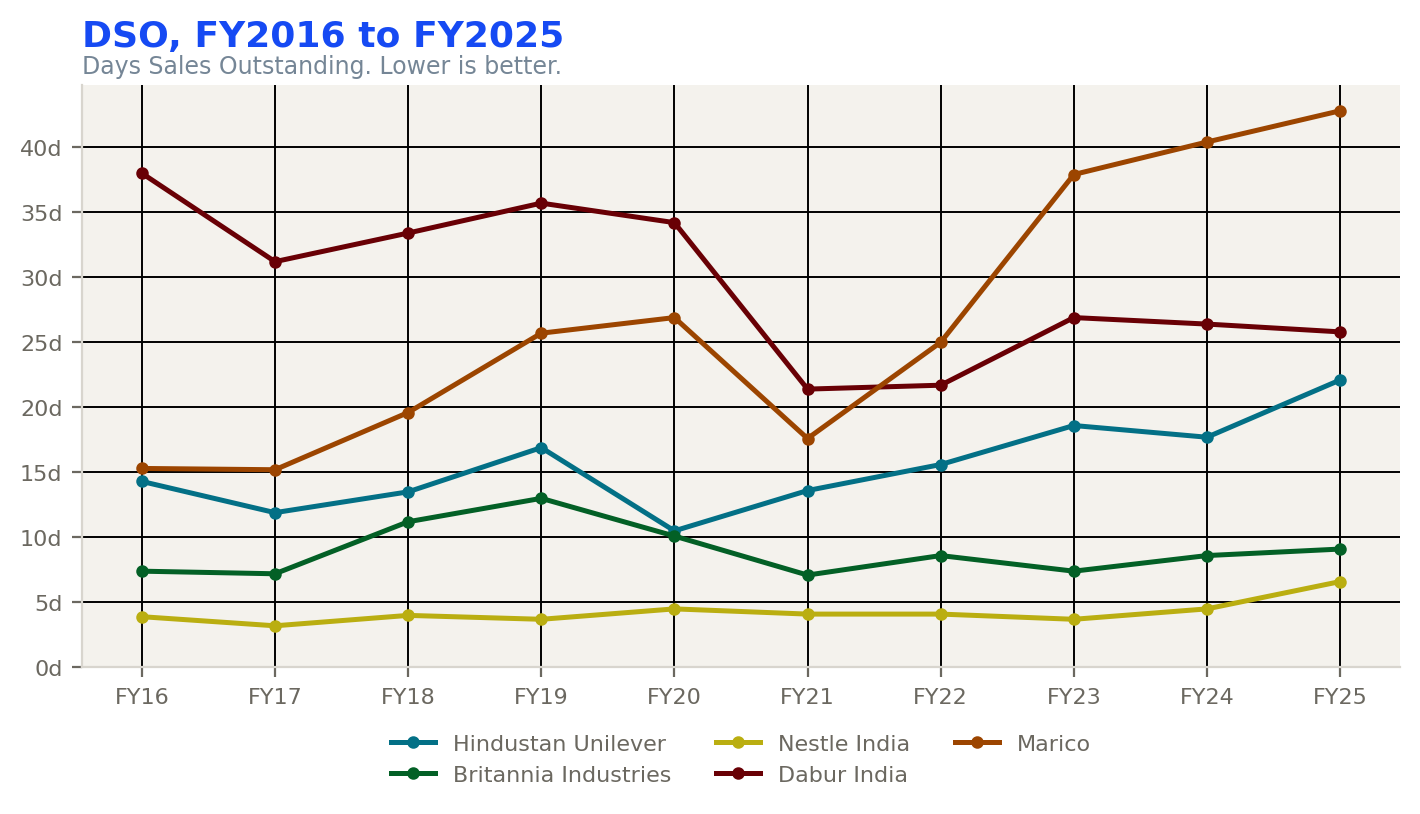
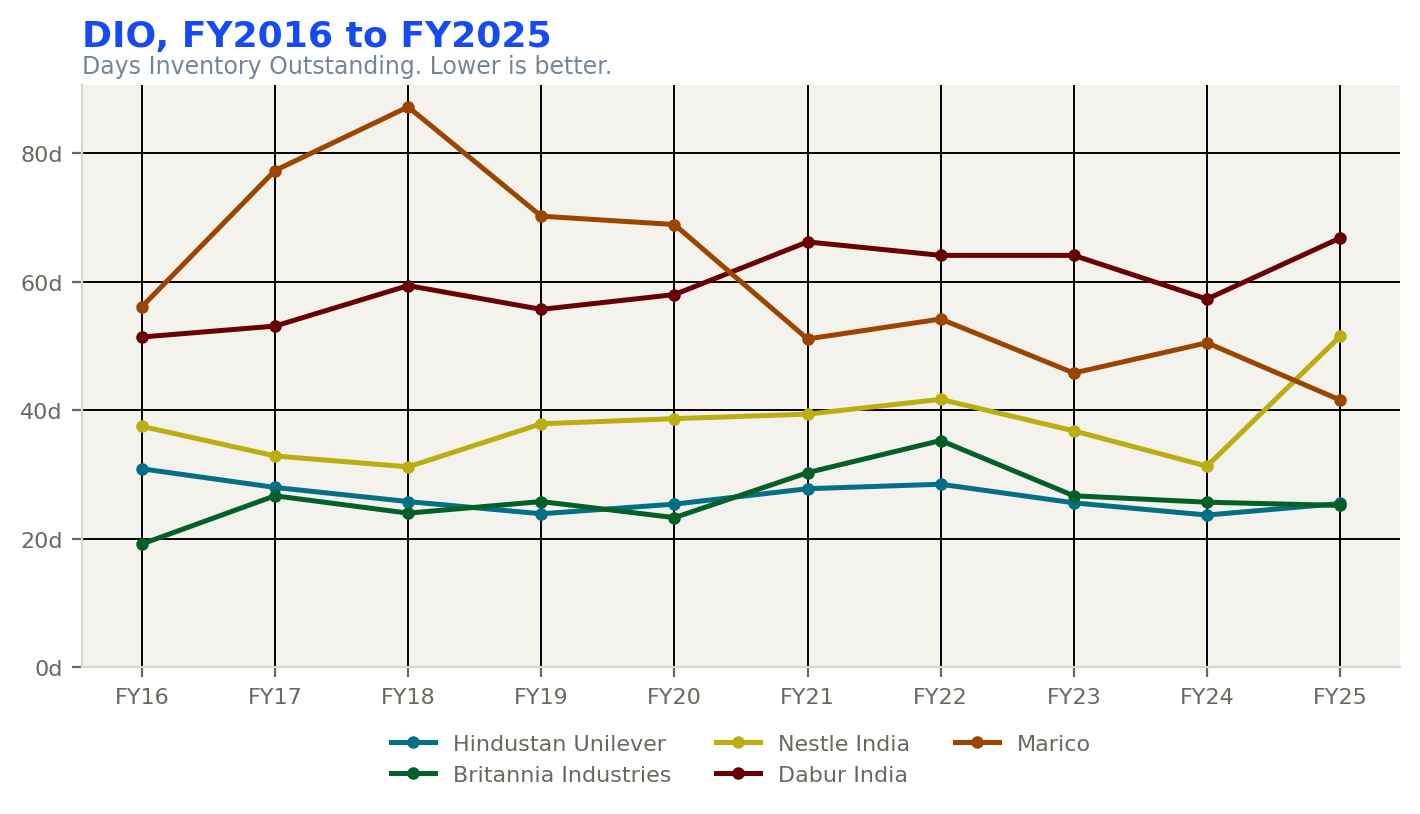
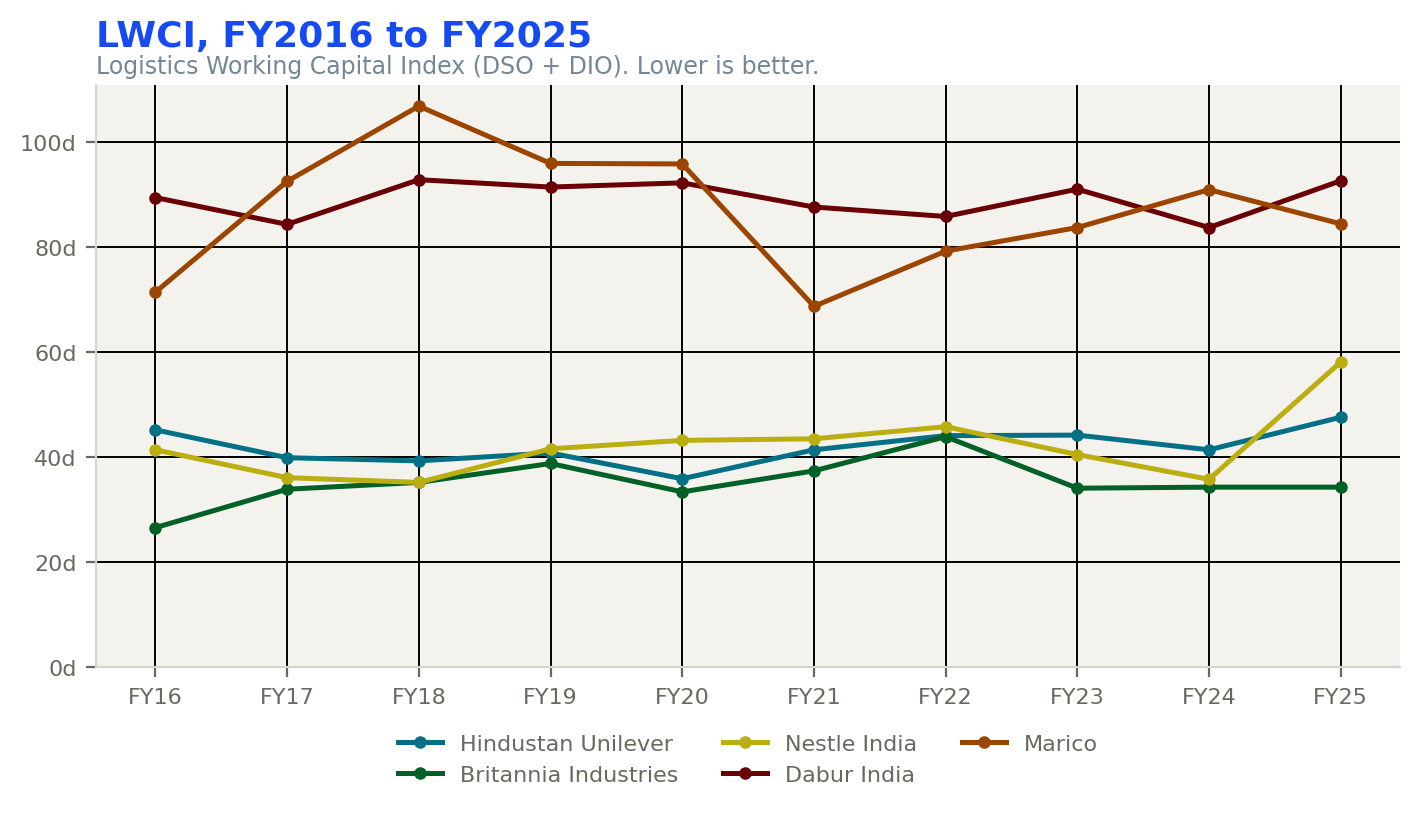
The Marico proof point: Marico reduced DIO by 45 days between FY2018 and FY2025. At FY2025 revenue of Rs.10,831 crore, that represents Rs.1,335 crore of working capital freed and roughly Rs.120 crore of annual financing cost removed from the P&L. It also removes the argument that high DIO in FMCG is structural. It is not. Dabur's 66.8-day DIO is a choice, not a constraint.
The table below is the corrected version of an analysis we published earlier that had a significant gap. The earlier model included the DSO-side receivable financing cost and the logistics cost premium, but left out the DIO-side inventory financing cost. That omission meant companies with large DIO problems but below-average DSO — specifically Nestlé and Dabur — appeared to have modest drag figures. The revised model adds the cost of carrying excess inventory above the Britannia benchmark, financed at 9% WACC. That addition changes the picture substantially.
Dabur in context: The Rs.129 crore annual DIO financing cost at Dabur has been running since at least FY2016. Discounted at 9%, the net present value of that unaddressed problem over ten years is approximately Rs.830 crore — likely larger than Dabur's entire annual spend on logistics and distribution. The cost of not fixing the supply chain has exceeded the cost of fixing it by a significant margin.
The matrix below plots LWCI trajectory, specifically the 3-year direction of travel, against EBITDA drag intensity. The combination determines not just the priority of intervention but the type. A company in urgent territory needs operational action within weeks. A company in early warning territory needs to build the infrastructure that prevents it from getting there.
The pushback we hear most often from finance teams is that DIO is a procurement decision and DSO is a credit decision, so neither is a logistics problem. We disagree with both parts of that framing, and the data supports the disagreement.
DIO is high not because procurement buys too much, but because nobody can see where the RM is between the supplier gate and the production line. When Nestlé's DIO jumped 20 days in FY2025, procurement was not ordering more. Demand was falling and the pipeline was not adjusting fast enough because there was no real-time signal from the downstream all the way back to the inbound RM queue. That is a visibility problem, and visibility is a logistics problem.
DSO deteriorates not primarily because customers pay late, but because invoices get raised late. A truck arrives at a distributor's warehouse. Someone physically signs a delivery receipt. That paper travels back to the billing team. The billing team creates the invoice in the ERP two to seven days later. The customer's payment clock starts from invoice date, not delivery date. Those two to seven days are logistics days, not credit days. ePOD eliminates them.
A proper RM-to-FG visibility programme needs to measure four data layers, each closing a specific gap that the balance sheet can signal but cannot diagnose.
Layer 1: Inbound RM velocity. The actual time from purchase order to plant gate, not the contracted lead time — including APMC delays, inter-state permit time, and carrier dwell at plant entry. This is where Nestlé's FY2025 DIO spike originated. Without GPS tracking from supplier premises to plant gate, this stage is entirely invisible: you know RM was ordered on day one and arrived on day fourteen, but you do not know that eight of those days were spent in a queue outside the plant waiting for a GRN slot. Data needed: ERP purchase order timestamps, TMS departure records from supplier, GPS plant gate entry, E-way bill generation times.
Layer 2: Plant staging and WIP. Time from gate entry to production line, and through the WIP queue to the finished goods store. For companies with seasonal commodity inputs — copra for Marico, wheat for Britannia, herbal ingredients for Dabur — this is where most of the DIO inflation happens. Dabur's 10-year DIO problem almost certainly concentrates in 3 to 4 SKU families and 5 to 6 supplier routes. Layer 2 data identifies which ones. Data needed: production scheduling system (SAP PP or equivalent), GRN timestamps from plant WMS, WIP transfer records, FG putaway completion times.
Layer 3: FG outbound and billing lag. From FG store to dispatch, and from dispatch to delivery confirmation and invoice generation. This is where LADSI lives. At HUL's revenue, one day of billing lag is Rs.173 crore of unbilled receivables sitting on the balance sheet, earning nothing, financed at WACC. ePOD eliminates this: a delivery confirmation on the driver's phone triggers the invoice in the ERP the same day. That is not a technology problem, it is a deployment decision. Data needed: TMS dispatch records with precise timestamps, GPS tracking during transit, ePOD completion, E-way bill closure at destination, AR invoice generation timestamp.
Layer 4: Carrier variance. The standard deviation of transit time by lane and carrier, not the average. Finance teams plan cash flow conservatively, building safety buffers around the 90th-percentile lead time, not the average. A network with a 5-day average and a 4-day standard deviation requires an 8.4-day planning buffer; one with a 7-day average and a 1-day standard deviation requires only 7.8 days. The second is more efficient in working capital terms despite slower average speed. Reducing standard deviation without touching average lead time frees working capital that appears nowhere in any freight rate analysis. Data needed: historical GPS trip records by lane, on-time delivery rates by carrier, E-way bill validity utilisation as a variance proxy.
Everything in this analysis comes from public data. The more interesting analysis requires yours.
Screener.in tells us that Nestlé is carrying Rs.1,455 crore of excess inventory. It does not tell us which SKUs, which plants, or which supplier routes are responsible. Screener.in tells us that Marico's DSO has been rising for nine years. It does not tell us whether the cause is channel mix shift, billing lag, or carrier network variance. Those answers require ERP data, TMS records, GPS trip histories, and E-way bill timestamps. We have built the infrastructure to ingest, process, and analyse all of those data sources, and to produce a calibrated version of the LADD model specific to your supply chain rather than your industry category. What takes a few weeks to set up produces a live view of logistics-driven EBITDA drag that updates daily and tells you exactly which lanes, carriers, and SKU families to address first.
Phase 1 (weeks 1 to 4) — Data ingestion. Connect to ERP and TMS. Extract historical trip data, invoice timestamps, dispatch records, and GRN logs. Build lane-level and SKU-level DIO and DSO decompositions that replace industry defaults with your actual parameters.
Phase 2 (weeks 4 to 8) — E-way bill calibration. Ingest EWB history to map actual transit times against contracted lead times. Compute variance distributions by lane. Every commercial truck movement above Rs.50,000 is in the EWB system — that dataset is a transit time truth table that no contracted SLA can replicate.
Phase 3 (ongoing) — Live LADD monitoring. Deploy as a live dashboard connected to real-time TMS and ERP feeds. LADSI, billing lag, variance premium, and EBITDA drag updated daily. Threshold alerts for LWCI and CFO-to-EBITDA. Track improvement with the same discipline as revenue.
If you want to run this on your own operational data, we would welcome the conversation. Reach us at research@freightfox.in or freightfox.in/intelligence.
FreightFox Research · LADD Framework · April 2025 · Source: Screener.in public filings FY2016 to FY2025 · All figures Rs. Crore.
FreightFox is a full-stack TMS and Control Tower platform that helps enterprises streamline freight procurement, execution, visibility, settlement, and sustainability—from Procure-to-Pay