

The bullwhip effect in supply chain refers to the phenomenon where small changes in consumer demand cause progressively larger swings in orders as you move upstream - from retailer to distributor to manufacturer to raw-material supplier. In Indian FMCG, the bullwhip effect is most visible during festive ramps (Diwali, Eid, harvest), where a 10% consumer demand uplift can trigger 40-60% manufacturer order spikes. This guide covers what the bullwhip effect is, the 4 main causes (Forrester's classic framework), real Indian FMCG examples, and how supply chain control towers eliminate bullwhip.
The bullwhip effect describes a situation in supply chain management where small changes in consumer demand lead to larger fluctuations in orders placed by suppliers.
The term is a metaphor: much like a whip, a small flick at the handle results in progressively larger motions at the tip.
As customer orders move upstream, each stage often overreacts, exaggerating the demand signal. This distortion can result in:
Understanding the bullwhip effect is crucial for businesses looking to accurately forecast demand, maintain smooth operations, and enhance overall supply chain resilience.
Consider a pizza restaurant, Mama Mia Pizzeria, its cheese supplier, Dairy Delight, and the dairy farm, Fresh Fields Dairy.
This simplified scenario clearly shows how a small change in retail demand can create a ripple effect, leading to inefficiencies at every level of the supply chain.
In a typical Indian FMCG festive cycle: retailers see a 15% Diwali demand uplift, distributors over-order by 30% (safety stock + extrapolation), regional warehouses request 50% more (anticipating distributor variation), and the brand schedules a 70% production ramp. Post-festive, when actual demand was only +18%, the entire chain is left with excess inventory and write-downs. A control tower with shared real-time demand signals cuts this distortion by 60-70%.
The bullwhip effect can disrupt the smooth flow of operations in a supply chain, leading to inefficiencies, higher costs, and inventory imbalances. Understanding the causes behind this phenomenon is essential for businesses aiming for a more responsive and efficient supply chain.
Here are five common factors that contribute to the bullwhip effect:
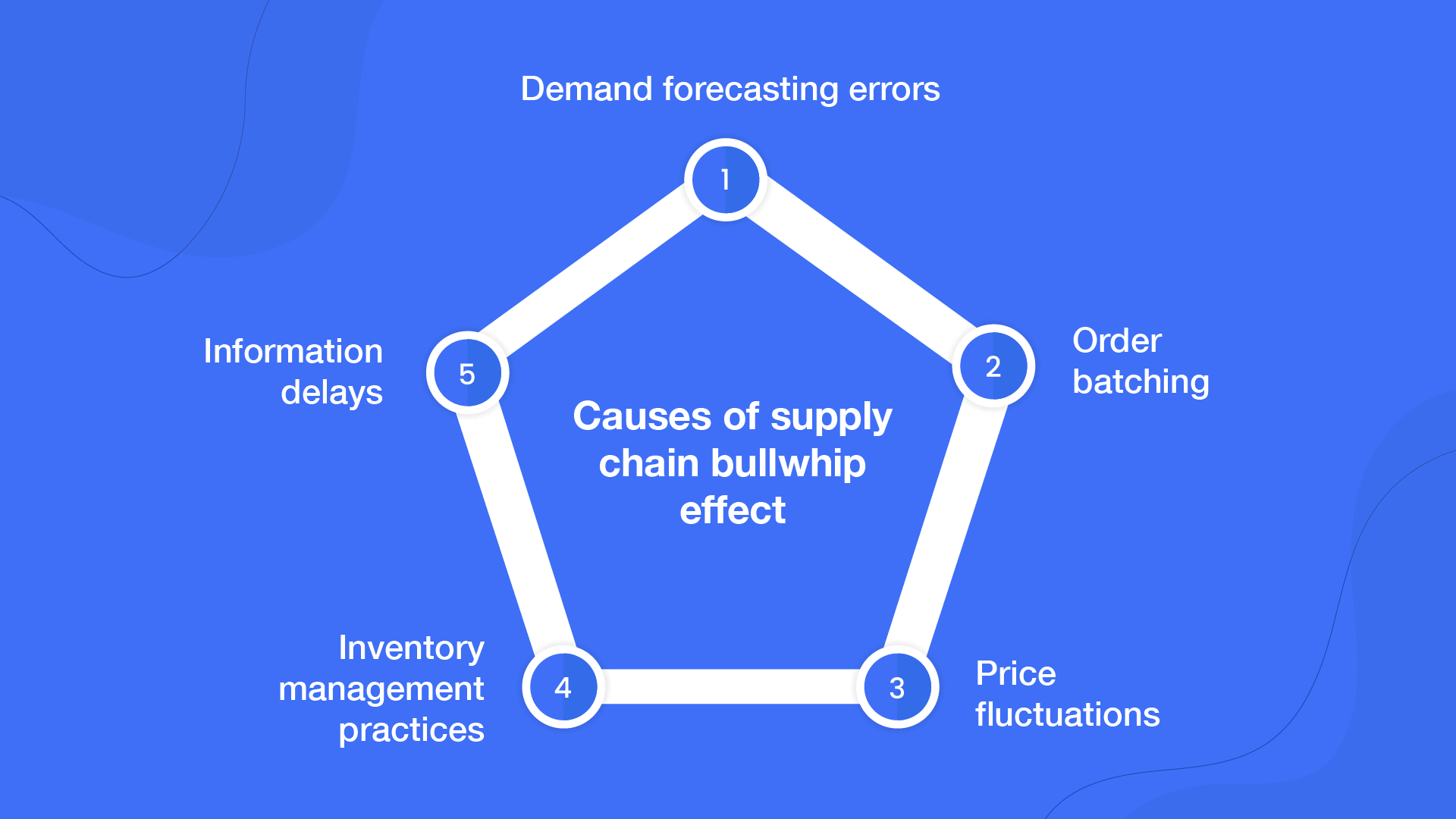
Inaccurate demand forecasting is one of the primary triggers of the bullwhip effect. When retailers misjudge customer demand, it can lead to overordering or underordering, creating a ripple effect throughout the supply chain.
Example: If a clothing store underestimates the demand for a trendy jacket, they might later place a larger order to catch up, unintentionally amplifying fluctuations upstream.
Discover how freight management practices can optimize visibility and reduce errors in our latest blog.
Order batching happens when businesses consolidate multiple orders into larger, less frequent shipments. Although it may reduce certain costs, it can unintentionally worsen the bullwhip effect.
Example: A restaurant placing a monthly order for paper napkins instead of weekly sends a larger, irregular demand signal to the supplier, who may interpret it as a sudden spike in need.
Prevent order batching with effective Freight Audit processes. Learn more in our blog on Freight Audit.
Frequent changes in product prices can also amplify the bullwhip effect. Customers anticipating price increases may stock up, leading to irregular ordering patterns.
Example: If a supermarket announces a price hike on popular cereal, customers may buy in bulk, causing the retailer to overestimate future demand and inadvertently trigger the bullwhip effect.
Inconsistent inventory management can worsen the bullwhip effect. Retailers often overorder to avoid stockouts, maintaining high safety stock levels.
Example: A tech retailer orders extra smartphones fearing shortages, only to find surplus inventory when actual demand falls short, creating inefficiencies across the supply chain.
Delays in sharing real-time information among supply chain partners significantly contribute to the bullwhip effect. When decisions are made based on outdated or incomplete data, supply chain reactions are often exaggerated.
Example: If a distributor fails to quickly communicate a sudden sales increase to the manufacturer, the resulting orders may not reflect true market demand, causing imbalances.
The bullwhip effect can create far-reaching consequences that go well beyond initial fluctuations in demand. Understanding its impact on critical supply chain operations highlights the importance of proactive strategies to minimize its effects.
Here’s how the bullwhip effect influences supply chain management:
The bullwhip effect often leads to erratic inventory levels, causing orders to swing between excess and shortage. Retailers, reacting to perceived demand changes, may overstock or understock their shelves.
This volatility not only ties up capital but also creates challenges in efficient warehouse management. According to a Stanford University study, the bullwhip effect can increase inventory costs by 10-30%, resulting in millions of dollars in lost revenue.
Manufacturers face challenges in production planning due to unpredictable and exaggerated orders. Sudden spikes or drops in demand can lead to:
This unpredictability makes it difficult to optimize operations and maintain cost-effective production. Fluctuating demand also contributes to higher transportation costs. The Council of Supply Chain Management Professionals (CSCMP) reports that transportation costs can rise 5-15% due to expedited shipments and inefficient routes.
The bullwhip effect acts as a financial wave, escalating operational costs across the supply chain. Fluctuating demand patterns can lead to:
These rising expenses can erode profit margins and weaken the financial health of businesses at all stages. McKinsey estimates that stockouts cost retailers $634 billion globally each year, directly impacting profitability.
Each participant in the supply chain reacts to distorted information, creating operational inefficiencies. This can manifest as:
The cumulative effect reduces the responsiveness and agility of the supply chain, making it harder to adapt quickly to market changes.
Suppliers often bear the brunt of the bullwhip effect, facing challenges in meeting unpredictable demand. This can result in:
Over time, these challenges strain relationships between suppliers and other supply chain partners. A study by the Food Marketing Institute found that the bullwhip effect can increase spoilage and waste by 10% in the grocery sector. Additionally, Deloitte estimated that disruptions in the automotive industry, partly caused by the bullwhip effect, cost the global industry $47 billion in 2021.
The bullwhip effect can disrupt the smooth operation of supply chains, but proactive strategies can help businesses tame this phenomenon. By adopting targeted measures, organizations can foster a more responsive, efficient, and resilient supply chain.
Here are four practical strategies to reduce the bullwhip effect:
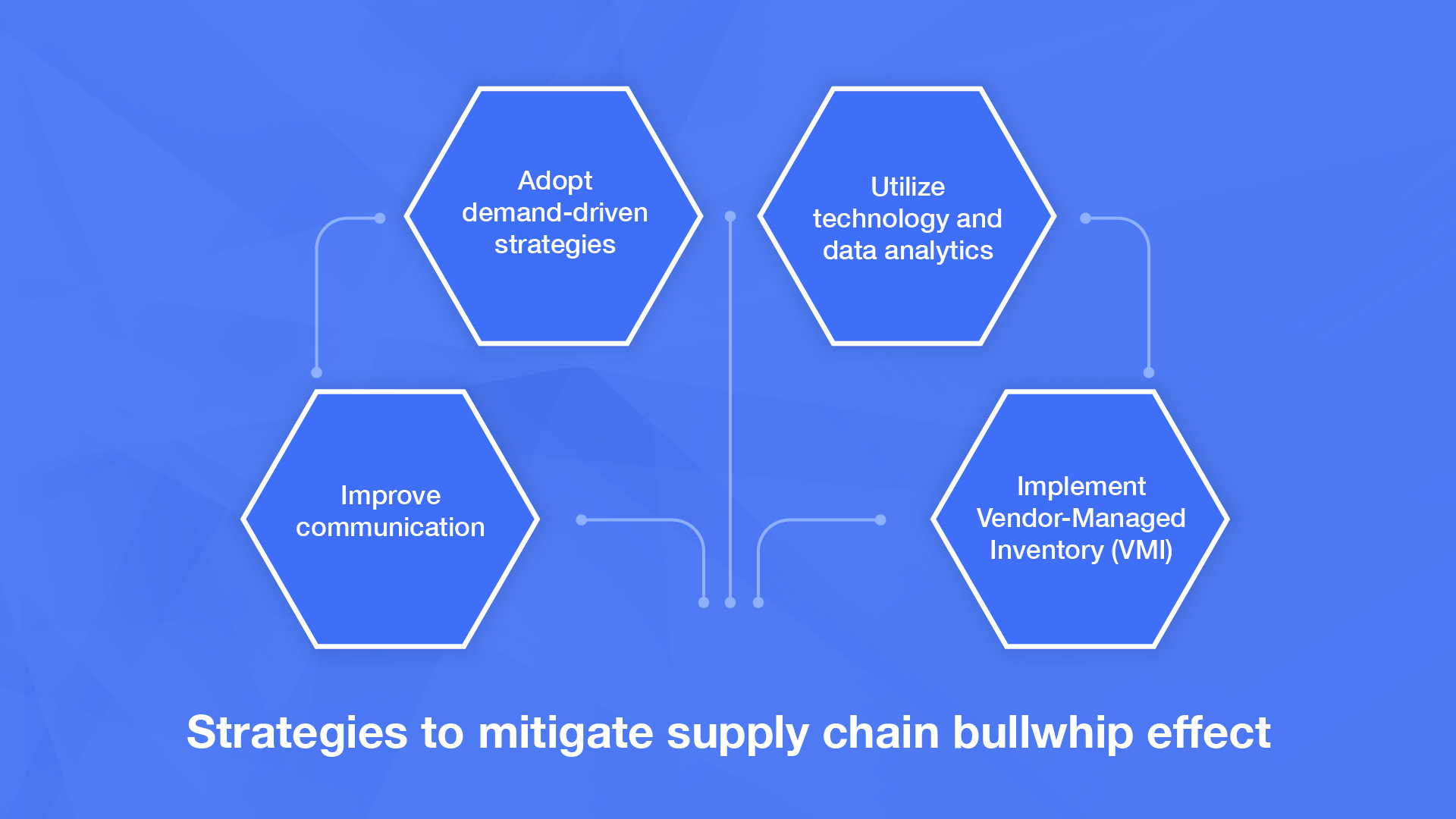
Transparent communication is key to mitigating the bullwhip effect. Establishing clear channels among all supply chain partners ensures everyone has access to real-time information.
Regular updates on:
…enable more accurate and timely decision-making throughout the supply chain.
Learn how Transportation Management Systems (TMS) streamline coordination in our blog.
Shifting from traditional forecasting to demand-driven strategies can significantly reduce the bullwhip effect.
This approach helps the supply chain respond accurately to market fluctuations.
Leveraging technology can enhance visibility and data accuracy across the supply chain.
Vendor-managed inventory (VMI) is a collaborative approach where suppliers monitor and manage inventory for their customers.
Although the bullwhip effect can initially seem like a disruption, savvy businesses can treat it as a valuable learning opportunity. It reveals weaknesses in supply chain operations and highlights areas for improvement. By understanding its lessons, organizations can turn these challenges into catalysts for positive change.
Here are the key takeaways businesses can leverage:
Mitigating the bullwhip effect starts with awareness and education among supply chain professionals. Understanding how small distortions in demand ripple through the supply chain fosters a proactive mindset.
Data analytics and technology are essential tools in reducing the bullwhip effect. Businesses should invest in advanced analytics systems that can process large volumes of data to provide accurate demand forecasts.
The bullwhip effect highlights the interconnectedness of supply chain participants, making collaboration a critical factor in minimizing its impact.
The bullwhip effect can create significant challenges in supply chains, but some companies have successfully implemented strategies to manage it. Here are two notable examples:
Walmart is renowned for its highly efficient supply chain. To reduce the bullwhip effect, the company uses Collaborative Planning, Forecasting, and Replenishment (CPFR).
Through collaboration and technology, Walmart maintains a responsive and smooth supply chain, minimizing fluctuations and inefficiencies.
Procter & Gamble, a leading consumer goods company, focuses on real-time demand data to optimize its supply chain.
With real demand insights and consistent pricing strategies, P&G effectively minimizes the bullwhip effect and enhances overall supply chain efficiency.
The bullwhip effect presents challenges to supply chains, but it also uncovers opportunities for improvement. When approached with innovation, it encourages businesses to strengthen processes, leverage technology, and foster collaboration. Working through these challenges provides a blueprint for creating a resilient and responsive supply chain.
FreightFox offers tailored solutions through its FreightManage and FreightIQ modules. Designed to reduce inefficiencies and provide proactive insights, FreightFox helps businesses enhance visibility, coordination, and resilience across their supply chain operations.
By integrating these modules directly, businesses can effectively address the challenges posed by the bullwhip effect and maintain a smooth, efficient supply chain.
The bullwhip effect highlights the complexities of modern supply chains, showing how small fluctuations in demand can create widespread inefficiencies. By understanding its causes, impacts, and practical mitigation strategies-such as improving communication, leveraging technology, adopting demand-driven practices, and fostering collaboration-businesses can transform challenges into opportunities. Real-world examples from Walmart, Procter & Gamble, and solutions like FreightFox demonstrate that a resilient, responsive, and efficient supply chain is achievable with the right approach.
Answer: The bullwhip effect occurs when small changes in consumer demand cause larger fluctuations in orders upstream in the supply chain. These fluctuations can lead to excess inventory, stockouts, and higher operational costs. Solutions like FreightFox help businesses reduce the bullwhip effect by providing real-time visibility, accurate demand insights, and proactive recommendations, ensuring a smoother and more efficient supply chain.
Answer: Businesses can mitigate the bullwhip effect by improving communication, adopting demand-driven strategies, leveraging technology, and implementing vendor-managed inventory. FreightFox supports all these strategies by offering FreightManage and FreightIQ, which provide real-time tracking, predictive analytics, and actionable insights to optimize inventory, streamline logistics, and align supply with actual demand.
Answer:FreightFox enhances supply chain efficiency by reducing operational inefficiencies and improving visibility across all stages. Its Freight Manage module streamlines logistics workflows, while Freight IQ offers proactive insights to anticipate demand fluctuations. By integrating these tools, businesses can minimize the bullwhip effect, reduce costs, and maintain a resilient, responsive supply chain.
FreightFox is a full-stack TMS and Control Tower platform that helps enterprises streamline freight procurement, execution, visibility, settlement, and sustainability—from Procure-to-Pay