
Choosing a Transportation Management System (TMS) is one of those decisions that quietly shapes everything downstream - freight costs, delivery reliability, team productivity, and even how confidently your finance team can forecast logistics spend. Yet most businesses approach TMS evaluation the same way they'd shop for any enterprise software: request a few demos, compare price sheets, and pick the vendor with the shiniest dashboard.
That approach almost always backfires. A TMS touches procurement, warehouse operations, finance, and customer service all at once, so evaluating it properly means going far beyond feature checklists. This guide walks through exactly how to choose a TMS the right way - from defining your requirements to running a structured transportation software evaluation - and ends with a practical TMS evaluation checklist you can use with your team.
A rushed TMS decision is expensive in ways that don't show up until months later. Teams end up with a platform that can't integrate with their ERP, doesn't scale past a certain shipment volume, or lacks the visibility their customers now expect. Re-platforming a TMS a year or two in is disruptive - it means re-training teams, re-mapping integrations, and absorbing the cost of a failed rollout on top of a new one.
A structured transportation software evaluation exists to prevent exactly that. It forces you to separate genuine business needs from vendor marketing, compare platforms on the same criteria, and involve the stakeholders - procurement, operations, IT, finance - who will actually live with the system every day. Done well, TMS evaluation isn't a procurement formality; it's the single biggest lever you have for making sure the platform you choose still fits your business three years from now, not just today.
This is also why so many manufacturers and enterprise shippers now treat evaluation as a formal process rather than an afterthought - with defined TMS requirements, weighted scorecards, and a shortlist that's tested against real shipment data before a contract is signed.
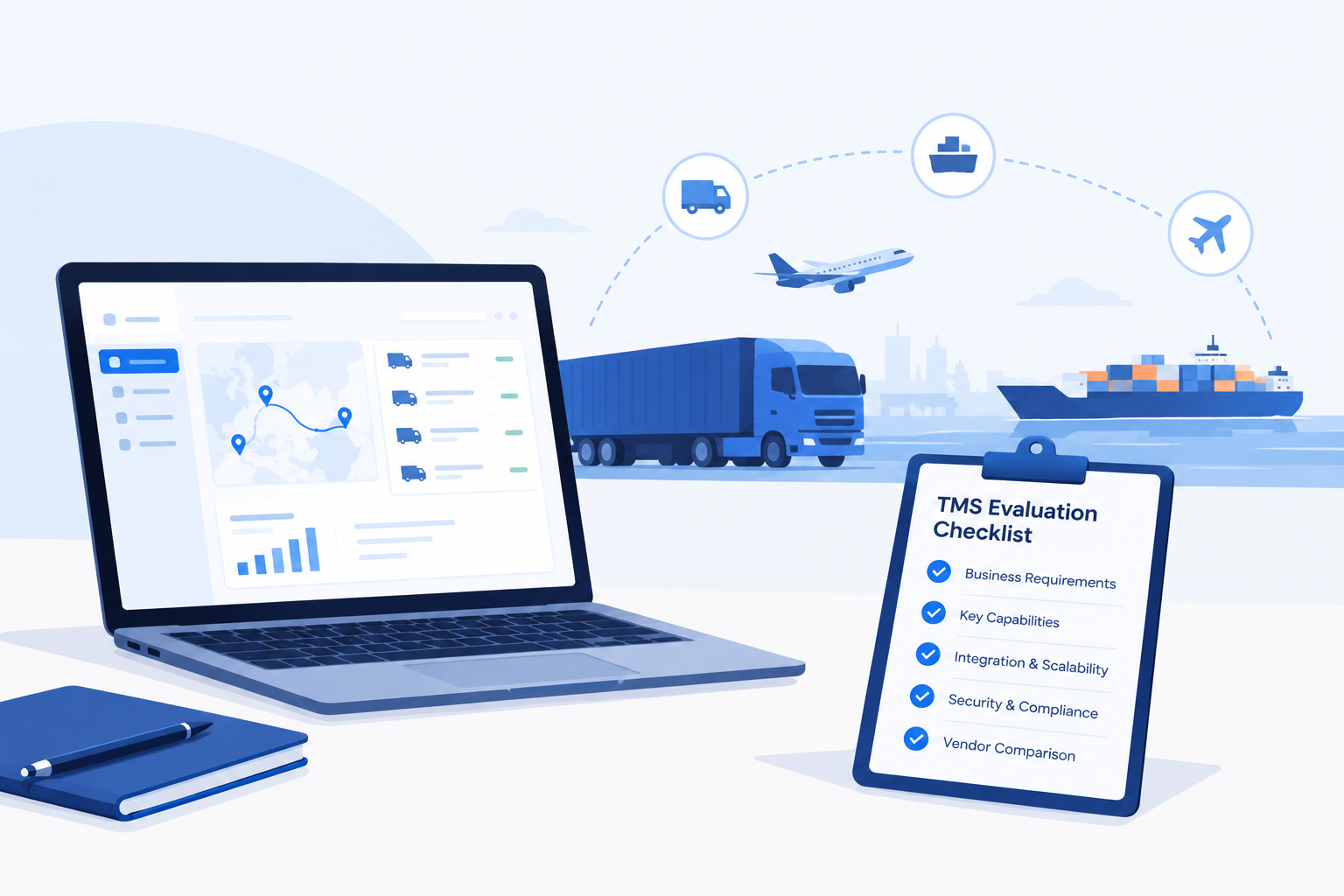
Before you look at a single vendor, get clear internally on what you actually need. Skipping this step is the most common reason TMS evaluations stall or lead to the wrong purchase.
Start by documenting:
Turning these into clearly written TMS requirements gives you an objective yardstick. Instead of asking "does this TMS look good?", you can ask "does this TMS meet requirement #7 - real-time integration with our SAP HANA instance?" That single shift is what separates a rigorous transportation software evaluation from a subjective one, and it's worth revisiting your TMS requirements list at every stage of the process, not just at the start.
Once your requirements are defined, it's time to evaluate TMS features against them. Rather than treating this as one long feature list, it helps to group capabilities into three areas that map to how a TMS actually gets used day to day.
At a minimum, the platform should handle the operational backbone of freight management:
If any of these core TMS features are missing or only partially supported, it's a strong signal the platform wasn't built for the complexity of enterprise freight operations.
A TMS rarely operates in isolation - it needs to talk to your ERP, WMS, and financial systems continuously. During evaluation, check:
Scalability matters just as much as day-one fit. A platform that works for 500 shipments a month but buckles at 5,000 will force you right back into another TMS requirements exercise sooner than you'd like.
This is where modern TMS platforms go beyond the basics, layering in the analytics and automation that legacy, ERP-bolted-on modules typically lack:
Evaluating these three areas together - core features, integration and scalability, and visibility with automation - gives you a far more complete picture than judging vendors on a generic feature list. It's also where most of the long-term ROI of a TMS actually comes from, since automation and analytics are what compound in value over time.
Even the best-fit platform can underdeliver if TMS implementation is treated as an afterthought. A few things worth evaluating at the vendor-selection stage, before you sign anything:
Bringing up implementation questions during evaluation - not after the contract is signed - is one of the most overlooked parts of how to choose a TMS. It's also worth asking any shortlisted vendor for reference customers of a similar size and industry, so you can validate their implementation track record against your own TMS requirements before committing.
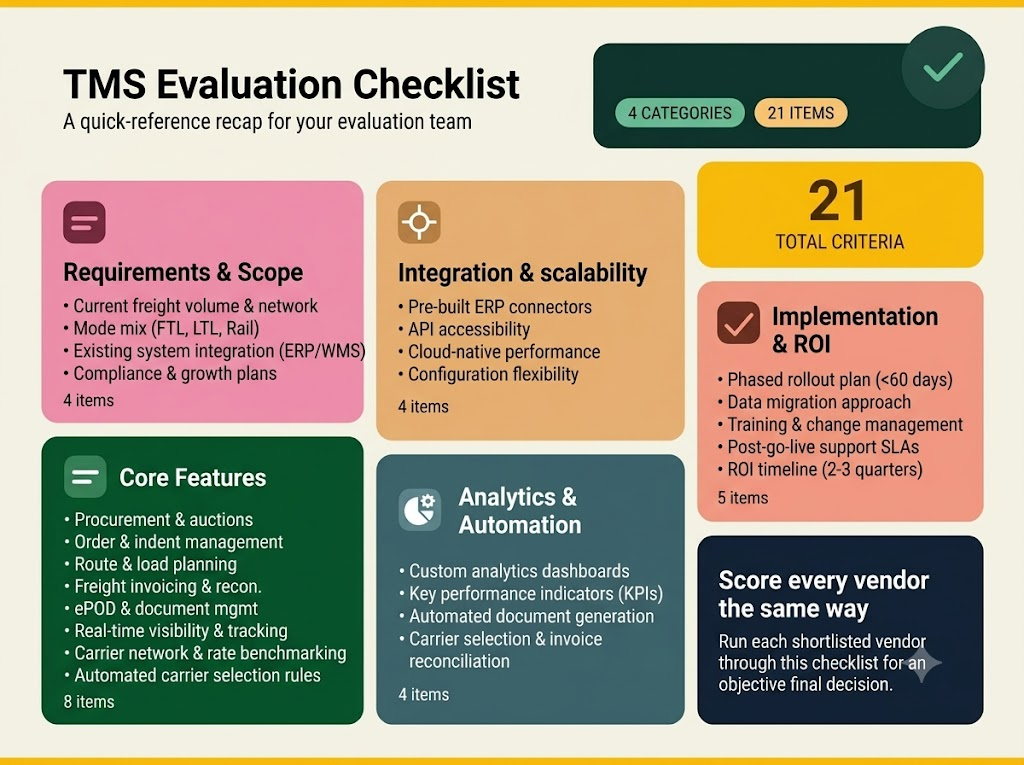
Here's everything above condensed into a usable checklist - a quick-reference recap to run through with your evaluation team, not new ground.
Requirements and scope
Core features
Integration and scalability
Visibility, analytics, and automation
Implementation and ROI
Run every shortlisted vendor through this same TMS evaluation checklist, score them consistently, and you'll have an objective basis for your final decision rather than a gut call.
Getting TMS evaluation right isn't about finding the platform with the longest feature list - it's about matching a system to your actual business requirements, testing it against real integration and scalability needs, and going in with clear eyes on what TMS implementation will really look like. Businesses that follow a structured transportation software evaluation process consistently end up with platforms that support growth instead of holding it back.
If you're actively working through how to choose a TMS for your organization, start with your requirements, use the TMS evaluation checklist above to compare vendors consistently, and don't sign anything until you've validated both the platform's TMS features and its implementation track record. For a closer look at how a modern platform approaches transportation management end-to-end - procurement, execution, visibility, and settlement in one place - explore how FreightFox supports enterprises through every stage of the freight lifecycle, including TMS implementation for manufacturers looking to cut freight costs.
Ready to see it in action? Book a demo with our team and get a tailored walkthrough of how FreightFox fits your specific TMS requirements.
FreightFox is a full-stack TMS and Control Tower platform that helps enterprises streamline freight procurement, execution, visibility, settlement, and sustainability—from Procure-to-Pay