
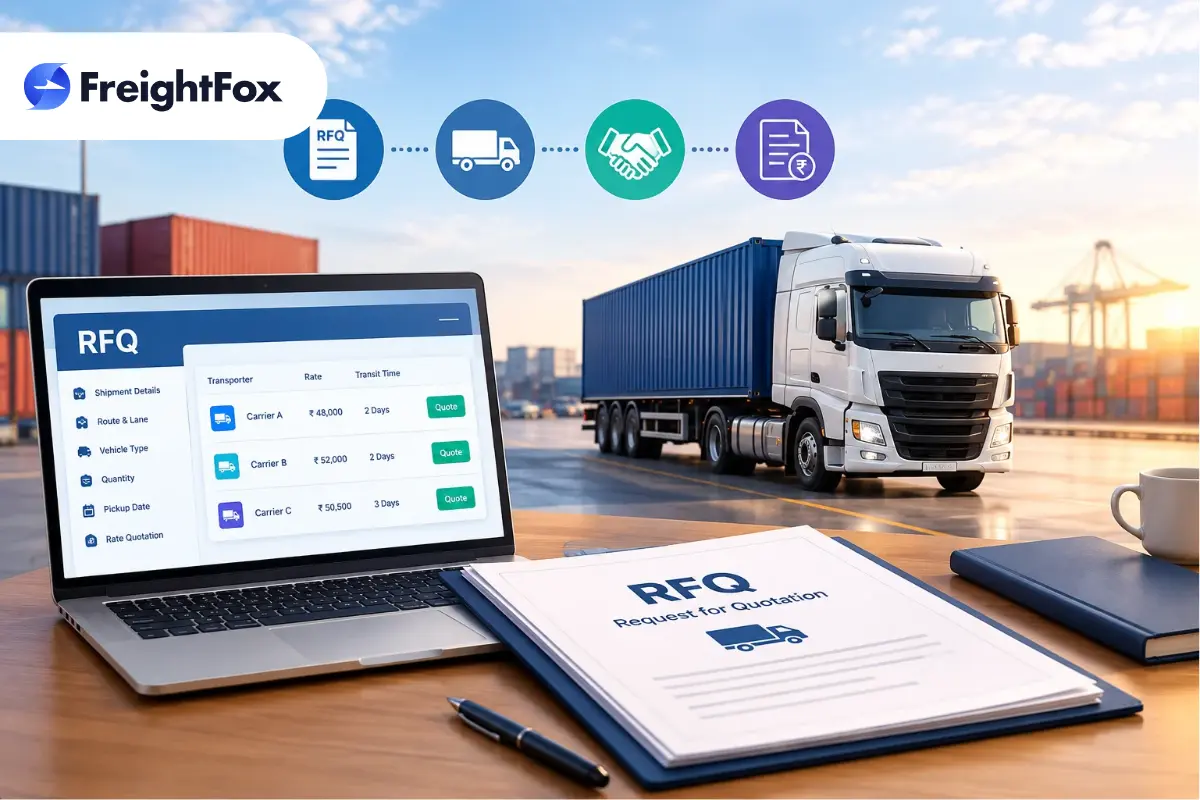
Every freight procurement team runs an RFQ process, whether it happens on a dedicated platform or across a dozen email threads. The idea is simple: ask multiple transporters for their rates, compare what comes back, and decide who gets the business. In practice, this is where many procurement teams lose the most time, not in deciding who to work with, but in getting clean, comparable numbers from everyone in the first place.
This piece walks through how the RFQ process actually works in freight procurement, what a well-structured RFQ should include, where manual processes tend to break down, and what changes when the process moves to a digital workflow.
An RFQ (request for quotation) process is how procurement teams collect and compare pricing from multiple vendors before deciding who gets the business. freight, that means sending lane and shipment requirements to transporters, receiving their quotes, and evaluating them against rate, service and capacity before deciding who moves the freight.
The RFQ itself is the document or request, the RFQ process is everything around it: who gets invited, how responses are tracked, how quotes get compared, and what happens when a lane doesn't attract enough competitive bids. A freight RFQ process typically runs through a few recognizable stages: defining requirements, inviting transporters, collecting quotes, comparing them, negotiating where needed, and deciding who gets the business.
How mature that process is varies a lot by team. Some run it entirely over email and spreadsheets. Others use RFQ software that structures each stage, which is what the rest of this piece gets into.
Running an RFQ involves three broad phases: setting the request up properly, getting transporters to actually respond, and turning those responses into a decision. Each one has its own failure points, which is why teams that skip or rush a phase usually end up with messier outcomes than the time saved was worth.
Everything downstream depends on how clearly the RFQ is framed at the start. That means specifying the lanes, expected volumes, vehicle types and service requirements before anything goes to transporters, and deciding who gets invited to quote. Some teams limit this to their existing transporter network, others widen it to test the market. On a platform like FreightFox, both options are available at once, the invite can go out to a team's own transporters as well as the wider network, rather than forcing a choice between the two.
Vague requirements at this stage are the most common reason quotes end up impossible to compare later, one transporter quotes for a smaller vehicle, another assumes a longer transit window, and the numbers stop meaning the same thing.
This is usually where manual processes lose the most time. Quotes trickle in through emails, calls and WhatsApp messages, in different formats, at different speeds, and some lanes simply don't get enough responses to be competitive. Digital RFQ tools fix the format problem directly, every quote comes in against the same fields. The participation problem takes more active management: on FreightFox, transporters get an email invite when the RFQ launches, and the platform flags which lanes are under-participated, so a team knows exactly where to follow up, by email or a WhatsApp campaign, instead of chasing blind.
Once quotes are in, they get compared on rate, transit time, vehicle type and whatever service requirements were set upfront. If a lane isn't competitive enough yet, there's room to push further, running another round with shortlisted transporters, or moving the lane into a reverse auction, where bids are benchmarked against market and historical rate data and a ceiling price can cap what gets paid.
The final step is deciding who gets each lane and setting up contracts, which can include more than one transporter on the same lane, often used for backup capacity or splitting volume across carriers.
A lot of RFQ delays trace back to incomplete requests, not slow transporters. If the RFQ doesn't specify enough upfront, transporters either quote on assumptions or come back with questions, and every round of clarification adds days. Three categories of information make the difference between an RFQ that gets clean, comparable quotes and one that needs rework.
This covers what's actually moving: the lanes (origin and destination), expected volumes or shipment frequency, and the vehicle type or capacity required. Without these fixed upfront, transporters fill in the gaps differently, and "comparing" quotes later becomes comparing different things dressed up as the same number.
Service expectations (transit-time windows, any special handling), commercial terms (rate structure, contract length, payment terms), and submission deadlines all belong here. These shape how a transporter prices the lane, a tighter transit window or stricter terms usually shows up in the rate, so leaving them vague doesn't simplify the RFQ, it just pushes the ambiguity into the quote itself.
The one piece teams most often skip: telling transporters what they're being evaluated on. If cost is the only factor, say so. If reliability, past performance or response time also count, that should be stated too, both because it affects how transporters respond and because it's the fairest way to run the process on the buyer's end.
Comparing freight quotes isn't just about finding the lowest number. A cheaper quote that misses the transit window or comes from an unreliable transporter can cost more in the long run than a slightly higher one that delivers consistently. Most procurement teams weigh quotes against four factors:
In a manual process, this comparison usually happens by hand, pulling numbers from scattered emails into a spreadsheet, which is slow and leaves room for error when lanes run into the dozens. On a platform like FreightFox, quotes come in ranked and ready to compare against these same four factors, since every transporter responds against the same fields from the start.
Where a lane's quotes are close, or nobody's decisively winning, two more signals help: how many transporters are actually engaging on that lane, and how much their prices vary from each other. A lane with few responses and wide price variation usually means transporters are still testing the market, not yet competing seriously, which tells a procurement team whether to push for another round before deciding.
A few problems show up in almost every manually-run freight RFQ, and they tend to compound rather than stay isolated.
No single source of truth - When quotes arrive across emails, calls and spreadsheets, there's no one place showing the full picture of a lane's responses. Someone usually has to manually consolidate before any comparison can even start, and that consolidation step is where errors creep in, a quote gets missed, an old version gets compared instead of the latest one.
Relationship bias creeps into selection - Without quotes standardized and sitting side by side, it's easy for selection to default to "who we usually use" rather than who's actually offering the best terms this round. This isn't necessarily a bad-faith decision, it's just what happens when comparing properly takes real effort and familiarity is the path of least resistance.
No benchmark for whether a rate is fair - A manual process rarely has live market or historical rate data to check a quote against. Teams end up negotiating from memory or last year's numbers, which may not reflect current conditions, a quote can look reasonable simply because nothing contradicts it.
Negotiation restarts the whole cycle - If a quote needs pushback, that usually means a fresh email thread, another wait for a response, another manual update to whatever spreadsheet is tracking things. There's no structured way to run a second round without essentially redoing the first one.
It doesn't scale - All of the above is manageable across a handful of lanes. Across dozens or hundreds, manual coordination stops being a minor inefficiency and starts being the main bottleneck in how fast procurement can move.
Most of what goes wrong in a manual RFQ has a direct fix once the process moves onto a structured platform.
The effect compounds over time. A single digitized RFQ saves some back-and-forth, but a team running its tenth one on a structured process has the benefit of nine prior rounds' worth of data and pattern recognition behind it, something a manual process rarely retains.
This shift from reactive firefighting to a repeatable, data-backed workflow is also what separates basic digitization from genuinely better freight procurement. For a closer look at what that distinction looks like in practice, across procurement teams, logistics leadership and transporters, our piece on how freight procurement software helps Indian manufacturers gain control over cost, capacity and compliance goes deeper into the mechanics.
A handful of habits separate RFQ processes that run smoothly from ones that generate constant back-and-forth:
A well-run RFQ process isn't really about the request itself, it's about the structure around it: clear requirements upfront, a way to get transporters to actually respond, a fair basis for comparison, and room to negotiate when a lane isn't competitive enough. Manual processes can get all of this right, but it takes consistent discipline to hold together across dozens of lanes and repeated RFQs. Structured RFQ software exists largely to make that consistency automatic rather than dependent on how carefully any one person is tracking things that week.
If you're evaluating how to move your own RFQ process onto a structured platform, our guide to RFQ Software covers what to look for, how the process works end to end, and how it fits into broader freight procurement software.
FreightFox is a full-stack TMS and Control Tower platform that helps enterprises streamline freight procurement, execution, visibility, settlement, and sustainability—from Procure-to-Pay