
Walk up to the main gate of almost any Indian plant, warehouse or distribution centre at 10 a.m. and you will see the same scene. Trucks are lined up on the road, drivers are waiting with paperwork in hand, and a security guard is checking entries in a register. Inside, the dock team is waiting for vehicles that are stuck outside.
That wait is rarely counted as a cost, but it is one. Every hour a truck spends at the gate adds to truck waiting time at plants, delays loading and unloading, and pushes back the next trip. The delay also hits vehicle availability, driver hours and delivery commitments.
This blog explains why trucks wait at gates, what gate management means in practice, where the delays happen, and how digital gate management helps. It also covers how to measure truck turnaround time and what operational gains to expect.
Most gate delays come from process gaps rather than a shortage of dock capacity. Common causes include:
None of these problems looks serious alone. Together they build queues that can keep a truck waiting for hours before it reaches a dock.
Gate management is the process of controlling how vehicles enter, move within and leave a facility. It covers advance scheduling, entry verification, internal movement to the dock, and exit clearance.
In a manual setup, this runs on registers, phone calls and a guard's judgment. Information sits in separate places, so nobody has a full picture of which trucks are expected, which are waiting and which are inside.
Gate management works best when it is connected to your wider logistics workflow. A transportation management system holds the shipment, vehicle and transporter details that gate teams need to verify a truck quickly. When that data reaches the gate in advance, check-in becomes a confirmation step rather than a data entry task.
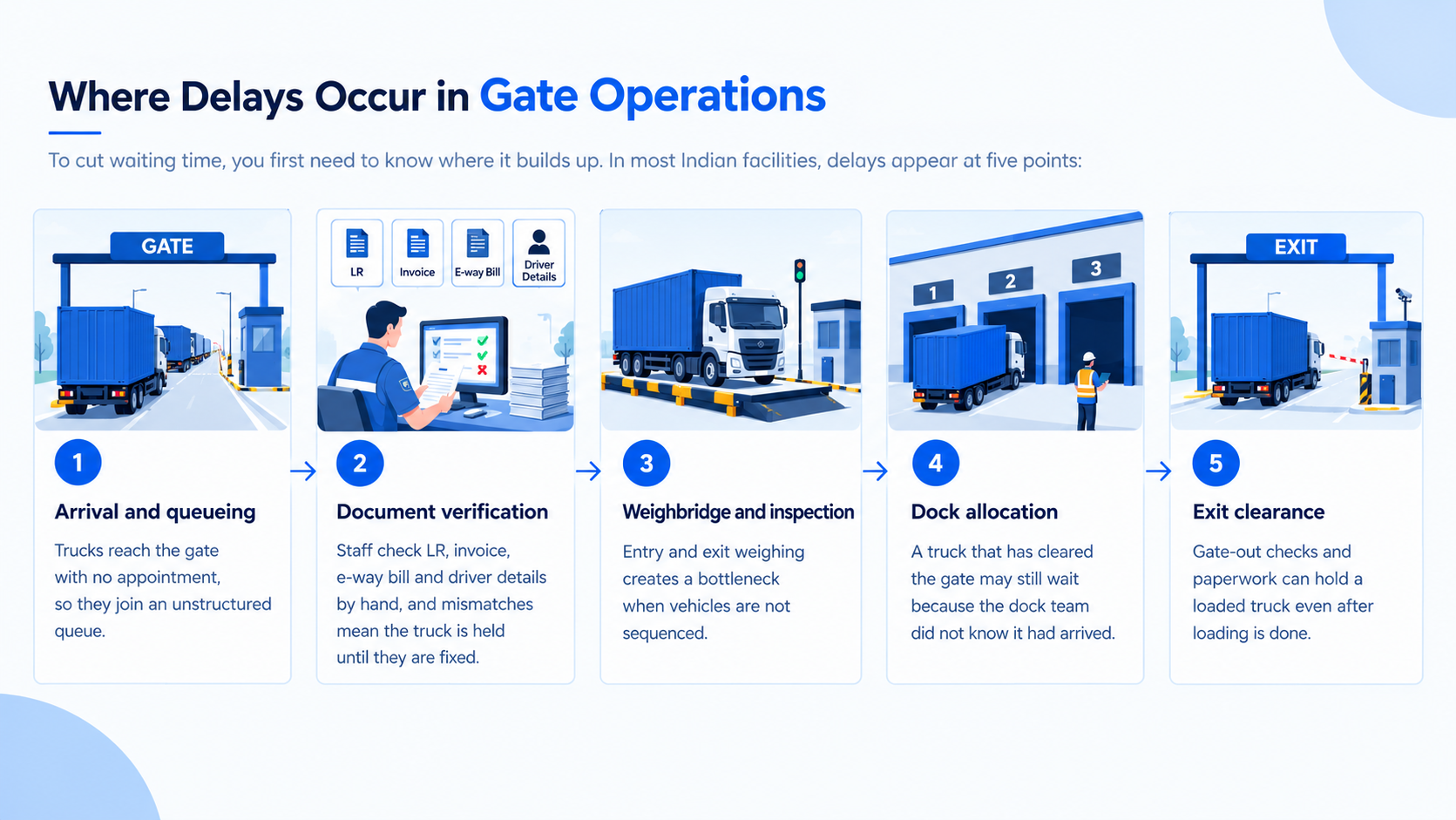
To cut waiting time, you first need to know where it builds up. In most Indian facilities, delays appear at five points:
The link between dispatch planning and gate readiness matters here. When the vehicle placed against an order differs from the one that arrives, or the order is not released in time, the gate has to stop and sort it out. Good dispatch management software reduces these mismatches by keeping indent, vehicle assignment and dispatch status in one place, so the gate sees what to expect.
Digital gate management moves the process from paper to a shared system. In practice, this changes four things:
The result is fewer manual steps at the gate and fewer reasons to hold a truck. Gate entry management also leaves a time-stamped record of every movement, which helps in audits and in settling disputes with transporters over detention claims.
You cannot reduce what you do not measure. Truck turnaround time is the total time a vehicle spends inside your facility, from gate-in to gate-out. To understand where the time goes, break it into stages:
Track these by facility, by transporter, by vehicle type and by time of day. Patterns appear quickly. You may find that waiting is concentrated in certain shifts, that particular transporters arrive late, or that one dock is a consistent bottleneck.
Start with a baseline for two to four weeks, then compare against it after you change the process. Use your own before-and-after figures rather than industry averages, because turnaround time depends heavily on cargo type, facility layout and volumes.
When gate processes are digital, teams usually see gains in these areas:
For plants running just-in-time or festival-season volumes, these gains matter even more, because small delays compound across a day of dispatches.
FreightFox offers Gate Management as part of its Execute solution, alongside indenting and ePOD. This connects gate activity to the rest of the freight workflow instead of leaving it as a standalone register.
For teams that want gate activity, dispatch and delivery handled in one flow, FreightFox works as freight execution software across the shipment lifecycle. That helps gate, logistics and transport teams work from the same information.
To see how Gate Management fits into your network, you can explore the Execute solution.
Truck waiting time at the gate is one of the most overlooked sources of delay in Indian logistics. It is also one of the most fixable. By moving to digital gate management, giving the gate advance information and measuring turnaround stage by stage, facilities can reduce queues, use docks better and keep trucks moving.
If long gate queues are slowing your dispatches, it may be time to look at how your gate operations run today.
Book a Demo to see how FreightFox can help you cut waiting time and improve truck turnaround across your plants and warehouses.

See how leading enterprises are optimizing freight costs, performance, and emissions with FreightFox — all in one platform.
FreightFox is a full-stack TMS and Control Tower platform that helps enterprises streamline freight procurement, execution, visibility, settlement, and sustainability—from Procure-to-Pay


