
Every SAP customer now has a date on the wall: SAP ECC end of support. Mainstream maintenance for SAP ECC ends in December 2027, and extended support beyond that runs only till 2030, at extra cost. Industry surveys show that a little over half of SAP customers have started deploying S/4HANA, but only about one third have finished the move. With SAP ECC end of life this close, the next two years will see the largest wave of ERP cutovers in a decade.
Most S/4HANA migration plans are built around finance core, procurement and manufacturing. Accounts payable is usually treated as a follow-on activity. And inside AP, one stream gets almost no attention at all: freight payables.
That is a costly blind spot. For US manufacturers, retailers and distributors, freight is one of the largest indirect spend lines, it has the highest invoice volume per dollar spent, and it runs on logic that standard ERP was never built to handle. When the ERP underneath it changes, freight payables does not slow down gracefully. It breaks.
There is an irony here. People have been invoicing for more than 5,000 years, from Sumerian clay tablets to Luca Pacioli’s bookkeeping rules of 1494 to the laptop on your desk. Yet most freight bills are still checked the way paper was checked: by a person, one line at a time, or not at all. An ERP migration is the best chance in a decade to break that habit.
This blog explains why freight payables is the most fragile part of an S/4HANA migration, what specifically goes wrong, and why US shippers are turning to FreightFox, the agentic AI platform built for freight payables, to keep freight audit and payment stable before, during and after cutover.
A raw material invoice has a purchase order, a goods receipt and a price. AP runs a 3-way match across the three and pays. A freight invoice has none of that in a clean form.
The result is leakage that already exists before any migration starts. Industry data puts the scale of the problem in plain numbers: up to 20% of freight bills carry invoicing errors, correcting a single freight invoice error by hand costs around $53, and 3% to 7% of total freight spend is recoverable. For a company spending $100 million a year on freight, that is $3 to 7 million leaking out every year.
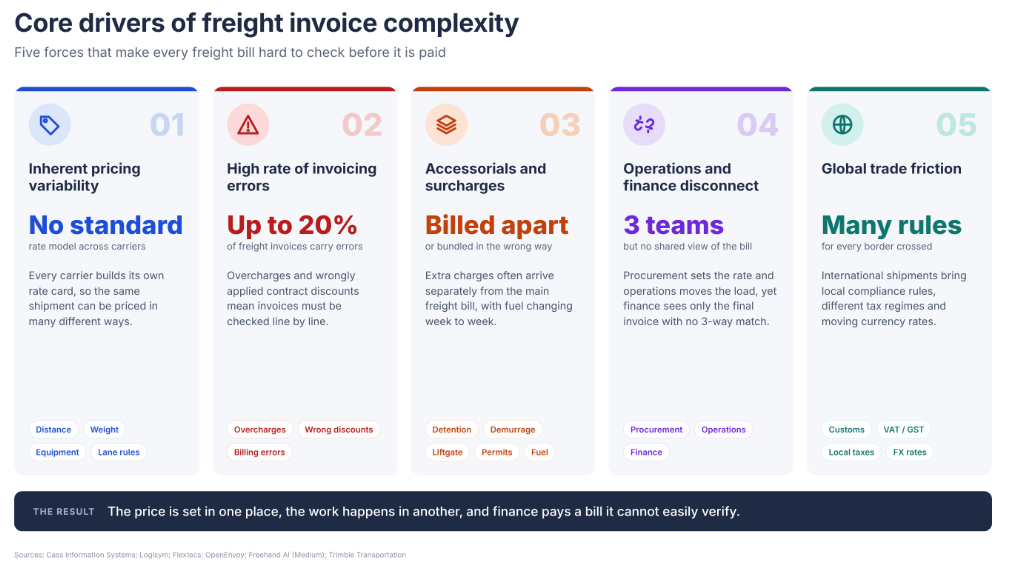
Every system in the chain reads the same charge differently, and finance pays a bill it cannot easily verify. Now add an ERP migration on top of this, and the controls that were barely holding start to fail.
A lot of freight logic lives quietly inside ECC: in custom code, informal approvals and years of carrier master data. A migration drags all of it into the open at once. Here are the seven places where it most often breaks.
Many ECC customers settle freight through LE-TRA shipments and shipment cost documents. LE-TRA is not carried forward as the strategic option in S/4HANA. SAP positions SAP Transportation Management as its successor, and LE-TRA can only be used in S/4HANA until the end of 2030.
So the migration is not just a technical upgrade for freight. It forces a redesign of how freight costs are calculated, settled and posted.
Over the years, most shippers have built freight pricing into Z-tables, custom condition types, user exits and Excel sheets maintained by the logistics team. Fuel escalation formulas, detention slabs and lane-specific rules rarely map cleanly to the new data model.
If this logic is not rebuilt and tested, the system either blocks valid invoices or, worse, passes overbilled ones without a check.
At cutover, every open freight invoice, partial payment, disputed bill and carrier credit note must move across without being paid twice or lost. Freight accruals for shipments already delivered but not yet billed must also carry over.
If they do not, the first month-end close on S/4HANA shows the wrong freight cost by plant and by product.
Most cutovers include a posting freeze of a few days to a few weeks. Carriers do not stop billing.
When the new system opens, AP faces a pile of freight invoices and carriers start calling for payment. The pressure to “just clear them” comes at exactly the moment when duplicates and overcharges slip through.
In S/4HANA, every vendor becomes a Business Partner, and records that fail validation must be fixed before conversion. Carrier masters are often the worst: one carrier created under several codes by different plants, mismatched tax IDs, outdated bank details.
Duplicate codes make duplicate payments easier, and bank detail changes during a migration window are a known fraud risk.
S/4HANA workflow does not copy ECC release strategies one to one. For freight, the real approval rules are often informal: the plant logistics head signs off detention, the transportation manager approves an extra stop, and finance looks only at amounts above a limit.
During the parallel run, two systems and two sets of rules run side by side, and the AP team does double work.
Invoices must be kept for many years for tax and audit. For freight, the useful record is wider: the bill of lading, POD, weight ticket and the audit decision behind each payment.
Once ECC is switched off, pulling this trail for a tax audit or a carrier dispute turns from a quick search into an IT request.
SAP’s own direction, known as SAP clean core, is clear: keep the core clean and close to standard, and build specialized logic outside it on connected platforms. This makes upgrades faster and cuts technical debt. The question for freight is where that logic should live.
Rebuilding everything inside S/4HANA puts the most change-prone logic in the place SAP is asking you to keep clean. A generic AP tool moves the work outside the core, but it treats a freight bill like any other supplier invoice, so the biggest source of leakage stays unchecked.
Freight needs a platform that sits outside the core and is built for freight.
Each level of automation adds one more source of truth to check the freight bill against. In regular AP, a 3-way match compares the purchase order, goods receipt and invoice. In freight, the closest equivalent compares the invoice, contract rate and proof of delivery, and that is where most AP teams and generic tools stop. It still misses the charges born during transit, such as detention, demurrage and reweighs.
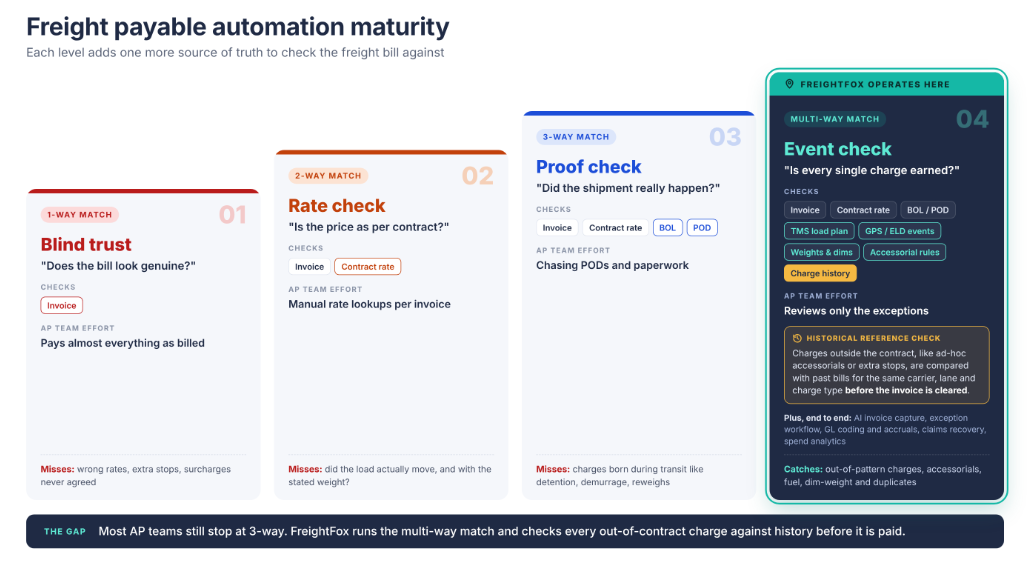
FreightFox works at level 4, the event check, which asks: “Is every single charge earned?” Instead of trusting the bill or checking only the rate, it confirms that each charge traces back to something that actually happened on the load. Any charge outside the contract, like an ad-hoc accessorial or an extra stop, is compared with past bills for the same carrier, lane and charge type before the invoice is cleared.
FreightFox is an automated freight payable platform. It runs outside the ERP core and connects to SAP, so the freight audit and payment process stays the same whether you are on ECC, in the parallel run, or live on S/4HANA. The ERP changes underneath. Freight payables does not.
FreightFox is not one more screen for your AP team to work in. It is a team of specialist AI agents that work every freight invoice end to end, with people stepping in only where judgment is needed.
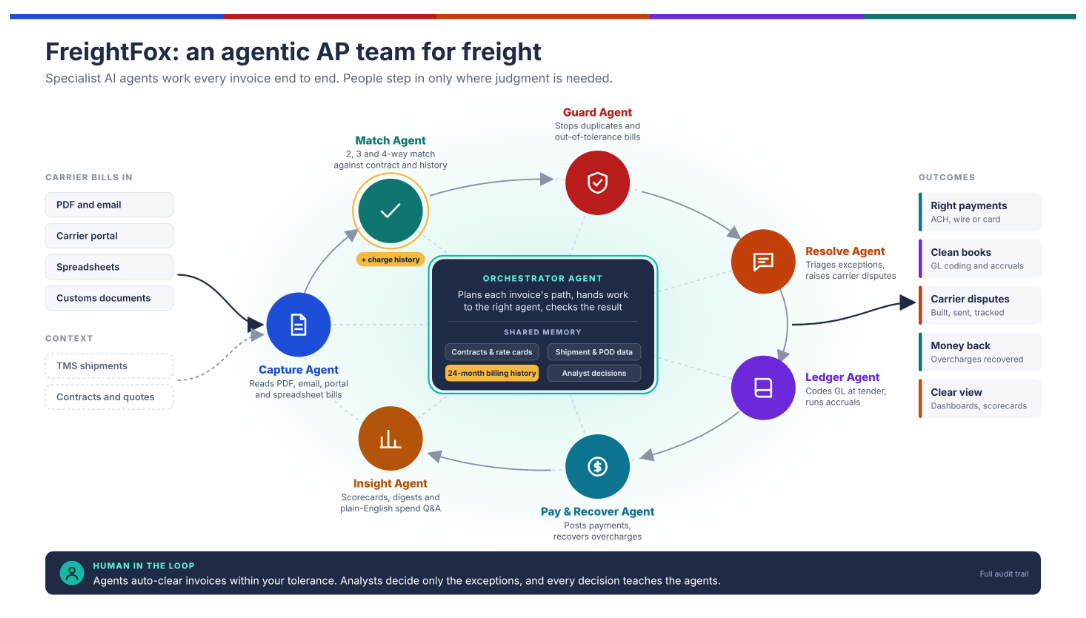
This is exactly what an S/4HANA migration needs: a freight process that runs on its own logic, outside the ERP, and keeps working while the ERP underneath is being replaced.
Each of the seven problems above has a direct answer when freight payables runs outside the ERP. Here is how that plays out in practice.
Change the connection, not the process. Freight invoices are captured, checked and approved in FreightFox, and only the approved, coded result posts to SAP. When you move from ECC to S/4HANA, the posting target changes. Your carriers, your AP team and your rules stay the same, so nobody learns two systems during the parallel run.
Freight logic moves out of custom code. Lane rates, fuel escalation, detention slabs, loading charges and accessorial rules are configured in FreightFox by the business team. There is no need to rebuild freight pricing in Z-tables or redesign it in a new module just to keep invoices flowing. Rate changes do not need an SAP transport or regression test, which keeps your core in line with SAP clean core.
Multi-way matching on every invoice. Each freight bill is checked against the contract rate, shipment data and proof of delivery. Every invoice is audited, not a sample, so leakage is caught before payment instead of chased after it.
Duplicate detection that understands loads. FreightFox catches the same load billed twice, even when it comes back under a new invoice number or split across bills. This matters most in the weeks after go-live, when backlog pressure is highest.
No blackout for carriers. Invoice intake and audit continue during the posting freeze. When S/4HANA opens, a clean, already-checked queue is ready to post, so the day-one backlog shrinks and carrier payments stay on time.
Exception flows that do not depend on ERP workflow. Detention, extra stops, damage and short delivery follow defined approval paths in FreightFox. Your freight approval matrix is built once and carries through the migration unchanged.
Accurate freight accruals from the first close. Accruals are based on delivered shipments, not only on invoices received. Your first month-end on S/4HANA does not depend on a manual accrual sheet.
A clean view of your carrier base. Because FreightFox works with carrier invoices every day, it surfaces duplicate codes, tax ID mismatches and bank detail changes. This is useful input for cleaning the master before Business Partner conversion.
Shipment-level history that outlives ECC. Invoices, BOLs, PODs and audit decisions stay linked to each shipment. Audit and dispute lookups remain a search, long after the old system is switched off.
Spend analytics and recovery. With every freight bill in one place, you get lane-level and carrier-level cost visibility, plus claims and deduction recovery against carriers.
The best results come when freight payables is a named workstream in your S/4HANA migration program, with its own owner and success criteria, and not a clean-up job after go-live.
Success criteria worth tracking:
Checking every freight charge sounds like more work, not less. In practice it is the opposite: once every charge is checked against the contract, the shipment and its history, almost every invoice clears without a person touching it.
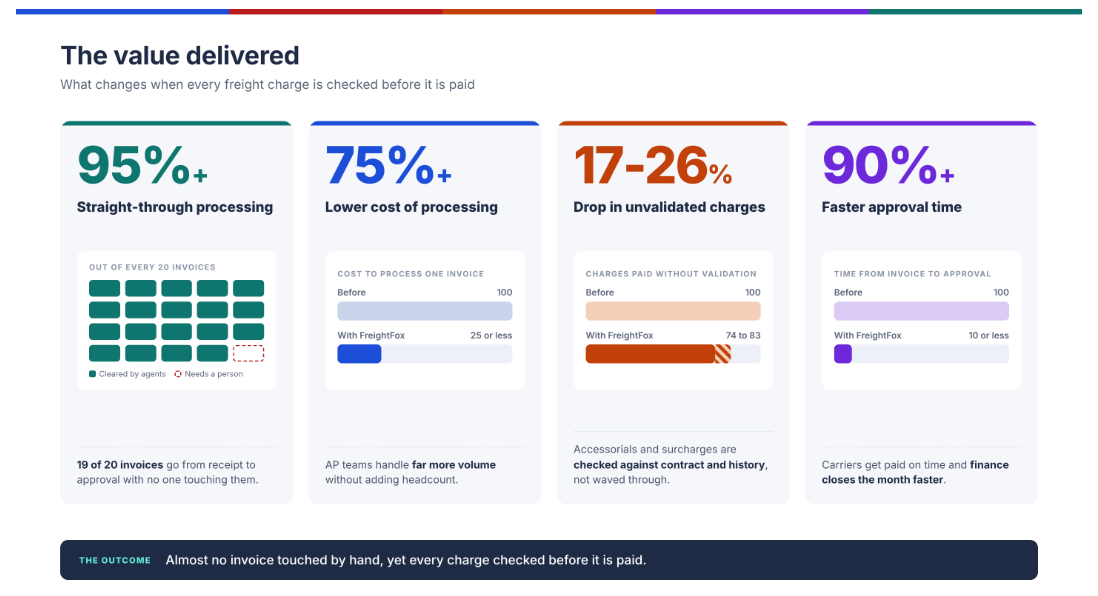
During an S/4HANA migration, these numbers matter even more. A high straight-through processing rate keeps the post-cutover backlog small, and faster approvals keep carrier relationships healthy while the rest of the business adjusts to the new ERP.
The 2027 deadline for SAP ECC end of support will not move, and your carriers will keep billing every single day of the migration. The safest path is to take freight audit and payment out of the ERP core now, run it on a platform built for freight, and let S/4HANA focus on what it does best.
Done this way, the migration stops being a risk to freight payables and becomes the moment you finally fix it: every invoice audited, duplicates stopped, accruals accurate, and a clean core that is easier to upgrade.
FreightFox stands apart in freight payable automation because it is built for freight:
Planning your S/4HANA move? Talk to the FreightFox team about a freight payables readiness review. We will map your current freight process, show where leakage sits today, and plan how to keep it stable through cutover. Visit freightfox.ai to get started.

See how leading enterprises are optimizing freight costs, performance, and emissions with FreightFox — all in one platform.
FreightFox is a full-stack TMS and Control Tower platform that helps enterprises streamline freight procurement, execution, visibility, settlement, and sustainability—from Procure-to-Pay


