Spot Rates and Spot Bidding in Indian Road Freight: How It Works
Written By:
Vikas Singh
October 23, 2026
Introduction
Every shipper in India has had a load that was not in the plan: a rush customer order, a transporter who didn't place the truck, or a lane that was never in the annual contract. The rate you pay for that load is a spot rate. For many teams, it is still settled through phone calls and WhatsApp messages.
This guide explains how road freight spot rates in India work, how spot bidding runs for truck-load requirements, how spot compares with contract rates, and how to judge whether your spot buying is working. Doing this well is a core part of any freight procurement strategy, because spot loads sit outside your annual contracts.
What Is a Spot Rate in Road Freight?
A spot rate is the price a transporter quotes for a single load on a given lane, for immediate or near-term movement. It is agreed for that shipment, not for a year, and it moves with market conditions on the day.
A spot quote typically covers:
Lane: origin and destination (for example, Pune to Chennai)
Vehicle type: a 32 ft multi-axle, a 20 ft container, an open-body truck and so on
Load details: weight or volume, material type and loading date
Price: usually a per-trip or per-tonne figure, with clarity on tolls and detention
Spot rates are not only for emergencies. They are a normal part of an Indian shipper's freight mix.
What Is Spot Bidding?
Spot bidding, also called a spot auction, is a structured way of discovering the spot rate. The shipper posts a truck-load requirement, invited transporters submit quotes within a set time window, and the shipper compares them and awards the load.
It replaces the informal method of calling transporters one by one and negotiating. The difference is that every transporter sees the same requirement, every quote is recorded, and the award decision can be traced afterwards.
How Spot Bidding Works for Indian Road Loads
A typical spot bidding cycle for truck-load freight runs like this:
Post the requirement. The shipper enters lane, vehicle type, weight, loading date and any special conditions such as covered bodies or unloading time.
Invite transporters. Requests go to a shortlist of transporters known to run that lane, or to a wider approved panel.
Open a bidding window. The window can be short, from minutes to a few hours, depending on urgency.
Collect quotes. Transporters submit prices, and in some formats can revise them while the window is open.
Compare and evaluate. Price is the first filter, but vehicle availability, past service performance and placement time matter too.
Award and confirm. The shipper awards the load, the transporter confirms the vehicle, and dispatch is planned.
Record the outcome. Final price, winning transporter and response data are stored for future benchmarking.
Step 7 is where many teams lose value. Without a record, each spot purchase starts from zero. Once a load is awarded, the details usually flow into your transportation management system or freight execution software for dispatch planning and shipment tracking, so the bid record and the execution record stay connected.
Worked Example: One Lane, Three Bids
Illustrative example only. The figures below are not real market rates.
A shipper posts a requirement for a 32 ft multi-axle truck on the Pune to Chennai lane. Three invited transporters quote within the bidding window. The benchmark for this lane and vehicle type, based on historical awards, is ₹72,000 per trip.
Transporter
Bid (per trip)
vs benchmark
Vehicle placement
A
₹71,000
1.4% below
Next morning
B
₹73,500
2.1% above
Same evening
C
₹78,000
8.3% above
Same day
The spread between the lowest and highest bid is ₹7,000, about 10% of the lowest bid. A single phone quote would not show this gap.
Which bid wins depends on the loading date. If the load can leave tomorrow morning, Transporter A is the best award: it is the cheapest and the only bid below the benchmark. If the customer needs the truck loaded tonight, Transporter B costs ₹2,500 more but places the vehicle sooner. Transporter C is priced well above the benchmark and offers no timing advantage over B, so it is the weakest bid. Price alone does not decide the award. The benchmark and the placement time are read alongside it.
Spot Rates vs Contract Rates
Spot rates
Contract rates
Duration
Single load or short period
Months to a year
Pricing
Moves with market conditions
Fixed or indexed
Best for
Urgent, irregular or low-volume loads
Steady, predictable lanes
Budget certainty
Lower
Higher
Capacity assurance
None guaranteed
Higher, but not absolute
Flexibility
High
Limited
Most shippers need both. Contracts give a base of predictable cost and capacity on core lanes. Spot buying covers the demand that contracts do not. When rates rise, contract transporters may also prefer higher-paying spot loads, which leaves some shippers to cover contract gaps on the spot market.
Spot and contract buying work best when run on the same platform and judged against the same freight rate benchmarking data, so you can see when a lane has enough repeat spot volume to move into a contract.
What Influences Road Freight Spot Rates?
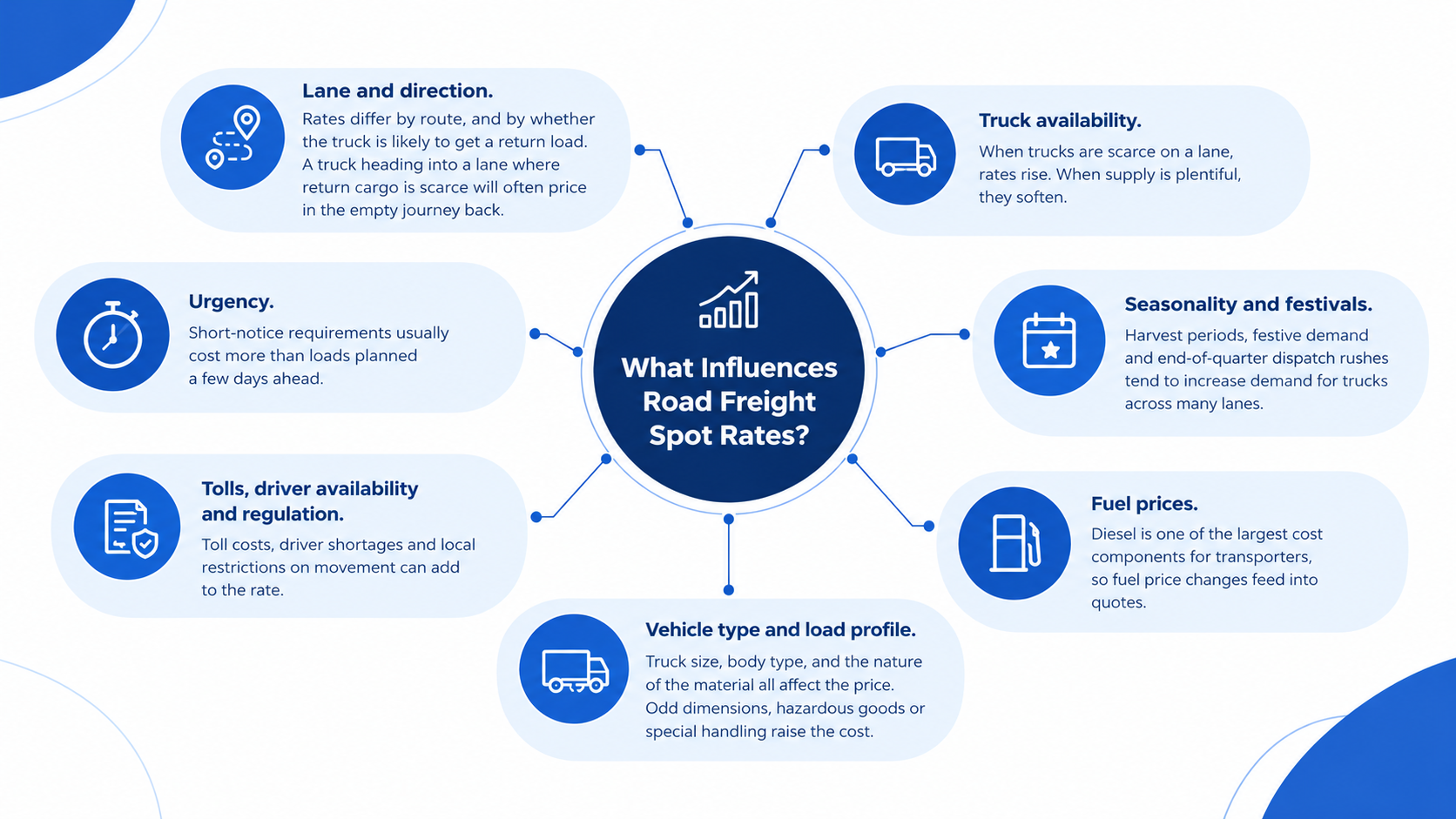
Spot rates in India rarely move for one reason alone. The common drivers are:
Diesel prices. Fuel is a large share of a transporter’s trip cost, so changes show up quickly in quotes. Contract rates often handle this through a fuel escalation clause.
Lane balance. A lane with plenty of return loads is cheaper than one where trucks come back empty. Many industrial-to-consumption lanes are directionally imbalanced.
Seasonality. Harvest periods, festive demand, month-end dispatch rushes and monsoon disruption all change truck availability.
Vehicle type and availability. Specialised vehicles such as temperature-controlled or high-capacity trailers usually cost more and take longer to find.
Load characteristics. Weight, material type, handling needs and loading or unloading time all affect pricing.
Notice period. Short-notice requests give transporters less time to arrange a vehicle and usually cost more.
Toll, route and regulatory costs. Route choice and compliance requirements change the transporter's trip cost.
Shipper reliability. Transporters price in detention. Shippers with long loading delays or late payments often see higher quotes.
Because these factors interact, a single quote tells you little. You need a benchmark for the same lane and vehicle.
Metrics to Evaluate Spot Bidding
Good spot bidding shows up in numbers. Track these for each lane and period:
Bid participation rate. How many invited transporters actually quote. Low participation suggests a weak panel or poor timing.
Quotes per load. More quotes generally mean better price discovery.
Quote turnaround time. How quickly transporters respond, which affects how fast you can award.
Rate vs benchmark. How the awarded rate compares with historical or market rates for the same lane and vehicle type.
Spread between lowest and highest bid. A wide spread is a sign that price discovery is adding value.
Placement and fulfilment rate. The share of awarded loads where the vehicle actually arrives as promised.
Cost per tonne-km or per trip. A normalised measure for comparing lanes.
Spot share of total freight spend. A rising share on stable lanes is a signal to review your contracts.
A low rate means little if the truck does not arrive. Always read price and fulfilment together.
When Spot Bidding Is Useful
Spot bidding earns its place in these situations:
Urgent dispatches where a vehicle is needed within hours or days
Contract transporter failure, where the primary carrier cannot place a vehicle
New or irregular lanes with no contract in place
Seasonal peaks when contracted capacity falls short
Low-volume lanes where an annual contract is not worth negotiating
Rate checks to test whether your contract rates are still competitive
It is less suited to high-volume lanes that run every day, where a contract usually gives better stability and service.
How FreightFox Supports Freight Procurement
FreightFox Procure is our freight procurement platform for Indian manufacturers and shippers. Procure supports spot buying in the following ways:
Real-time spot bidding for urgent and on-demand shipments, with competitive digital bidding workflows to help control spot freight costs.
Automated RFQs that cover launch, vendor invitation, standardised bid capture, auto-evaluation and award across lanes and suppliers.
Rate benchmarking that compares bids against market intelligence drawn from live auctions, historical lane and region rates, and a network of 1,500+ verified transporters.
Spot and contract procurement on one platform, so both can be reviewed against the same data.
Nubra AI, our conversational AI for procurement teams.
Enterprises typically save 7–9% on freight spend after moving procurement to Procure. Results depend on your lanes, volumes and starting point.
A spot rate is the price quoted for a single truck-load on a specific lane for immediate or near-term movement. It reflects market conditions on that day rather than a pre-agreed contract.
In spot bidding, all invited transporters respond to the same posted requirement within a set window, and every quote is recorded. Phone-based buying is harder to compare, audit or benchmark.
No. In a soft market, spot rates can be lower than contract rates. In a tight market they are often higher. The only reliable way to know is to benchmark both against the same lane.
Urgent, irregular, seasonal and low-volume loads are the usual candidates. Stable, high-volume lanes are generally better served by contracts.
Compare the quote with historical rates and other bids for the same lane, vehicle type and period. Without that history, a quote has nothing to be judged against.
It can, because it widens the set of transporters who see the requirement. Track placement and fulfilment rates alongside price to confirm.
Conclusion
Spot freight is a permanent part of Indian road logistics. The question is whether you buy it through scattered calls or through a process that gives you comparable bids, a benchmark and a record. Structured spot bidding makes rates easier to defend and shows which lanes deserve a contract.